


















♫ Together together
Were winning together
Forever and ever
You’ll be remembered
For every little thing you do for me…♫
My latest – and lead article: “Winning the War for Talent While Improving Profitability” just released in American Bar Association’s Law Practice Magazine. Co-written with my friend Steven Campbell CPA CA. https://lnkd.in/drNezZQt Deep dive into law firm finance in the context of today’s environment.
Rules For Winning the War For Talent While Improving Profitability
Law firms are facing another year of unique challenges in 2022. The big three include:
- Associate recruiting, retention and compensation (including stay and year-end bonuses), compounded by firms adjusting to work/life balance resulting from associates working from home.
- Inflation and higher interest rates impacting a firm’s ability to raise rates to match or exceed inflation.
- Changing lawyer preferences resulting from ‘back to the office’ and hybrid working arrangements.
We review the profit drivers that Robert (“Bob”) Arndt discussed in his 1988 book: “Managing the Economic Levers” published by the Section of Economics of Law Practice, American Bar Association as Bob’s advice is as relevant today as then and provides guidance in today’s environment.
Bob broke down the business of law into five categories using an acronym that he called RULES:
R = rates
U = utilization
L = leverage
E = expenses
S = Speed
Traditionally law firms raised rates to increase profitability. However, Bob suggested there are other methods, such as:
- managing the client intake process (Bob considered this to be the most important point);
- tailoring rates and billing policies to specific clients and matters;
- managing rate and billing adjustments;
- billing often and keeping the client informed;
- tying partner reward structure to rate performance; and
- reporting rates achieved.
The business of law has changed since Bob first published his principles. We propose to build on the RULES principles by incorporating analytics and new approaches to matter management to provide ideas for improving profitability and client value in today’s environment.
Rates
There are four rates that firms should monitor to understand the impact of cash leakage on profits: Standard, Negotiated (Worked), Billed, and Collected. Understanding the factors behind each rate provides insights into minimizing ‘cash leakage’ (or the reduction from billable hours worked to realized amounts), thereby improving partner profits.
Standard Rates
A standard rate is an attorney’s quoted hourly billable rate. Standard rates are more aspirational than realistic: today’s profitability surveys ask about negotiated rates. Interestingly, following the Great Recession, firms discovered that many clients measured their negotiating success by the percent discount achieved to standard rates. Firms that did not increase standard rates learned that it put them at a price disadvantage for many years against firms that continued to increase standard rates annually. With inflation running around 8% in Q1 2022, many firms plan to increase their standard rates by 8 –10%.
Negotiated Rates (Worked Rate)
Negotiated rates are agreed to adjustments from standard rates, ideally reserved for large clients with good credit and payment histories. The average firm negotiates discounts from the standard by 7.7%. Be watchful for deeper discounts: for a firm with a 30% profit margin, each 1% adjustment reduces profit by 3%. When clients persist, evaluate whether an Alternative Fee Arrangement (AFA) or blended rate is appropriate. If a client’s discount is significantly below the firm average, it may be time to terminate the client and seek more profitable work.
Billed Rates (write-downs)
Downward adjustments can occur when the billing lawyer feels the time worked exceeds the value the client received or agreed to pay. The average firm discounts worked to billed rates by 8.2%.
Sidebar:
Poor supervision to original targets: Supervisors fail to monitor delegated work.
Inexperienced lawyers: Junior lawyers learning curve and time written off for training.
Staff turnover: New lawyers having to come up to speed.
Client Guidelines: Lawyers failing to comply with client guidelines.
Scope Creep: Poor client communication.
Collected Rates (write-offs)
Write-offs occur after an account is billed and the client is either unwilling or unable to pay the account. In 2021, partial or total account write-offs averaged 9.4%.
Sidebar
Sticker Shock: Insufficient discussion with client as to the expected fees. Risk of disrupting client relationship.
Poor credit risk: Clients onboarded without ability to pay.
Contingency fees: Time written off due to poor case assessment and / or risk sharing with client.
Billed too late: Client refuses to pay as billed beyond client guidelines.
Accumulated Leaks
The amount of lost opportunity in this cycle is enormous. Assume a firm with a standard worked value of $326 million, and using the average realization deduction percentages noted above, we arrive at a net cash collection of $250M. As shown in the chart below, for every 1% improvement in realization, firm profit would increase by $3.26M.

Actions firms can take to improve realization
Working with an Am Law 200 firm during the Great Recession, when realization was dropping across the industry, we used informative analytics to help the firm improve the standard to cash collected realization by 4%.
When presented with analytics like the table above, partners were amazed at the impact of discounts they readily agreed to give previously. The partners embraced a new review procedure: all rate adjustments had to be centrally approved (in this case, by a retired partner). When clients asked for a discount, the partner could honestly say they did not have the authority to approve the request. If the client persisted, they were informed that their request had to be approved by a committee that reserved adjustments for extenuating circumstances.
The benefits of this system were:
1) it shielded the partner from being the person who had to say no; and
2) it ensured that discounts were reserved for legitimate reasons.
Further analysis revealed systemic issues that, once addressed, further improved realization. These included:
- Inconsistent standard rates: These were alleviated by implementing centrally set standard rates based on competitive rate information by practice, timekeeper seniority and geography.
- Improved and centralized client in-take process: Clients were vetted for creditworthiness, past billing, collection, and profit trends. Retainers were required for new clients.
- Improved matter intake process: All new matters required engagement letters that included the firm’s billing and collection policies.Partners were required to outline the scope and set fee budgets for all matters, proactively communicating and collaborating with clients.
- Enforced standard client arrangements as set out in the client’s SOP (Standard Operating Procedures): Clients were informed as to their fee and evergreen obligations.Time entry systems were programmed for alerts for time or expense entries inconsistent with the client SOP. This resulted in fewer pre-bill adjustments and audit exceptions, thereby speeding the time to
- Centralized contingency matter acceptance with enhanced risk assessment.
- Year-end discounts (thought to incentivize clients to pay accounts) were stopped.
Utilization
Utilization in the RULES context starts with the worked billable hours per timekeeper. The 2022 Report on the State of the Legal Market: average billable hours increased from 120 per month in 2020 to 124[1] in 2021; an annualized increase of 48 hours per timekeeper. It should be noted that 2021 results are still 120 hours per year lower than 2007, the year before the great recession.
Effective Capture & Timely Record All Time:
Studies show that when timekeepers record their activities, a significant amount of time goes unrecorded when worked in short durations, on mobiles, evenings, and weekends.
Software solutions contemporaneously capture all activities performed on most electronic devices, including email, texts, phone calls, and most computer software applications. Timekeepers can electronically review, amend, and submit these, capturing time that previously went unrecorded.
Based on a survey of users one year after we implemented such a system, we concluded that the firm captured 3.7%[2] more time, contributing an additional 11.1% profit.
The survey also concluded that the timekeepers spent 1.5% less time manually reconstructing and entering their time. Given current demand increases, this productivity gain could translate into billable hours without increasing the total number of hours that timekeepers work.
There are only so many hours in a day and most attorneys feel that they are giving all they have. But there are still metrics that a firm should monitor to help attorneys ensure that their efforts are being used as productively as possible. Some metrics are:
- Percent of billable time to total time recorded: Many of us know attorneys that are first in and last out but fail to achieve targets.This identifies those attorneys that may benefit from time management coaching.
- Uneven distribution of work: One firm introduced a Red Light / Green Light system. Attorneys choose a stoplight color from red to green, indicating how busy they expect to be in the coming week, month and quarter. New work assignments were given to lawyers with matching expertise and availability (and to those that asked for opportunities in new areas of law).
- Size of Clients: Analysis of major law firms indicates that attorneys working on smaller clients have lower billable hours.They experience small bursts of work for many clients instead of large blocks for attorneys working on more significant clients. This conclusion was drawn from a client segmentation profitability analysis.
- Freeze Hires: Based on a profitability study during the recession, a firm implemented a policy to freeze new hires for practices where total underutilization hours was greater than the equivalent hours of an FTE attorney.
Leverage
Leverage is the billable hours ratio of equity partners to other timekeepers and is one of the best drivers that lower rate firms can use to improve partner profits. Take Cole, Scott & Kissane, a 2nd 100 firm with 541 lawyers in Florida. The average profit per timekeeper was only $20K; yet the Profit per Equity Partner of $3.7M ranks it as one of Am Law’s 2020 survey’s most profitable firms. Cole achieved this result through high leverage. While leverage may not be a key factor for all practice areas, clients are increasingly seeing the value of delegating work to the least expensive, competent professional – thereby increasing leverage and profits through enhanced utilization of paralegals and other paraprofessionals.
Firms could use leverage to turn the war for talent from being money-driven to offering enhanced training and mentoring, a holistic sense of purpose, and a better work/life balance.
In the 2021 Above the Law Millennial Survey by Major, Lindsey & Africa, associates were asked what they would desire over increased salary. The results:
- 29% more time off,
- 25% flexible work schedule,
- 26% reduction in billable hours, and
- 8% more time for career, training, and development.
A Thomson Reuters survey indicates that associate turnover reached 23.2% in 2021 compared to 15% in 2020. Moreover, TR estimated that the turnover cost for an associate is 1.5 – 2 times annual salary. Based on an average 3rd year associate salary of $250,000, the cost to the firm would be $375,000- $500,000 per associate.
Let’s assume a firm with 100 associates working an average of 1,488 billable hours per year. If total associate hours remained the same and the firm hired five additional associates, then average associate hours would drop down to 1,417. By increasing leverage, the firm would have the opportunity to meet the associates’ priorities for fewer hours, flexibility, etc. and save costs over the long term. How? By cutting hours, a firm could potentially get to 2020 attrition rates, possibly lower. Assuming no salary reductions (and average salary noted above), the net savings from lower turnover ($1.5M-$2.4M) would more than pay for the compensation of the additional associates ($1.25M), as shown in the chart below.


If a firm were to follow this recommendation of increasing leverage AND addressing associates’ priorities for reduced hours, flexibility, professional development, etc, they would almost certainly improve associate satisfaction and retention. In ‘Practice What You Preach’, David Maister’s survey results found a causal relationship between employee satisfaction and profit, where a 10% satisfaction improvement causes a 25% increase in firm profit.
Expenses
Most expenses, other than rent, are expected to increase with inflation in 2022. If firms can increase negotiated rates equal to inflation, then partner profits will increase at the inflation rate. Further Net Income Profit margin improvement will come to firms that reduce their space footprint; as rent is the largest expense following salaries, those gains could be significant.
Speed
Speed refers to the time lag from the date work is done to when payment is received. Work in Process is time worked by not billed and Accounts Receivable is time that has been billed but not yet paid. WIP+AR = ‘lock up’. According to a recent PwC survey in the average firm, Lock-Up = 115 days.
One firm reduced their lock up to 78 days in a matter of two years. How could they do it?
Different approaches have been used. An imaginative approach came from a firm in Atlanta, GA. They implemented a policy whereby lawyers would be paid a princely sum of $7 a day if they submitted each day’s time by 10 am the next morning. The firm’s accountant stated: “You would be amazed at what lawyers will do for $7 a day”.
Other approaches: E-billing systems check time for date worked vs date recorded: If too long a lag, the time may not be accepted. Others watch hours recorded by day – and monitor for timekeepers attempting to game the system with time reversals.
The results on profit and working capital are clear in the numbers. Just a five day decrease in lock up increases PPEP [profit per equity partner] by over 2%.
Here are recommendations to reduce lock-up:
- Cash is King: Evaluate partners on cash collections as opposed to hours worked or billings. Link profit to cash collected, not accrual accounting.
- Determine client profit based on collections: Partners do not get credit for work done until it is collected.
- Timely Billing: Bill frequently and at time(s) where results were achieved (see the “graph of gratitude”). Bill half your clients in the first two weeks of the month and the others in the last two weeks.
- Measure the Right Indicators: Billing rate and billable hours are not the best metrics for monitoring conversion and velocity: Billable hours and billing rates are too early in the work-to-cash continuum to be meaningful. Instead, focus on collected rates and cash collections, and tie evaluations and incentives to these targets.
- Stop Work: Monitor lock-up and have a senior partner follow up with partners with delinquent clients: stop existing work, and cease taking on new matters.
- Draws: Link draws to cash management – this has been suggested many times rarely implemented.
- Engagement Letters: Use on all matters, incorporating billing and collection terms. Consider Evergreen retainers when appropriate.
- Get Timely Information: Move to real-time reporting vs. printed reports that are outdated almost immediately.
- Cut out the Speed Bumps: Client account audits slow down the collection cycle; ensure that e-bill accounts are audit-proof. There are real-time time capture tools that are very effective in ensuring client guidelines are met.
Conclusion
Working Smarter and not Harder is a well-worn maxim. Today, by following the RULES and employing effective technology tools and informative analytics, we can achieve greater profit without flogging associates to death with their billable hour requirements.
Appendix: Time Management Best Practices:
Not wishing to appear tone deaf that associates feel they are overtaxed already, the following recommendations do not suggest that timekeepers should work more hours – only that they convert more of the time they have already worked to recoverable time by following proven strategies. This further detail implements Bob Arndt’s Utilization principle and assists in reducing the time leaks noted above.
Keep track of Time Spent on All Tasks (billable and non-billable):
You need to know where you spend your time – billable and non-billable. You can see which are the unproductive time wasters and concentrate on your productive tasks. Today there are technological tools that will highlight time wasting activities.
Create a To-Do list for Tomorrow at the end of today:
Create your to-do list at the end of the day by recording all the things you need to accomplish while they are in your head. You know what you have to do tomorrow.
Identify Your Daily, Weekly and Monthly Goals:
Write down what goals you wish to accomplish by the end of the day, the end of the week and the end of the month. Listing them helps you stay on task when interruptions and distractions arise.
Prioritize Tasks:
Time management is partly developing the ability to discern what needs to be done from the rest and then doing it – promptly.
Create a To-Do list and sort your tasks into four categories:
- Important and Urgent: Do these First – they are the most important work to be done today.
- Important but not Urgent – Make room for these…they are longer term goals; schedule them into your day after the important and urgent tasks.
- Urgent but not Important – These are Time Sinks… schedule them low in priority
- Neither Important nor Urgent – Put on the Never Never list – they are not taking you towards any of your goals.
Stop Procrastinating (Today not Tomorrow!):
There are many reasons for avoiding a task, none of them good. You may be avoiding something unpleasant, time consuming or fearing failure. Failing to face up and deal with these only makes them worse. Break a large task into smaller ones. Do the most unpleasant task first. Delegate an unpleasant task (remember to return the favour in the future).
Stop being a Perfectionist:
Perfection is the enemy of task accomplishment. The 80/20 rule – 20% of your tasks will take 80% of your time. Squeeze time burners into a time budget and do them as quickly as possible. Remember “satisficing: Pursuing a course of action satisfying the minimum requirements to achieve a goal.” Send your results to the delegator asking if they wish more work to be done.
Stop Burnout by doing the Important & Urgent things today:
All of us have a ‘most productive’ time of the day. Match that time with your most important and urgent tasks and use your best energy for your most important tasks.
Seek a Time Management Mentor (Someone with good time management skills):
Mentoring is one of the benefits of working in a large firm. Find a partner who is willing to take you under his/her wing and teach you what they know.
Ask assigning Partner for a Billable Hours Goal for a Task (keep assignments on budget):
When someone assigns a task, ask “How much time do you want me to put into this before we sit down for a review?” You both establish a block of time and a deadline for the task and avoid ‘project creep’.
Take Short Breaks after each task completion:
Reward positive behavior for task accomplishment. Enjoy a short break and allow your brain to refresh.
Block off Time to Achieve Tasks in your Calendar (keep 20% time uncommitted):
Take your tasks and establish a time budget for each (hopefully with the delegator). When you run up to your time budget, re-evaluate what needs to be done and discuss with the delegator.
Limit Distractions and Interruptions:
Interruptions are a factor of life such as email. Squeeze email into three time slots (9 am, 1 pm and 5 pm) and for a fixed amount of time (20 mins).
Work from a clean desk (clutter free desk):
Clutter is a distraction and a sign of disorganization. Work from to-do lists and get the papers off your desk.
Stick to a Routine:
A routine allows you control of your life, time and tasks and structure your time to best use. You set aside the time for all the things you need to do in a certain order and priority.
Estimate how long it will take you to complete a task and compare your time against your estimate.
Break Complex Tasks into Smaller, Manageable bites:
Break bigger tasks into bite-sized chunks and allocate those to your time schedule.
Delegate if at all possible:
Delegate tasks to the lowest common competent person who can accomplish them. This will develop the skill of task management and supervision and allow you to use your time for the most important and urgent tasks in your day rather than routine matters.
None of these suggestions require a timekeeper to work more hours; this is all newfound income that goes straight to the bottom line by eliminating leaks from the billable hour boat.
One thing is clear. By paying attention to and tweaking the R.U.L.E.S., we can increase profitability, increase both associate retention and satisfaction and win the game of work – life balance. You will be remembered by your associates and partners for everything you do for them.
—
Bios:
Steven Campbell:
Steven Campbell is a Consultant with Acumen Consulting, LLC. He helps law firms develop strategies to improve performance, leveraging innovative analytics and his extensive law firm experience to provide insight and clarity.
With over 25 years of experience in AmLaw COO and law firm consulting roles (including Thomson Reuters Elite’s Business Intelligence team), Steven has been a pioneer in data-driven profitability analysis and performance management in law firms.
Steven’s deep understanding of law firm operations and challenges has enabled him to partner with firms to successfully design and implement data-driven strategies with enthusiastic adoption, achieving significant transformational results and enhancing both firm profitability and client value. You can contact him at: Steven@AcumenKPI.com and phone 313 580 0468.
David J. Bilinsky:
David J. Bilinsky is considered a visionary in how technology and other forces are changing the practice of law and how legal organizations can take advantage of these changes.
As the Practice Management Advisor and lawyer for the Law Society of British Columbia for 20 years he advised lawyers on ethics, practice management, and technology. He is a Fellow of the National Center for Technology and Dispute Resolution (NCTDR) at the University of Massachusetts and a Fellow of the College of Law Practice Management. He is the co-chair of the Law Firm Finance Board for the ABA’s Law Practice Division and past ABA TECHSHOW co-chair. He currently is the principal of Thoughtful Legal Management, a legal practice management consulting firm. You can contact him at daveb@thoughtfullaw.com and phone 778 697 7110.
[1] To November 2021
[2] Assuming a firm that had a 30% margin before the recovery of lost time, a 3.7% revenue increase translates into an 11.1% profit improvement.

♫ They’ll never take my pride
They’ll never take my strength
They’ll never take my faith
They’ll never take my trust
They’ll never take my hope
But I’m ready to go
For the love that’s there for
the takin’ (for the takin’) ♫
— Lyrics custom generated by AI using “lawyers and change.”
Artificial Intelligence (“AI”) was a science fiction concept that has walked out of fiction novels and into our lives.
AI and e-Discovery:
It didn’t take long for e-Discovery vendors to start incorporating AI into their products.
AI started out by analyzing large document sets for the purpose of predicting document relevance in litigation cases. It then went further and suggested priorities of what needs to be reviewed. This process takes place much faster and cheaper than the older method of armies of associates reading every document in a data set. Using it early in the e-discovery process, and repeated as new documents appear, enhances the results.
Based on learning garnered from past actions and outcomes, AI now grasps the overall e-discovery process and can suggest who should be interviewed, what new keywords should be searched and what should be placed under a legal hold.
One of the newest applications in this area is Sherlock — merlin.tech’s digital bloodhound. They state:
“Sherlock is our revolutionary, AI-powered digital document bloodhound. It is a smart, machine-learning algorithm designed to make it easier to find information in large document populations.
They go further:
“Sherlock’s strength is its speed, scalability and flexibility. It can analyze and rank a million documents in 100 milliseconds — 10 million in a second. It can then deliver new documents in order of likely relevance, allowing you to review and mark them relevant (“Thumbs Up”) or not (“Thumbs Down”).”
You can send one document or many to Sherlock. It will analyze them, extract key terms, build an AI model on the document set and apply the model to millions of documents in milliseconds.
AI and Transactional Practice:
Is a client looking at a merger or purchase of a business? Submit the contracts of the target to AI and have it analyze them for errors, missing information, and inconsistent language so your client knows what to expect in the book of business they are looking to acquire.
The Amercian Bar Association reports: “Such software can also ensure that language is applied consistently, no matter how many attorneys had a hand in the drafting. Through document comparison and automatic learning, software such as contract comparison tools can identify missing clauses or conditions, inconsistently used terminology or undefined terms, both within a single document and across a pool of similar documents.”
Such contract and document review software can be invaluable when it comes to looking at large IP portfolios for example, by analyzing them and drawing insights therefrom.
Developers here include leverton.ai, from the German Institute for Artificial Intelligence. It is a patented and award-winning product that uses AI to extract relevant data, manage documents, and compile leases in real estate transactions. The cloud-based tool is said to be capable of reading contracts at high speeds in 20 languages.
Another developer is thoughtriver.com, a “contract acceleration” application, which handles contracts, portfolio reviews, and investigations for improved risk management. Its “Fathom Contextual Interpretation Engine” was developed together with machine learning expert authorities at Cambridge University.
The company states that it designed the product to automate summaries of high-volume contract reviews. While users usually read content extracts, they can also read the meanings of clauses provided by AI. The system is also said to be capable of flagging risky contracts.
AI and Legal Research:
What started off as a simple idea of digitalizing case law now has some serious long-term implications for lawyers. These databases have gone well beyond just case law to incorporate all types of legal information, in multiple languages, from multiple jurisdictions. These big databases are tamed by AI research assistants, which use machine learning and natural language processing to aid your legal research.
Take vlex.com. vLex is “The world’s largest collection of legal information, on one service.” It offers a wide range of legal titles and collections containing thousands of documents, with daily updates — all available on a single AI-powered legal research platform. It received the 2021 Legal Breakthrough Award for Vincent AI, its legal research assistant.
vLex states: “Only with vLex can you access full-text Canadian cases, the entire Irwin Law collection of legal books and the Maritime Law Book, alongside coverage from over 100 countries, with authorities seamlessly linked across jurisdictions to enhance your legal research.”
Unfortunately, another promising AI legal research initiative, ROSS Intelligence, which had started in 2014 at the University of Toronto, had to close shop in January 2021 due to the fact that a lawsuit by Thomson Reuters (“TR”) had left it without sufficient funds to operate. TR alleged that it stole content from Westlaw to build its own competing legal research product. ROSS is fighting the lawsuit and vows to come back. Bob Ambrogi quoting ROSS’s CEO Arruda in legalsites.com writes: “Once the litigation concludes, we hope to return to business as usual: innovating in the legal research space,” he said. “That might mean licensing the technology or using it in other applications, or it might mean building and iterating our platform as it exists today. But for the time being, we are focused on winning this litigation.” We hope ROSS emerges and pursues the promise of their innovations.
There are other AI legal research providers as well, such as:
alexsei.com — Alexsei produces memos referencing caselaw and legislation in select regions of the United States and Canada.
AI in Litigation:
AI is being used to analyze possible legal arguments and case strength by taking the case facts and using AI prediction technologies to forecast litigation outcomes. Legal analytics software can look at a judge’s past rulings, win/loss rates and other data points to look for trends and patterns in case law and predict a possible case’s outcome.
AI can also be used to analyze a client’s legal position and determine if there are any logical inconsistencies, gaps in evidence, logic, or arguments in a client’s position. Once uncovered, the lawyer can then evaluate risks and see if there are additional documents, witnesses or such that can be used to tighten up a legal position.
AI and the Human Interface:
There are other benefits. Lawyers can do something that AI, at least at the present time, cannot — namely build a human-to-human connection. Relieved of the tedium of law practice, lawyers can spend their time learning the client’s business and building the bonds that will strengthen the lawyer — client relationship.
Since lawyers are no longer chained to their desks performing mind-numbing hours of contract or document review, they can enjoy a higher quality of life and they can take on more of the type of work they enjoy. This is not only more satisfying, it taps into their creativity and purpose for which they went into law — namely to meet client needs. It keeps client’s better informed, it lowers stress, leads to a better work-life balance, and provides greater confidence in the results. Since AI is so much better at taking on large data sets (in whatever context) it can lead to saving time for the client and the lawyer, which in turn can reduce costs and increase satisfaction. AI can also lead to higher quality results, as the machine never tires, goes on a break, or gets ill.
Change is happening to the law due to AI and lawyers are clearly lining up to take the love.
(This article previously appeared at PracticeTalk in the CBA Publication Bartalk for August 2022.

♫ People say they wouldn’t change a thing, even if they could. Oh, but I would
Oh…oh, I, I’d done a lot of things different… ♫
— Music and lyrics by D. Dillon, B. Anderson, recorded by Kenny Chesney.
There is a war going on and not just the one in Ukraine. COVID, law firm management’s back-to-the-office movement, and the resultant calls for greater work-life balance from associates who have now tasted the forbidden fruit of working-from-home, have all compounded the whole associate retention, recruiting, and compensation landscape.
In the 2021 Above the Law Millennial Survey by Major, Lindsey & Africa, associates were asked what they would desire over increased salary. The results:
- 29% more time off;
- 25% flexible work schedule;
- 26% reduction in billable hours; and
- 8% more time for career, training, and development.
This clearly runs headlong into management’s goals for an annual increasing billable hour requirement or at least holding them steady from year to year.
Associates, tired of waiting for change, are voting with their feet. A Thomson Reuters survey indicates that associate turnover reached 23.2% in 2021 compared to 15% in 2020. Moreover, Thomson Reuters estimated that the turnover cost for an associate is 1.5-2 times annual salary. Based on a 3rd year associate salary of $200,000, the cost to the firm would be $300,000-$400,000 per associate.
What is the usual grounds for competition between firms for associates? Greater associate compensation — which in turn translates into increasing hourly rates charged to clients with resultant — and expected — pushback.
Is there a win-win in this situation? I believe so. The solution is to adopt procedures that tighten up the financial boat and allow for a greater percentage of fees worked to be collected, thereby reducing the sheer volume of work being performed.
There are a number of policy changes that can increase the bottom line without causing lawyer burnout. One is to reduce the leaks in the billable hour boat. This starts at the client intake process. By vetting clients carefully and mandating written retainer letters with evergreen retainer and collection clauses on all new matters, the resultant account write-downs and write-offs can be reduced to a minimum. Increasing billing frequency keeps the client informed on the state and cost of the work to date. Having associates and partners review files frequently with clients cuts down on “scope creep” and resultant sticker shock. Time capture software can reduce unrecorded time spent on mobiles, evenings, and weekends.
A simple policy of requiring daily time submission cuts down on lawyers reconstructing their daily time entries with resultant missed entries. A firm in Atlanta, GA paid their timekeepers $7/day if the time entries were in by 10 a.m. the next day. Their CFO stated: “You would be amazed at what lawyers will do for $7 a day.”
Another technique is to reduce “lock-up” — the time between time worked and time paid. Clients have introduced policies to refuse time that is too old; firms have backed this up by setting time and billing systems to reinforce this. Having a partner being told that the client will not be billed, and he will not be paid, for his 45 worked hours because they are too late certainly brings home the point of timely time entry.
Bill in accordance with Jay Foonberg’s “Graph of Gratitude.” Jay Foonberg is both a CPA and a lawyer and the author of the venerable “How to Start and Build a Law Practice” (now in its 6th edition). In his graph, you can see when is the best time to render an account based on when the work was done. Gratitude does not age well — send your bill before it has eroded. By maximizing your account collections, you and your colleagues don’t have to bill 115% of your target collected income just to realize 100% of your collected fees target.
While measuring billable targets and billable rates are fine, they are too early in the cash flow cycle to translate into cash in hand. Make sure you are measuring collected rates and cash collections and tie these metrics to performance evaluations to keep your time billers focused on producing work that leads to collections and not just monthly invoice targets.
Lastly, pay draws based on accounts paid, not fees billed. Cash is king and notwithstanding accountants and their accrual systems, you can’t spend cash you haven’t received.
These are a sampling of the techniques that can be implemented by law firms to increase their bottom line without flogging associates and partners to death and hopefully increasing associates quality of life. We can do a lot of things different.
Time Management is the Flip Side of the Coin to Billing Time
Better time management can reduce long hours in the office spent meeting your billable time goal. Here are a selection of time management best practices:
Keep track of time spent on all tasks (billable and non-billable): You need to know where you spend your time — billable and non-billable. You can see which are the unproductive time wasters and concentrate on your productive tasks. Today there are technological tools that will highlight time wasting activities.
Prioritize tasks: Time management is partly developing the ability to discern what needs to be done from the rest and then doing it — promptly.
Create a To-Do list and sort your tasks into four categories:
Important and Urgent: Do these First — they are the most important work to be done today.
Important but not Urgent: Make room for these… they are longer term goals; schedule them into your day after the important and urgent tasks.
Urgent but not Important: These are Time Sinks… schedule them low in priority.
Neither Important nor Urgent: Put on the Never Never list — they are not taking you toward any of your goals.
Ask assigning partner for a billable hours goal for a task (keep assignments on budget): When someone assigns a task, ask “How much time do you want me to put into this before we sit down for a review?” You both establish a block of time and a deadline for the task and avoid “project creep.”
Break complex tasks into smaller, manageable bites: Break bigger tasks into bite-sized chunks and allocate those to your time schedule.
This article is excerpted from an upcoming article on the Rules For Winning The War For Talent While Improving Profitability by Steven Campbell CPA and David J. Bilinsky for the American Bar Association’s Law Practice Magazine. Steven Campbell is a Consultant with Acumen Consulting, LLC. Steven has been a pioneer in data-driven profitability analysis and performance management in law firms.
(This article previously appeared at PracticeTalk and Tech Tips in the CBA Publication Bartalk for June 2022.
https://www.cbabc.org/BarTalk/Articles/2022/June/Columns/The-War-for-Talent
♫ Nobody does it better
Makes me feel sad for the rest
Nobody does it half as good as you
Baby, you’re the best…♫
Lyrics and music by: Marvin Hamlisch, Carole Sager, recorded by Carly Simon.
I haven’t done a book report in a good long while. But I am going to make an exception this time.
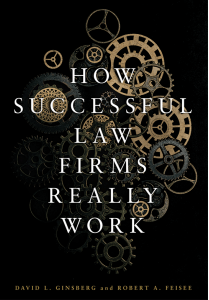
A book has come along that every lawyer who wishes to run a firm at its peak should not only have on his/her shelf but it should be well-thumbed, stained from coffee spills, its cover torn from constant use and sitting on the corner of their desk within arm’s reach for quick reference. I am speaking of “How Successful Law Firms Really Work” by David L. Ginsberg and Robert A. Feisee, published by the American Bar Association, Law Practice Division (“HSLFRW”)
A few books have been written that outline how to run a law firm. “How to Start and Build a Law Practice” by Jay Foonberg, now in its 6th edition, is perhaps the grand-daddy of them all. But Ginsberg and Feisee have taken all the collective wisdom of running a law practice and condensed it into 332 pages of sage advice. Is it the bee-all and end-all of law practice management books? No – but it is an excellent compilation and overview from a 50,000 foot perch, of the things that you should consider in keeping all the balls of legal management in the air. From here you would be well-versed into jumping into any number of books that address the specific needs of law firm management for greater in-depth knowledge.
Who is it aimed at? HSLFRW focuses on the operation of a small to medium sized law firm. It is designed to aid you in the step-by-step creation of your customized business plan by addressing the issues raised in each successive chapter. But it is more than that. It integrates and builds on each chapter by illuminating and then integrating concepts so that you come out of the process with an appreciation of how each pillar upholds the operation of a law firm works and with its companions.
The book starts with a chapter “How to Use This Book” which starts a reader off on the right foot in terms of how to make the most of what is set out in the subsequent chapters. The premise is that lawyers, no matter how brilliant, may lack basic business skills; and it seeks to help lawyers of all levels master and implement proven business strategies.
The book starts with questions of ownership and how to structure your team for maximum effect. Since all firms rise or fall by their people, human resources comes next. Moving on to training, it deals with issues of how to mold your staff and professionals into an efficient and productive team.
Managing your time is next, since you will have to be able to schedule management tasks as well as legal work into your daily schedule and keep all pots, so to speak, on a constant simmer.
With the fundamentals taken care of the book moves to clients: Who are your ideal clients and how do you market to them and then manage them. What does your legal product look like and how do you deliver services within a clearly defined scope of work. What is your role relative to your clients? Emphasizing that ethics underpins all that you do, a chapter on how to stay out of trouble is next.
Then we jump to more of the nitty-gritty of running a firm. Finances, budgeting and managing money is next; followed by technology and systems. Since firms run on procedures, there is a chapter on how to develop procedures customized for your firm.
Next is your office environment – how does your firm look and how does it operate? Which one are you – a business or a profession – and the implications of viewing your firm each way and what is your definition of success?
Strategic Planning – both short and long term – are included as are emergency planning and wellness: how to care for yourself.
Lastly the book concludes with the statement that you are now ready to run your own firm.
Whether for lawyers just starting out or for lawyers seeking to make partner or better yet, managing partner and desiring knowledge to take them to the next level, this book is a tour-de-force. At $85 for non-ABA members, $68 for ABA members (all USD) it is a steal. You can order it online from the ABA here.
This book is so good it makes me sad for the rest. I have but one regret with regards to it…I wish I had written it.
© 2022 David J. Bilinsky
(Concurrently published both on http://slaw.ca and this blog.)

Attribution 2.0 Generic (CC BY 2.0)
♫ Slip sliding away, slip sliding away
You know the nearer your destination, the more you’re slip sliding away… ♫
Lyrics, Music and Recorded by Paul Simon.
Something extraordinary is taking place in Ontario.
Family law lawyer Russell Alexander of Russell Alexander Collaborative Family Law Lawyers of Toronto and six other locations in Ontario, Canada has started an online petition on Change.org entitled: “Petition to Amend the Requirement For In Person Court Attendances.”
What are they petitioning for, you ask? Good question:
“We, the undersigned lawyers and paralegals who practise family law, hereby petition to the Attorney General of Ontario and to the Regional Senior Justices, that there shall be immediately put in place an overriding direction that all court attendances shall be presumptively virtual unless the parties and their counsel agree otherwise or if the court for good reason orders that a particular attendance shall be in person or hybrid (ie. some may attend virtually and some may attend in person).”
They state the issue as follows:
“The Issue
1. The Chief Justice and Regional Senior Justices at both Ontario court levels (Ontario Court of Justice and Ontario Superior Court of Justice) have issued Notices to the Profession that stipulate revised practices and standards to determine whether various types of court attendances shall be in person or virtual.
2. While the directions are not always consistent, there is a disturbing trend to emphasize the necessity for in person attendances as opposed to virtual attendances.”
Their petition has garnered 987 signatures as of the date of writing.
It seems that many people agree with Russell that the move to virtual hearings has has a number of benefits and increased access to justice. A selection of the reasons for signing the petition highlights many of them:
- Diego Cariaga writes: “Virtual hearings will continue to spare lawyers and clients of unnecessary stress and costs since for the vast majority of litigation matters it is not necessary or helpful to appear in-person (as COVID-19 has demonstrated)”
- Catherine Haber: “I am a practicing family lawyer with many years of experience.Virtual hearings are far more cost effficient for the public.There is little advantage to more costly in person hearings.”
- Tom Dart: “Virtual appearances lower costs to the client where they are represented. We need to look at the attendances from the client perspective. Where clients can’t access the internet, in person may be the only method. In person should be reserved for such cases. I agree with the other reasons submitted as well.”
- Rachelle Laforge: “Prior to the pandemic, the court system was operating with technology and resources from the 90s at best. The court system has not been at the forefront of innovation but was forced into it during the pandemic.One of the positive outcomes of the pandemic has been that the court system was catapulted into present times as far as technology goes.Innovation is about solving real problems. Virtual court hearings provide:- More access to justice (anyone with a phone can have access…no need to drive, fly, cab it to the court house and pay for parking)
– Costs have been significantly lowered for clients (no need to pay lawyers to drive to court houses and wait around on running lists)
– Ease of presentation of documents – which sometimes need to be voluminous in cases of coercive control (I had a case where I needed the judge to consider 117 messages from a dangerous self-rep where he wrote emails with Bold lettering, coloured text and coloured highlights)…
– Zoom hearings provide for opportunities to have break out rooms where parties and lawyers can quickly jump in and out of…cant do that quickly in person;
– French speaking parties can get counsel from anywhere in the province to attend without incurring prohibitive costs;
Clients in northern Ontario and other small communities are limited for representation due to conflicts…virtual proceedings provides for clients to be able to go outside their community for representation without the prohibitive costs of travel.”
Russell Alexander sets out the case for keeping virtual hearings as well:
The Case for Dropping the Presumption
This risk is remedied by the use of remote/virtual case conferences, because it actually improves access to justice and the expeditious resolution of disputes in several ways.
First, let’s revisit the odds of settlement: If only 10% of cases resolve at the first case conference, it may be a fair inference that these same 10% would also resolve their matters via a Zoom case conference. This renders the in-person experience to be arguably unnecessary.
Second, the costs savings of Zoom conferences are significant. No travel, no parking, no traffic. Court security line-ups, confrontations, and courthouse conflicts are all eliminated. There is no more sitting around for several hours or the entire day. Legal expenses each of the lawyers representing the parties are also significantly reduced.
Third, access to justice can only continue to improve. Clients can choose their preferred lawyer from anywhere in the province. Lawyers will be more readily available for the currently under-served northern and rural communities. Clients with legal aid certificates will be more likely to secure a lawyer.
Fourth, technology and the internet heighten accessibly to the justice system, as compared to having to travel several hours to the courthouse and back. Most people can access a case conference through Zoom – even if its with the assistance of a friend, family, or employer. Justice “hubs” can be set up at libraries or the SCJ’s family law information centres, or in empty SCJ courtrooms, for parties who cannot access the required technology. There are many other innovative ideas to address the issues of technology and connectivity.
Fifth, the court can implement procedures to screen and assist victims of domestic violence who are involved in family court matters. This will also help to regulate and prevent litigants who perpetrate domestic violence from using the litigation process to exact further harm, harassment, and psychological damage on their ex-partners.
Sixth, the toll on peoples’ mental health of going to court in-person, confronting their ex-partner, dealing with conflict and potential health risks lingering from the pandemic can be remedied by via Zoom case conferences. Parties can conduct their hearing from the safety and privacy of their own homes.
Seventh, the rise of self-represented litigants is a problem that plagues the Family Court system. Remote hearings by Zoom have stymied this, somewhat. It has helped those who would otherwise have to resort to self-representation, by freeing up more Family lawyers. Those lawyers could keep practicing and serving clients remotely, despite health concerns, daycare, and other needs. For example, clients in rural and northern communities were retaining lawyers with legal aid certificates from the GTA and other larger centres.
If in-person hearings return to the old norm, many Family lawyers will simply no longer practice family law. That is the benefit of a law degree: We can choose to practice in any area of law that does not require in-person attendances. (And the list is endless: Wills, estates, real estate, corporate, tax, business and so on). An exodus of Family lawyers will result in fewer lawyers accepting legal aid certificates, and increased time and expense associated with in-person hearings.
All of this will result in alarming spikes in the number of self-represented litigants.
Plus, self-represented litigants often require greater time and resources to adjudicate their matters. They may be unable to focus on the legal issues. They may not understand the law, fail to comply with the Family Law Rules, and be unaware that there are rules of evidence and court-issued practice directions that they need to follow. They can sometimes be vexatious. All of this often results in mental and emotional strain on the judiciary, and can lead to burnout, inertia and the justice system’s slide to entropy.
To emphasize the point with the court, Russell and his crew are holding a virtual press conference May 10, 2022:
Panel of Ontario Family Lawyers to Hold Virtual Press Conference Calling for Courts to Continue Remote Hearings
Lawyers say so-called ‘Zoom divorces’ save clients’ time and money and should continue
Their press release states as follows:
WHAT:
A panel of veteran Ontario family lawyers will host a virtual press conference to discuss the recent Notice to the Profession from the Ontario Superior Court of Justice ordering the return to in-person court attendance. The thrust of these pronouncements is that many court hearings will revert to in-person from virtual, which will mean less access to justice and higher legal costs for many clients.
The panel recently started a petition that has received over 900 family lawyer signatures thus far in attempt to reverse the decision.
The media is invited to attend the press conference to learn more about what this means for family lawyers in Ontario and those seeking divorce. There will be an opportunity to ask questions.
Registration is required to attend via Zoom by completing the sign-up form below.
WHERE:
On Zoom: https://us02web.zoom.us/webinar/register/WN_zw6hCGIlT36zQ-7vGpAPBQ
WHEN:
Tuesday, May 10, 10 a.m. ET
WHO:
The Ad Hoc Committee for the Preservation of Access to Justice consists of:
- Russell Alexander-Founder and Senior Partner at Russell Alexander Collaborative Family Lawyers, practicing for 24 years (Called to the Ontario Bar in 1998)
- Gene C. Colman-Founder of Gene C. Colman Family Law Centre, practicing for 43 years (Called to the Ontario Bar in 1979)
- Natalie Derbyshire-Partner at Stanchieri Family Law Professional Corporation, practicing for 16 years (Called to the Ontario Bar in 2006)
- Brian Galbraith-Owner and Founder of Galbraith Family Law Professional Corporation, practicing for 32 years (since 1990)
- LisaGelman-Founder of Gelmanand Associates, practicing for 27 years (Called to the Ontario Bar in 1995)
Gary Joseph-Managing Partner and Chair at MacDonald & Partners LLP, practicing for 44 years (Called to the Ontario Bar in 1978) - Karen Kotansky-Managing Partner at Gelman and Associates, practicing for 28 years (Called to the Ontario Bar in 1994)
- Nafisa Nazarali-Managing Associate Lawyer at Russell Alexander Collaborative Family Lawyers, practicing for 12 years (Called to the Ontario Bar in 2010)
- Ram Shankar-Founder of Shankar Law Office, practicing for 28 years (Called to the Bar in India in 1994. Called to the Ontario Bar in 2014)
I will be watching the press conference with interest this coming Tuesday. The move to virtual court hearings, in my opinion, was a positive one and should be continued for all the reasons noted above and more. It remains to be seen if this novel approach to achieving change in the profession will ultimately be successful. But it is certainly aimed at keeping the changes that have occurred in the courts from slip-sliding away…
© 2022 David J. Bilinsky
(Concurrently published both on slaw.ca and this blog.)

License details
Creator: Daniel Kulinski
Copyright: Daniel*1977, 2009
♫ Something new is going on tonight
I like this grove, it makes me feel so right
Darling you know you better hold on tight
Something new is coming on tonight… ♫
— Music and lyrics by A. Mae, N. Yanofsky, F. Golde, J. Faulker, H. Hancock,
J. Watley, A. Cymone, R. Kleiner, Q. Jones and recorded by Andrea
In April 2021 I wrote a column on CILEX, the Chartered Institute of Legal Executives (“CILEX”) in the UK for my regular column PracticeTalk for the Canadian Bar Association. As of June 2021, CILEX was offering the CLIEX Professional Qualification (“CPQ”) program that offered a different path to becoming a legal professional in the UK. At that time there was a lot of talk about what CILEX’s entrance into the market might mean for students, for the legal profession, for regulators, for the public and the like. Well I thought we could take a step back and see where CILEX is today.
The original column:
In an article published February 21, 2021 in legalfutures.com entitled “Legal education and training: Unfit for purpose,” Professor Chris Bones states: “The revolution starts now. Legal education and training is not fit for today, let alone the future….”
Prof. Bones is Chair of CILEX, the Chartered Institute of Legal Executives (“CILEx”) in the UK. CILEX is the professional association for 20,000 Chartered Legal Executive lawyers, paralegals, and other legal practitioners in England and Wales. They are recognized in England and Wales as one of the three core approved regulators of the legal profession alongside barristers and solicitors.
CILEX offers education and training to become a legal secretary and an apprentice program that leads to being a paralegal, advanced paralegal or Chartered Legal Executive and Chartered Legal Executive Lawyer.
While traditional lawyers are generalists on graduation, CILEX lawyers can achieve a specialist designation on graduation in: Dispute Resolution; Criminal Litigation; Residential Conveyancing; Commercial Conveyancing; Employment Law; Business & Commercial Law; Family Litigation; Wills & Probate; or Immigration Law.
CILEX claims that their professionals are demonstrably more diverse and representative of the UK population than their peers in other branches of the profession. CILEX does not restrict access to candidates with a specific set of prior qualifications; it opens up the profession to people from all backgrounds, including those who have not gone to university.
Their education program requires their students to work in a legal environment from the very beginning of their studies. CILEX states that students apply their learning to practical scenarios and build and refine the skills of a practising lawyer as they progress. They claim that their model requires their employers to validate their experience and competence at every stage, meaning practical, work-based skills are “baked-in” to the training and that CILEX trainees become adept at using legal expertise to address real-world challenges for their clients from the outset.
They recognize that legal technology holds immense potential to benefit both the consumer and the legal services provider by improving efficiency, by reducing costs and by enhancing accessibility. CLIEX states that they support the responsible uptake of technology and innovation in the legal sector, insofar as such progress continues to benefit the consumer.
CLIEX states that they have a focus on technical expertise and practical skills with the development of the core behaviours required to create forward-thinking, commercially minded, adaptable lawyers who really understand the clients they serve.
The CLIEX Professional Qualification (“CPQ”) program “sets new standards in practice-focused training and work-readiness, broadens access to legal careers and develops professionals at all levels who are equipped from the outset to add real value to their employers and clients.”
Students will be able to register for CPQ in June 2021. Something new is coming.
According to CILEX, as of November 2021: “Some 140 new CILEX Fellows* and Advocates** swore an oath to mark their qualification at the annual graduation ceremony held by CILEX (Chartered Institute of Legal Executives) on Saturday.
They were joined by a further 237 members, who were recognised for becoming Graduates, the step before becoming a CILEX Fellow.”
CILEX Fellows have completed the academic stage of training, have been in qualifying employment for at least three years and have met the relevant work based learning outcomes. They are authorised by CILEX Regulation.
CILEX Advocates are Fellows who have gained extended rights of audience in their practice area, allowing them to undertake advocacy in certain proceedings.
CILEX Graduates have completed both their CILEX Level 3 Professional Diploma in Law and Practice and their CILEX Level 6 Professional Higher Diploma in Law and Practice, or equivalent studies.
CILEX President, Caroline Jepson praised the graduates for their hard work and perseverance, recognising that so many achieved qualification while studying alongside full time work.
She stated:
“I have a plea for you today, and it is this – let us hear your voice. Join us in elbowing our way through the elite snobbery and let us together shut down those perceptions which have held us back for far too long.
“Help us create a legal profession that is ‘qualification-route blind’ – one that appoints, rewards and promotes based on merit alone. Build pride in CILEX and help us reach the point where CILEX lawyers are automatically recognised and valued as specialist lawyers.”
It seems that the experiment continues and these new legal professionals journey to find their new groove continues…
© 2022 David J. Bilinsky

♫ So let your trumpets blow
Round the walls of Jericho
Let your mighty voices sound
Until the walls come tumbling down…♫
– Music, Lyrics and recorded by: John Fullbright
Back in December 2015 I wrote a column on Uber and the Practice of Law for my regular column PracticeTalk for the Canadian Bar Association. At that time, Uber, Lyft and other ride-sharing services had not yet come to BC and there was a lot of talk about what Uber’s entrance into the market might mean for passengers, for Uber and other ride-sharing drivers, for taxi drivers and the taxi industry, for safety of such rides and the like. Well I thought we could take a step back and see the effect that Uber and Lyft and other such services have had and reflect on the lessons that disruption can have for the legal industry, particularly what lies in the public interest.
The original column is as follows:
What do Uber, the taxi-replacement service, and the practice of law have in common? This was recently posted by a friend in Facebook:
Transportation in the new digital economy; Vancouver is Uber-free, but I tried it in Sacramento. Download the app and fill in basic information (e.g. credit card) in advance. When ready, the app confirms pickup location, takes your destination address, estimates the fare and wait time for pickup, and (if you approve) calls a driver. Best feature: when you arrive, just step out of the vehicle and go; payment is automatically charged to your card. No fiddling with charge cards, signatures, etc. A very positive experience – I will definitely use the service again.
Uber is a disruptive technology/service that is changing the face of ground transportation in cities where it has taken hold. Does Uber hold any lessons for the practice of law? To start, let’s look at the commonalities of taxis and the practice of law. Each:
- Has a monopoly that excludes competitors.
- Calculates the fare at the end of the ride.
- Is highly regulated.
- Extols the virtues of their regulations as protecting the public’s interest.
- Claims that their exclusivity is necessary to ensure the proper operation of the market for their services.
What are the differences between taxis/the practice of law and Uber?
- Uber app estimates your fare in advance.
- Uber app shows the route you will be taking.
- Uber collects feedback from riders and uses this to ensure quality control.
Uber claims that they offer predictability, lower prices for a similar product, greater convenience, reliability and quality of service by focusing on the client experience.
What evidence is there in support of Uber’s arguments? Well, the Competition Bureau says ride-sharing services are good for consumers, calling them innovative and likely to create lower prices and better service (http://bit.ly/1Nj0Xcg).
What happens when Uber comes into a city?
- The condition of taxis suddenly improve.
- Uber itself begins to face lower-cost competitors.
Certainly there are many detractors and negative aspects of the Uber model. However, Uber is an example of the emerging platform business model, in which competitors can enter a marketplace for virtually zero marginal cost against entrenched competitors.
Can this happen to lawyers? Clients don’t necessarily want a lawyer; they want a solution to their legal problem. Does it matter to them if a lawyer or a non-lawyer provides the service?
I have often said that the hardest law to repeal is the law of economics. In this case, Uber and similar services have the law of economics on their side.
—
Investopedia, in a column entitled: “Uber Advantages and Disadvantages” by Mohamed S. Jalloh, a financial analyst at Broadridge and an Investopedia contributor, looked at what happened when a disruptive technology and business model was introduced into a service industry that had been, up to that time, granted a monopoly on providing bespoke ride services. Did the forecast negative impacts of introducing ride sharing materialize?
Mohamed lists the key takeaways:
- Ride-sharing services like Uber have disrupted the taxi and limo industry,
- Uber has become a prime example of the gig economy at work.
- Uber’s advantages include door-to-door convenience, safety, and reliable quality.
- Uber’s disadvantages include its surge pricing and the negative effects of replacing steady jobs with gig work.
There is no question that the disruption has had deep implications. Mohamed states:
Bright-yellow taxicabs once dominated the streets of Manhattan. By 2020, there were four times as many ride-sharing vehicles on the streets as taxis. Those vehicles were summoned by apps offered not only by Uber and Lyft but by Via, Juno, and Gett.
Riders have to register with a particular service and their credit cards lodged, resulting in the loss of autonomy for their actions. In this way, both problematic riders and drivers are weeded out of the system. Both drivers and passengers are encouraged to rank each other, resulting in low rated drivers driven out of the system and low rated passengers banned.
OK you say – there is a vast gulf between providing legal services and providing a ride in a car. I get it. But the big question is, what implications does a disruptive model such as Uber and Lyft have for the legal profession? Both taxi drivers and lawyers claim they require a monopoly over their services to ‘protect the public interest’. Did this argument stand up when looking at the Uber experience?
The answer is a mixed bag. No question the availability of options for seeking transportation services expanded. However, the cost of said services were not necessarily reduced, given ‘surge pricing’ which allows Uber to increase fares at high-travel times. Passengers are provided certainty (they knew the cost of the ride before they step into the car), the cleanliness of the rides were stated to have gone up and the speed of the service over a cab increased (since the credit card is on file, the passenger just has to step out of the vehicle at their destination – no fiddling with credit cards and / or cash). However, since Uber and Lyft in Vancouver were restricted in the areas in which they could operate, the taxi industry still retained its monopoly outside of these areas.
But in terms of the big question of whether maintaining a monopoly was necessary to protect the public interest, there is no question that the answer was resoundingly, no. The public interest was not mortally wounded when the taxi monopoly disappeared. The taxi industry, however, definitely took a hit. And we all know that the interests of the taxi industry do not necessarily align up with the public interest.
This has lessons for lawyers. Consider that if we do nothing, as lawyers we may let our mighty voices sound until the walls come tumbling down….
© 2022 David J. Bilinsky

♫I shall be telling this with a sigh
Somewhere ages and ages hence:
Two roads diverged in a wood, and I –
I took the one less traveled by
And that has made all the difference…♫
– Lyrics by Robert Frost, music by Randall Thompson
Law is presently at a cross-road. On one hand, I can see a brilliant legal future that resembles Tomorrowland at Disneyland – filled with sparkling new technologies such as AI, Blockchain and innovative legal search tools that help lawyers meet and exceed client’s needs. On the other hand, the future could be a place where lawyers have been largely marginalized, the right to representation is bypassed in the name of expedience, the rule of law is undermined by politicians and the justice system ridiculed due to its cost and failure to render justice in any meaningful way to the majority of the public.
The new technological tools, while welcome and exciting, do little to change the justice system from a structural standpoint. They are, I fear, the equivalent of a new technological way to flog a dead horse. Without redoing the justice system to make it simple, speedy and affordable, it may simply collapse due to its own burdensome complexity, delay and cost, taking lawyers and their future, with it.
Which road shall we choose? The future is in our hands.
Justice under attack
The signs of a darker future are certainly apparent, and voices have been raised calling for greater attention. No less than Madam Justice Beverley McLachlin, the former Chief Justice of Canada has said: “The principles and institutions underpinning the rule of law are under increasing attack, even in Western democracies.” If the rule of law is undermined, then so is the future of justice and lawyers. As lawyers, we need to be seen to work with other stakeholders to find ways to strengthen the rule of law and be powerful and reasoned voices to advocate when it is under attack.
Structural issues
Law is complex. Along with the sheer number of laws, regulations, bylaws and such that apply to everyday life, there is the issue that each jurisdiction has its own laws, in some cases for a relatively small number of people. The BC Law Institute, for example, in its constitution, has as one of its goals to: “promote the clarification and simplification of the law and its adaptation to modern social needs.” Much more can be done to make laws consistent in application and simpler across all types of borders and within jurisdictions as well.
Emerging Issues
Technology, along with other factors, is causing changes in society at a rapid pace. The law has largely lagged behind in providing protections, resulting in corporations and other entities asserting greater and greater powers over individuals who largely are left without effective remedies. For example, The Office of the Privacy Commissioner of Canada recently stated: “Commissioner Daniel Therrien warns privacy concerns are reaching crisis levels and is calling on the federal government to take immediate action by giving his office new powers to more effectively hold organizations to account.”
“Unfortunately, progress from government has been slow to non-existent,” says Commissioner Therrien, whose annual report to Parliament was tabled. “Not only are the privacy rights of Canadians at stake, so too is our democracy and other fundamental values.”
Law loses its value if it fails to grapple with emerging legal issues and provide protections for those in society. This challenge will only continue to grow over time.
Regulatory issues
The rules and operation surrounding civil procedure, criminal justice, mediation and arbitration, administrative boards and tribunals as well as the regulatory environment of lawyers is reflective of the complex legal environment within which lawyers operate. Working with judges and others to adopt processes to regularize laws and streamline and simplify the operation and regulation of justice and regulatory systems are steps in the right direction.
Law Schools
What kind of challenges do law schools train law students to meet? According to the Harvard Law Review in an article entitled, Law Schools, Leadership, and Change by Susan Sturm: “There is a growing sense that law school is preparing people for a set of professional roles that do not match the demands or needs of a changing society. Research has documented an overemphasis on a narrow conception of technical mastery, and an underemphasis on the imperative to connect education with professional leadership for challenging times.”
Sturm continues later in the article: “Issues of justice, problem-solving ethics, change strategies, and inequality also tend to be marginalized within the mainstream curriculum, which encourages students to develop a radically skeptical attitude toward even the possibility of engaging in normative argument or achieving change.”
If we are going to implement the kind of changes that Sturm is advocating, we need to start by training lawyers to meet the challenges of the future head on. We need to emphasize how lawyers can be change agents in defining the future relationship of law to society.
Criminal Justice
According to the Canadian Department of Justice: “The cost of the criminal justice system is high. A Justice Canada report estimated that the total cost of Criminal Code offences to the justice system and society in 2008 was about $100 billion, including tangible costs of $31 billion. Roughly half of these tangible costs were criminal justice system costs. Police account for the majority of expenditures (57%), followed by corrections (32%), courts (5%), prosecutions (4%) and legal aid (3%).” Lawyers can be meaningful players in discussions on how to implement change to reduce the delay, cost and operation of the criminal justice system so that justice can be seen to be done.
Family Law
There is perhaps no area of the law that needs systemic change as family law. M. Jerry McHale, QC stated it well: “Last, but not least, closing the implementation gap – the discrepancy between what we know and what we actually do in family law – is also a matter of changing the underlying adversarial culture of the family justice system to make it less contentious and more truly collaborative. Academics, practitioners and critics have been writing about this change for nearly 40 years! Admittedly, it is no simple task – adversarial attitudes are deeply woven into the history, fabric and methods of the justice system. But the exorbitant fiscal and emotional costs of the long-dominant litigation model can no longer be supported. The system is unworkable, and it is losing credibility. As such, it falls squarely and immediately to the law schools and to the judges, lawyers, legislators, administrators, and service providers who make up the family justice system to come to grips with the problem of adversarial family law culture change for once and for all.”
(originally published in PracticeTalk in the Canadian Bar Association’s BarTalk magazine:
https://www.cbabc.org/BarTalk/Articles/2019/August/Columns/The-Future-of-Law)
© 2022 David J. Bilinsky

♫ But there never seems to be enough time
To do the things you want to do,
once you find them… ♫
— Music, Lyrics and recorded by Jim Croce.
What is the one thing we all own in equal measure, every day? The answer is simply enough — Time. We all take our daily allotment and spend it on work, pleasure, things we have to do, things we want to do, things we wished we didn’t have to do, things that waste time, and more. How we use it can make us happy, it can make us sad, it can bring about positive change to the world, it can bring a smile to someone’s face, or sadness to another. Two things we can’t do with it is bank it or get more of it. Accordingly, let’s spend a little time to explore how to best manage our time.
The first step is to write down your goals. These are not just work and career goals but life goals as well. You may want to make partner or launch your own firm. You may wish to do public advocacy work or learn to play a musical instrument or write a play. You may wish to ski more often, run a marathon, or travel. The point is that goals unset are goals unmet. What does success mean to you? Rank your life’s goals, research what has to be done to achieve them and then develop a plan that will take you to your life’s goals.
Next, write out the tasks that will take you toward your life goals and those that others have set for you. Each task should take you closer to a goal.
Remember that tasks should be S.M.A.R.T.: Specific, Measurable, Attainable, Relevant, and Time Based.
- Specific: Goals should be tightly focused and clear so you can foresee the steps that need to be taken for goal achievement.
- Measurable: What gets measured gets done. Have milestones set that allow you to judge your progress toward goal achievement.
- Attainable: Do you have what you need to achieve your goal? Or do you have to gain experience, education, skills, or credentials to do this? Perhaps you need to set sub-goals to take you toward your big goal.
- Relevant: Do your tasks bring you closer to your life’s goals?
- Time Based: Set a deadline for each task to hold yourself accountable.
Now, sort out your tasks into four categories:
- Important and urgent: +I+U
- Important but not urgent: +I~U
- Urgent but not important: +U~I
- Not urgent and not important: ~U~I
Sorting your tasks starts the process of prioritization:
- +I+U: Do these tasks right away.
- +I~U: These are your long-term goals. Set aside time for these in your day!
- +U~I: Delegate these tasks if possible. If not, schedule them lower in priority.
- ~U~I: Set these aside to do later, if ever (typically time wasters).
Create a “To Do” list from your priorities and keep it on your desk. This allows you to keep your priorities in front of you at all times. Organize your desk and remove clutter — those are usually distractions.
Develop good time management skills and habits. Good time management skills can be learned and nurtured over time and will only increase your value to your firm, to your family, and of course, to yourself. They will allow you to find time to do the things you enjoy.
Set a time budget and allocate a set time to each task and then block off time in your daily calendar based on your tasks. Once a task time is up — evaluate what has to be done to complete the task, create a new To-Do, sort your To-Dos again, and start the next task.
Cut out all time-wasting activities. Reward yourself for task accomplishment with a small break and reward. Reinforce how good time management works for you and clears your To-Do list as you work through your day.
Remember that procrastination is the enemy of goal achievement. Procrastination can be a sign of a fear of success, a fear of failure, that you don’t deserve your life’s goal or find a task overwhelming. When the urge to procrastinate comes on, counter it by immediately working a bit on your goal and a task and experience the relief in having started. Break down a big task into smaller portions and conquer each in turn and watch your progress.
Plan to deal with obstacles and interruptions. If someone walks into your office and looks to be staying, grab your coffee cup and head off to the coffee machine. They can talk while you get a coffee and — you got them out of your office!
Resolve to stop multitasking. It may feel like you are accomplishing a lot, but that doesn’t stand up. According to bit.ly/bt0422pt-1:
“Studies now show that multitasking can actually damage the brain. As the brain can primarily focus on one thing at a time, keeping track of multiple things at once or accepting multiple streams of information can lead to decreased productivity and distraction from the task at hand.”
Consistently work on your Important but not Urgent: +I~U tasks. These are the ones that will change your life’s path as you desire it to be. Plan your tasks to gradually move yourself into the area(s) of practice in which you desire to be. Measure your progress to stay motivated!
Set a daily billable time goal and track your progress to it throughout your day. You owe it to your family, your firm, and not the least of all, to yourself to grow into being a more effective and responsible lawyer each and every day. Hold yourself accountable for your progress and reward yourself for achieving your daily billable time goal.
Track all your time — billable and non-billable. There are many reasons for doing this. By seeing where you are spending your time, you increase accountability to yourself and to others. Tracking all your time increases your focus on your +I+U tasks. It exposes your time wasters, time sinks, and traps. It prevents project creep, by keeping tasks within their allocated time budget. You enhance your personal bottom line, which in turn benefits yourself and your practice. Most importantly, it will gradually transform you into a better lawyer.
Prevent leaks in your time boat. There are many possible ways to leak billable time. The first is the failure to accurately capture time. Up to 40% of your billable time can be lost if not recorded contemporaneously with task completion. A second is to write off billable time at the time of billing. A third is to reduce an invoice to receive payment. A final one is to write off an entire bill as uncollectible. Plug the leaks in your financial boat by using your time to achieve effective client objectives. Remember client satisfaction ulti-mately drives collections.
Having an accurate billable and non-billable time record allows you to perform analytics on your time and finances. A “Key Statistics” report will show you the financial health of your practice at a glance with such indicators as: Effective Hourly Rate, Work In Progress, Billings, Billing Turnover, your Billing Realization, your Collection Realization Rate, and many more.
Accurate time records will also allow you to forecast your future cash flows and track them against your cash flow needs, providing you with feedback on your financial health and providing you with needed information for cash flow management.
Lastly, pass on your hard-earned knowledge. Teach younger lawyers your time management skills. Act as a time mentor and help grow the next generation of associates into lawyers and partners your firm will value.
Good time management skills can help us all make the most of this most precious of resources, and thereby find the time to do the things we want to do, once we find them.
(c) 2022 David J. Bilinsky
(originally published in PracticeTalk in the Canadian Bar Association’s BarTalk magazine: https://bit.ly/3qSFo04)

♫ Further on up the road baby,
things gonna change… ♫
— Music and lyrics by J.L. Hooker, C. Thompson, C. Santana; recorded by Santana.
The State Bar of California’s Committee on Professional Responsibility and Conduct has just issued Formal Opinion No 16-0002. It looked at a lawyer’s ethical obligations with respect to unauthorized access by third persons to electronically stored client confidential information in the lawyer’s possession. In some ways it parallels what is set forth in s. 10-4 Security of Records of the Rules of the Law Society. What is illustrative is that “the Committee adopted an approach that posed questions lawyers should consider in order to comply with the duties of competency and confidentiality. In light of ever-changing technology, the Committee concludes that an on-going engagement with that evolving technology, in the form of security issues to consider and re-consider, was preferable to a “bright line” or “categorical approach.”
The Committee looked at four scenarios: An attorney’s laptop is stolen; an attorney’s smartphone is left in a restaurant overnight; a firm is infected by Ransomware and a lawyer’s laptop was accessed while the lawyer was using an unsecured public Wi-Fi network. Hypothetically the Committee looked at the factors to consider in each scenario.
The requirement to make reasonable efforts to protect client information from unauthorized disclosure or destruction was affirmed. California went further, however, and stated that: “Given the obligation to preserve client confidences, secrets and propriety information, it is appropriate to assume that reasonable clients would want to be notified if any of that information was acquired or reasonably suspected of being acquired by unauthorized persons.” In BC, we have an obligation to notify the Executive Director of the Law Society but the Rules and Code are silent on the duty to notify a client if the firm lost control or custody of any of the lawyer’s records [10-4 (a)] or if anyone had improperly accessed or copied any records [10-4 (b)].
California also affirmed the American Bar Association formal opinion of 18-483 that holds: “lawyers with managerial authority within a law firm must make a reasonable effort to establish internal policies and procedures designed to protect confidential client information from the risk of inadvertent disclosure and data breaches as the result of technology use, which includes monitoring the use of technology and office resources connected to the Internet and external data sources.” They also held that a law firm should: “consider preparing a data breach response plan so that all stakeholders know how to respond when a breach occurs.”
This opinion, I believe, foreshadows what could be eventually adopted in other jurisdictions. Prudent firms may wish to examine the formal opinion with a view to revamping their policies and procedures to reflect this evolving thinking because further up the road, I believe, the thinking is gonna change.
As a First Step Towards Greater Security
Check if you have adequate insurance to protect yourself against various losses, including data breaches, cyber-losses, cyber-extortion and social engineering (phishing) fraud scams.
The Law Society
has a good breakdown of the coverages that are available that the Law Society insurance does not cover.
The Sedona Conference Canada
has prepared a commentary on privacy and information security for legal service providers — Principles and Guidelines (Aug 2020) that is well worth reviewing.
The Sedona Conference
has also prepared a Commentary on a Reasonable Security Test (Sept 2020). This Commentary begins with a brief summary of the importance of having a test, the reasoning behind a cost/benefit approach for the test, and what issues the test does not address. Part I sets out the proposed test and the explanation of how it is applied. Part II provides review and analysis of existing resources that offer guidance on how “reasonable security” has been defined and applied to date and explains how they bear upon the test.
Create a data breach plan
before you are hit with a breach that will allow you to deal quickly and decisively with any possible data breach. Lawyers Mutual of North Carolina has published a Data Breach Incident Response Plan Toolkit by Tom Widman, founder, president and CEO of Identity Fraud, Inc.
Inside your data breach plan
Sharon Nelson, David Ries, and John Simek have written “Be Prepared — Planning for When Your Law Firm Suffers a Data Breach.” This article is a nice compact review of the issues to consider placing inside your data breach plan.
Protect personal information and data breaches
The Office of the Privacy Commissioner of Canada and The Office of the Information and Privacy Commissioner of Alberta has published “Security Personal Information — A Self-Assessment Tool for Public Bodies and Organizations.” This comprehensive tool is an incredible resource for any organization seeking to examine their systems and procedures to protect personal information and data breaches.
DLA Piper
has summarized Canadian privacy statutory data breach obligations.
The Canadian Bar Association
has published an article in 2015 written by Jeffrey Kaufman entitled, “Law Firm Privacy Compliance in 10 Steps.”
(c) 2022 David J. Bilinsky.
(originally published in PracticeTalk and TechTips, in the Canadian Bar Association’s BarTalk magazine:
https://www.cbabc.org/BarTalk/Articles/2020/December/Columns/Evolving-Views-on-How-to-View-Security
https://www.cbabc.org/BarTalk/Articles/2020/December/Columns/As-a-First-Step)