

















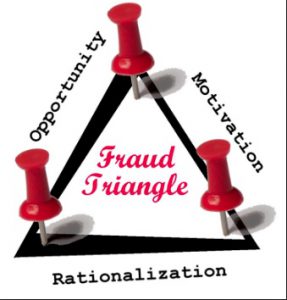
 Attribution: Chantal Pare.
♫ Everybody thinks you’re the lamest
We all know you’re a fraud
Life can be so frustrating
I’m so glad you got caught…♫
Music, Lyrics and recorded by: Hawk Nelson.
Fraud in the workplace cost Canadian businesses $3.2 billion, reported the CBC in 2011 (the last date I could find statistics). While lawyers have been aware of, and taken steps to prevent, fraud attempts by outsiders on their trust accounts for some time now, there is a largely unacknowledged vulnerability of fraud committed against law firms by employees. The sad truth about internal fraud is that people deny that there is a fraud problem in the first place or only react after a fraud is discovered.
Consider these internal fraud facts:
- “On the basis of the evidence it is likely that losses in any organisation and any area of expenditure will be at least 3%, probably near to 6% and possibly more than 10%” (PFK.com “The Financial Cost of Fraud, 2015).
- “25% of internal fraud cases result in losses of a million dollars on average” (Langlois Advocates – Lawyers, “Theft or Fraud by an Employee: Management Rights and Legal Action.”
- “Previous research suggests that fraud, like many crimes, is under-reported” (Statistics Canada, 2006; PricewaterhouseCoopers, 2005; Smith, 1999).
- “The more steps businesses take to control and uncover fraud, the greater their chances of detecting fraudulent activities and the better their ability to assess the effectiveness of their anti-fraud strat Thus, strategies for detecting and preventing fraud are key mechanisms in keeping the costs, direct and indirect, of fraud down” (PricewaterhouseCoopers, 2007).
- “The prospects of recovery of the proceeds of fraud are dim, with 65% of victim companies recovering 25% or less of the stolen funds. And many recover nothing.” (The True Cost of Fraud: Direct Costs, Tracy Coene in Insurance & Risk Management).
- ACFE in their 2018 Report to the Nations (A global study on occupational Fraud and Abuse being the largest global study on occupational fraud) looked at 2,690 real cases of occupational fraud from 125 countries over 23 major industry categories. They found:
- The mean, or average, loss due to the frauds in their study was $2.75 million, which is an enormous amount when considering how much damage such a loss represents to most organizations.
- The median loss for all cases in their study was $130,000. While 55% caused less than $200,000 in financial damage, more than one-fifth resulted in a loss of at least $1 million.
What are the steps you can take to reduce fraud?
Trust, but Verify: Trust your employees to do their jobs properly, but take steps to verify that this is in fact the case.
Establish Hiring Procedures: Check references of your final candidates. Let your candidates know that you will be doing this.
Set up Internal Controls: There are a number of well-established policies and procedures you can put into place now to reduce the opportunity for someone to commit a fraud.
Dual Signatures: While trust accounts require the signature of a practising lawyer, there is nothing that prevents you from adding a second signatory to both your general and trust accounts. Two sets of eye balls looking at a cheque is better than one.
Train Employees in Fraud Prevention: By having regular training on how to prevent and detect fraud, your law firm is sending the message on what behaviour is acceptable and what is not. Anti-fraud examiners state that employees are the “best possible fraud detectors.”
Conduct Regular Audits: “Internal auditing is an independent, objective assurance and consulting activity designed to add value and improve an organization’s operations. It helps an organization accomplish its objectives by bringing a systematic, disciplined approach to evaluate and improve the effectiveness of risk management, control, and governance processes.” (Wikipedia)
Monitor Vacation Absences (or lack thereof): “Two classic fraud prevention techniques are mandatory vacations and periodic job rotations. Mandatory vacations of one week or more (consecutively) are helpful, because the employee cannot continuously monitor a fraud scheme while away. Job rotations are also effective at disrupting these schemes especially when the employees are not given advance notice” (Essentials of Corporate Fraud).
Hire Experts: Periodically hire an expert in detecting fraud to examine your policies and procedures and assist in your antifraud steps.
Check your bank statement for unusual activity and signatures. If someone has forged your signature, you must detect this and report this to your bank quickly.
There are a number of steps that you can take to ensure that you do not become a victim of internal fraud. However, if the worst should happen, then at least you can take some solace in the fact that you have established systems and procedures that should detect the fraud and ensure that the perpetrator is eventually caught.
Internal Fraud Resources:
The Association of Canadian Anti-Fraud Examiners (ACFE) has a Fraud Prevention Check Up in PDF format in both English and French. It recommends that you perform this check up in conjunction with an Anti-Fraud Examiner but the list provides a good overview of the steps you can take now to reduce fraud.
The Law Society of BC published “The Trust Accounting Handbook” that encapsulates the procedures and rules for operating a trust account. It also publishes a list of the Fraud Alerts to the profession.
PracticePro has an excellent resource that addresses several types of fraud.
RubinBrown LLP has a list of 30 internal control considerations in an article entitled “Focus on Law Firms: Managing Law Firm Fraud Risks – An Internal Control Checklist” (June, 2016).
The Association of Certified Fraud Examiners, Inc.,in an article entitled “Designing an Effective Anti-Fraud Training Program,” sets out the topics to cover in designing employee training to counter fraud.
The Canadian BankingAssociation,in an article entitled “Protecting Yourself from Cheque Fraud,” advises “Review your monthly bank statement or regularly check your transactions through online or telephone banking. If you see transactions you didn’t do, notify your bank immediately and they will investigate.”
Dave Slovin,in an article entitled “Blowing the whistle: a well-designed, accessible whistleblower hotline can be a powerful tool in the fight against fraud,” quotes Warren E. Buffett chairman of the board of Berkshire Hathaway, a global investment firm with 180,000 employees, who said after their recently installed hotline, “Berkshire would be more valuable today if I had put in a whistleblower line decades ago.” The issues raise dare usually not of a type discoverable by audit, but relate instead to personnel and business practices.
((originally published in BarTalk, a publication of the BC Branch of the Canadian Bar Association. This article has been updated for the purposes of republishing).

♫ Nothing takes the past away
Like the future
Nothing makes the darkness go
Like the light…♫
Lyrics and Music by: M. Ciccone, M. L. Ciccone, P. Leonard, recorded by: Madonna
After a break of a couple of years due to health concerns, we are resuming the New Year’s Legal Predictions Blog Post! We have reached out to our friends & colleagues for their insights into the future of the legal world. This year we are grouping everyone’s thoughts under 16 categories from “Artificial Intelligence in the law firm environment” to “Something you will be working on or thinking about in 2019.”
I am happy to present their thoughts and trust that they will be interesting, humorous and thought-provoking. I hope our dear readers will share their thoughts in the comments area!
1. Artificial Intelligence in the law firm environment
Andrew Clark
• AI is already seeing hype and uptake this year and will continue into next year. As decision-makers realize the hype is gathering momentum, the focus will shift to the risks associated with AI – which will delay actual implementation.
Eugene Meehan QC:
• Will AI and their juridical spawn replicate or replace us? Need to watch Blade Runner again, but only Ridley Scott’s Director’s Cut version – the one with the not-so-ambiguous ending.
• Service, filings, production, billings, and even reception will become increasingly automated. For some law firms. Not all.
Stewart Levine:
• Perfectly suited…perhaps better than many attorneys.
Andre Coetzee:
• Artificial Intelligence is no longer a buzz word and firms will leverage AI services to assist with mundane tasks so as to enhance productivity, save time, increase accuracy and allow the lawyer to focus on strategic work. Trust, however will be key in adoption of AI services. A few examples of the application of AI:
o automate legal searches of case law;
o proof reading of contracts and legal documentation;
o document analysis.
Nikki Black:
• AI software development will continue to increase in 2019 and we’ll see some really creative tools come to light that will help reduce the mundane aspects of practicing law, allowing law firms to streamline their workflows so that lawyers can focus on more high level, complex analytical issues. So keep an eye on AI advancements in the legal tech space – there’s sure to be a lot of interesting developments in 2019!
David J. Bilinsky
• AI will be applied for success in cases where the data sets (contracts, discovery, case law) are better suited to automated processes either due to the prohibitive costs of traditional search, the need for speed of search results or where substantive increases in accuracy favour such processes. The challenge for small to medium law firms will be to lever this technology as the application of AI currently favour the resources of a larger law firm.
2. Alternate legal service providers
Bill Lipner:
• Startup – both “public” and “in-house incubations” – will begin to spring up like mushrooms in the rainy season, as AI enters the early-market stage of development. Point-applications will continue to chip away at repetitive data-intensive applications within law firms, nudging the efficiency-curve upward.
Stewart Levine:
• Growing and rightly so…with AI great for delivery and cost to consumer.
Bill Lipner:
• You’ll see a quantum leap as legal service consumers continues to seek faster-better-cheaper services…
David J. Bilinsky:
• There are many factors that can be resisted, but battling against economics is one where the battle is ultimately futile. The demands for more affordable access to justice will continue to get louder and the movements calling for change will ultimately be successful. This will translate into the loss of exclusivity for lawyers as consumers demand more affordable justice in such areas as family law, residential tenancies, low value claims and others. Non-lawyer alternative service providers will be licensed to provide legal services in these areas, resulting in the “Wall of Jericho” that protects lawyers to come a’tumbling down.
3. Alternate business structures
Eugene Meehan QC:
• Advanced digital legal assistant technologies will begin to displace the need for some office staff at some firms, in some areas of law, but again, not all. Some areas of practice are necessarily labour intensive, and benefit from higher than average staff ratios. At Supreme Advocacy our clients benefit significantly from having our lawyers as efficient, fast, and productive as possible – our staff to lawyer ratio is 2:1. i.e. 2 staff for 1 lawyer, not the other way around.
Stewart Levine:
• Growing and rightly so…with AI great for delivery and cost to consumer.
Bill Lipner:
• Not here in the good old USA.
David J. Bilinsky:
• ABS – Alternative Business Structures – will be approved shortly after governments approve new non-lawyer legal service providers (as noted above) to provide lower-cost A2J(Access to Justice) services in addition to lawyers.
4. Law school education
Eugene Meehan QC:
• Ever since Law Schools abolished obligatory courses (i.e. first year plus Civil Pro is all you need to take in Ontario) ‘law school education’ is a potential oxymoron. You can graduate while knowing nothing of Tax, Family, Evidence, Trusts, Real Estate, Employment Law, Creditors’ Remedies, Corporate, Insurance, Municipal Law, Statutory Interpretation. Would you go to a physician that skipped cardiology, pediatrics, or infectious diseases? Sure you can say I’m stuck in medieval times – but so are law students that don’t take what they should.
• Law schools should change their focus from simply providing a legal education to creating lawyers. Dentists are good dentists on graduation, good-to-go, because they have a structured not-much-choice dental school. If a dental student goes to dental school and says I don’t wanna learn how to pull teeth, how do you think that’s gonna go?
• Lakehead has it right. They so prepare their students for the practice of law they are (in Ontario) exempted from articling. That will be the future.
Stewart Levine:
• Don’t think a move to two years will happen anytime soon but more clinical education.
Bill Lipner:
• Will legal-tech finally become a serious course of study? Ethics issues are pushing us in this direction.
David J. Bilinsky:
• Law Firms will be a major, but not the exclusive, factor finally calling for law schools to produce graduates that are trained to practice law rather than research it.
5. Post call legal training
Ajit Roopnarine
• 2019 will see a wider array of CPD courses and programs with increasing emphasis on sensitivity and unconscious biases in the workplace. Ethics-based discourse will take shape around equality, diversity and inclusion. Ultimately, heightened awareness will culminate in law firms updating or introducing internal workplace policies on topics including harassment, diversity and cannabis.
David J. Bilinsky
• Eventually lawyers will lose the right to self-regulation as governments respond to the demand for greater access to justice. With the loss of self-regulation will come the demand by governments regulating lawyers and the public that lawyers periodically demonstrate competence in certain areas prior to being allowed to practice. This will necessitate the need for CLE courses to incorporate exams to indicate actual competence in the area of study.
6. Blockchain and smart contracts
Sharon Nelson and John Simek:
• Bitcoin became a household name over the last year as front-page news reports tracked its meteoric rise and analysts speculated whether the “Bitcoin bubble” was about to burst. The recent roller-coaster ride in bitcoin value, peaking at an all-time high of just under $20,000 per bitcoin, demonstrates that digital currencies have real-world value. Unsurprisingly, the financial and legal sectors are paying close attention because cryptocurrencies now are replacing some bank functions.
• The advent of Bitcoin and the blockchain technology that powers it heralds a new period of disruption — and opportunity — for the legal profession. Lawyers will need to become familiar with these technologies work in order to remain competitive as the practice of law continues to evolve. We have seen great strides in the use of smart contracts based on blockchain this year and that trend will certainly continue.
Andrew Clark
• Blockchain is already in progress in BC – with corporate registries. It will continue – not just with contracts – but with evidence management.
Stewart Levine:
• Happening.
Bill Lipner:
• Sure: they’ll become a real thing, but so will legal services surrounding the way smart contracts function. This is just one of several new legal-services categories (AI is another). Things always go wrong with tech…
David J. Bilinsky:
• Blockchain, virtual currencies, smart contracts and AI will be four major disruptive technologies forcing change on the legal profession. Education, understanding, adaptation and assimilation will be essential to be able to continue to practice in areas touched by these technologies.
7. Legal service regulation
David J. Bilinsky:
• As noted above, as a consequence of lawyers opposing the increased calls for alternative and affordable access to justice solutions, the legal profession will be facing the loss of self-regulation in the short-term. The long-term consequences of this will be governments approving new non-lawyer service providers and a consequential new legal services regulation model. Once self-regulation is lost in one jurisdiction, the dominos will start falling in other jurisdictions and this will result in a wave of change in how lawyers operate.
8. Practice management
Stewart Levine:
• PM movement continues.
Bill Lipner:
• AI will lend a BIG hand here… all the big folks will be announcing AI-Assisted PM solutions..
Ajit Roopnarine
• 2019 will see small and small-to-medium law firms spending big on cybersecurity measures. As the trend toward work from home continues in 2019, the risk of being compromised will increase. Management will respond by implementing more cybersecurity layers for employees accessing firm servers and databases at distance. The cost of enhanced defense systems will challenge the smaller firm’s bottom line, but will provide much needed peace of mind.
Thomas. L. Spraggs:
• Over the last decade, cloud computing has become increasingly important in day-to-day activities. The cost of this transaction has been to trade significant amounts of personal privacy. In 2019, mainly in part through the reporting of data breaches, personal information use and data security will continue to be a hot topic. In reality, the bargain will continue to be too seductive for most users. People continue to trade their privacy for the convenience of free and low cost and ubiquitous access to the Internet and services. Lawyers who have wisely used these products to increase efficiency will have new dedicated legal products to choose from. From highly automated services delivery platforms to personal client portals (good riddance email) and compelling A.I. tools, 2019 is looking like the year that technology is finally becoming intuitive and relevant for lawyers who want to practice their craft in a responsible technology-enabled way. I predict 2019 will mark the year where this finally begins.
David J. Bilinsky:
In Canada, there will be increased demand for a ‘one-stop’ solution that combines integrated full legal and general accounting with practice management that is affordable, scalable and in the Cloud.
9. Legal technology
Brian Mauch:
• My prediction is now that hosted email services like Microsoft’s Office 365 are available in Canada, and are reliable, secure and inexpensive, I don’t expect many law firms of any size to continue to maintain on-premise email servers. This will be a radical switch for firms who are more comfortable keeping their email servers in their office, but they will appreciate it the first time that power or internet issues take their office off-line, and they find that they’re still able to send and receive email on their smartphones. It will also be a radical switch for technology professionals who have made a living out of maintaining on-premise email servers, but everyone will need to adapt to the new reality of cloud computing, which is finally becoming mainstream.
Michele Lange:
• The next era of communication is upon us. Legal teams are used to fast-paced, always-on communications, no matter in the office, at home or on a client site. It’s the culture of the practice of law. Furthermore, legal professionals, for the most part, live in their email because of the need for access to information all the time. Finding the next generation of communication platforms that meet these demands, while protecting security and privacy, is a significant challenge.
• In 2019, legal collaboration tools will take root as a new communication channel in law firms and corporate legal departments. These platforms are built around team messaging and represent a convergence of forces to get legal teams interacting in a fluid manner with chat, supplemented with videoconferencing and document and screen sharing.
• Collaboration platforms specific to the legal industry make this technology no longer a nice-to-have, but rather an essential tool which enables law firms and corporate legal departments to get more done in less time, contributing to the bottom line while increasing employee and client satisfaction.
Nikki Black:
• In 2019, legal cloud computing software will continue to be adopted at a record pace, acquisitions in the legal tech space will occur at at a similar rate, and artificial intelligence software will show incredible promise as it comes of age.
• For starters, cloud computing software use by law firms will continue to increase. For most firms, the focus has already shifted from whether they should use it to when and how they should use it. This is occurring, in part, because some well known legacy software programs that are premise-based are being phased out and moved into the cloud. The end result is that cloud-based options abound for, among other things, billing and law practice management software, and thus the challenge for many law firms in 2019 will be how to choose the right software tools to fit their unique needs.
• Another trend to keep on eye on will be legal tech acquisitions and mergers. In 2018 there were a record-breaking number of acquisitions and mergers in the legal technology space and that trend will continue into the coming year. Because competition is fierce, new startup companies often struggle to stay afloat. Funding has been scarce compared to prior years, leading to acquisitions as a means to an end for some companies. Also of note – more established legal cloud software companies, such as those in the law practice management space, will continue to grow their market share since they’ve already established a foothold and as a result have gained significant momentum. But don’t forget about the well known larger technology companies such as LexisNexis, Thomson Reuters, and Bloomberg Law either. All three show great promise, in part due to the large amounts of data owned and the ways that they’re putting that data to use. Between some interesting and strategic acquisitions in recent years and lots of new product development, you’re going to see increased product roll-outs from these companies that have lots of potential, especially in their use of AI tools to harness and make sense of all that data.
Stewart Levine:
• Perfectly suited…perhaps better than many attorneys.
Bill Lipner:
• Legal-Tech will become a more and more important differentiator among firms. Both what they use – and what THEY CREATE.
Andre Coetzee:
• To remain competitive, flexibility and agility are becoming increasingly important for firms. Those firms who have not adopted cloud services will do so as to ensure they remain nimble and competitive.
• We are literally swimming in data and hence leveraging Business Intelligence tools to access and depict key information visually, will lead to better decision making within firms.
• The adoption of software that allows for collaboration between staff, clients, co-council etc. is going to increase and will enhance productivity and efficiency. Lawyers and staff are able to use the collaboration software to communicate with each other at the office, at a client site, working from home or in different geographic regions.
Thomas. L. Spraggs:
• Technology just keeps getting better. Remember the days where learning software was a big thing. Now, software must be intuitive or face immediate failure. The legal community has been responsibly slow to adopt new technologies. Responsibility to fundamental principles of procedural fairness, confidentiality, and truth-seeking underpin the tensions that the ever-increasing technology landscape may encroach. 2019 may mark the year where technology begins to finally align with legal principles and technology as they become further integrated.
David J. Bilinsky:
• The New Yorker Magazine, Nov. 12, 2018 edition, published an article entitled: The Upgrade – Why doctors hate their computers. Atul Gawande states:
“Something’s gone terribly wrong. Doctors are among the most technology-avid people in society; computerization had simplified tasks in many industries. Yet somehow we’ve reached a point where people in the medical profession actively, viscerally, volubly hate their computers.”
• The issue seems to be that in moving from paper files (where doctors could write as much or as little as they wished), to computer-driven systems that span all functions across a hospital has meant that doctors must complete many if not most of the fields in the systems used to store patient records. This is seen as a time drag on most doctors – but the benefits of so doing are shared by all those working within the health care provider – from nurses to physios to pharmacists.
• The same issue exists in law firms; lawyers resent the need to record all or most of the information called for in a robust firm-wide practice management system; they don’t fully realize or appreciate the benefits to the firm as a whole in so doing.
• The doctor’s solution: moving to scribes who sit with the doctor and fill in the computerized forms with instructions from the doctor while the doctor treats the patient. I believe that lawyers could benefit from the same solution: go back to secretaries whose function is to enter all information in the practice management system (including detailed notes of all meetings, phone calls, billable time, tasks remaining and such) in order that the firm overall can realize the full benefit of the practice management system.
10. Online justice/online dispute resolution/access to justice
Sharon Nelson and John Simek:
• In August 2018, the American Bar Association released a report titled, “Access to Justice Commissions: Increasing Effectiveness Through Adequate Staffing and Funding,” available at https://www.americanbar.org/content/dam/aba/administrative/legal_aid_indigent_defendants/ls_sclaid_atj_commission_report.authcheckdam.pdf. The report’s major findings and recommendations included:
• Expand the stakeholders in the A2J effort beyond the judicial and legal community to include participants from business, civic, social services, and community groups;
• Adequate and effective staffing is necessary to provide A2J Commissions with support, continuity, communications, and continued momentum;
• Leadership provided by the Conference of Chief Justices and individual Chief Justices in expanding access to justice cannot be overstated; and
• Private philanthropy through contributions from private foundations have played a key role in expanding A2J and accessing such financial support should be continued and encouraged.
• Our own state of Virginia is studying and adopting some of these recommendations and we expect many other states to do the same.
Andrew Clark:
• ODR will continue to grow – in volume and jurisdiction. The judiciary will get more engaged to understand how this impacts the courts and will also focus on ensuring ODR maintains a sufficient open court system.
Stewart Levine:
• GROWING.
Jordan Furlong:
• BC’s Civil Resolution Tribunal, the most successful online dispute resolution system in the world, will export its expertise to two other Canadian provinces intrigued by the prospect of re-routing a significant number of smaller and more straightforward disputes out of the courts while keeping them within the overall justice system.
Jeremy Hessing-Lewis:
• No Click Search: Google will continue the trend of no-click search results, where answers to queries are delivered directly rather than a list of websites. Some law firm websites will leverage this technology to improve traffic through banks of Q&A content. The accuracy of this information will become increasingly problematic as Google attempts to match the authority of search engines with localized legal authority. This will help address the access to justice gap even while misinformation is occasionally broadcast at scale. Rather than competing with free, lawyers will double down on the message that “legal information is free, legal advice costs money.”
Bill Lipner:
• It’s coming: but on-line “assisted” by real attorneys using tools like AI to reduce the issues and facts to a short-list a human will then sift through.. less leg-work – more cases per attorney at lower cost.
David J. Bilinsky:
• The kinks in BC’s Civil Resolution Tribunal are being worked out. As it matures, other jurisdictions will jump on the Online Dispute Resolution bandwagon. Already the UK is moving forward on Her Majesty’s Online Court as are other jurisdictions. No one expected the transition from bricks and mortar courts to virtual courts to be seamless; but the promise of lower costs, faster resolutions and greater access to justice offers too much promise to ignore. Progress will continue on this front.
11. Law, ethics and technology
Andrew Clark:
• The high cost of court houses will continue to prioritize and put pressure on the courts to make use of technology in an effort to defer or eliminate some of the needs for major courthouse upgrades and replacements.
Stewart Levine:
• Time to “get over it.”
Bill Lipner:
• Oh boy: this will continue to evolve as law schools finally admit that technology is part of legal practice, and the ethics of AI (the newest but not the only example) show us there are no bright lines…
David J. Bilinsky:
• Each new technology will continue to raise ethical issues for lawyers. Legal regulators, in order to do their job properly, must acquire the technical sophistication to understand the legal and ethical implications of emerging technologies. This will present a challenge for regulators, CLE providers and law schools in order to stay ahead of the curve and educate and regulate the lawyers of the future.
12. Cybersecurity
Joe Kashi:
• With the publication of ABA Formal Ethics Opinion 483, the ethical obligations of lawyers to prevent, disclose, and remedy data breaches have become clearly defined.
• These data security ethical mandates and the increasingly severe consequences of data breach will substantially change the trajectory of legal technology.
• In a very real sense, the highly-connected online world is now filled with unascertainable dangers. Paradoxically, being so easily and broadly connected may force us to re-adopt a less connected model of practicing law in self-defense, as leading cybersecurity experts warn that threats are evolving faster than reliably effective defenses.
• Increasingly, smaller law firms are prime targets for extensive “spearphishing” financial fraud and organized crime in the form of ransonware extortion, causing major business disruption and mounting losses for even the smallest law office. When your files become unusable due to extortionate encryption, it’s hard, if not impossible, to effectively represent your client and avoid blowing deadlines. Perhaps a quarter of our local law offices have been immobilized by ransomware within the past year or so, and those are only the ones of which I am aware.
• Consequently, lawyers who fail to prioritize data security, protection of client confidences, and continued operations increasingly do so at their own peril.
The current data security environment has several short-to-intermediate-term implications:
- In the short term, cloud computing will become less attractive, at least from an ethical standpoint, as multi-hundred-million account breaches become the norm, affecting even experienced online companies like Yahoo, Equifax, and Adobe.
The advent of sophisticated data security threats like spearphishing and ransomware add another layer to older security threats, such as the identity threat, “social engineering, and interception of unsecured Wi-Fi and cable networks. Those older threats remain very real in many law firms.
Due diligence will become more demanding than simply accepting marketing puffery about “assured online security” at face value. Data security, avoiding operational disruption, and protecting client confidences will trump desktop convenience and techno-cool when in apparent conflict.
- One unexpected short-term result of tightened security is that fax transmissions of highly confidential documents are becoming more common. That’s already occurring with medical records being faxed rather than Emailed. Easier, more wide-spread encryption of transmitted records will remedy this.
- Our highly connected world may become less connected in self-defense, as certain critical law office functions like accounting and billing are moved to internal systems that have no connection to the Internet.
- Standalone applications that are not reliant upon cloud computing/storage will again become attractive due to their ascertainable level of security and greater end-user control.
- Encryption will become the norm for confidential client data, particularly with the advent of Windows 10’s easy Bitlocker implementation.
- Stricter Internet usage policies and user training to avoid phishing and inadvertent introduction of malware into an office network will become critical parts of law office data security.
Current data suggest that over 90% of serious data breaches are due to human error and that smaller law offices have become prime targets for highly specific “spearphishing” financial fraud.
- Layered anti-malware defenses at each office will become the norm. Relying upon some free anti-virus software of uncertain provenance will not be ethically nor operationally sufficient.
- Cyber insurance and third party cybersecurity testing will become the norm.
Sharon Nelson and John Simek:
• Since 2016, many solo/small/mid-sized firms began adhering to the Center for Internet Security’s (CIS) Controls. In March 2018, CIS released CIS Controls Version 7, the newest (and free) iteration of its original 20 important cybersecurity recommendations. The CIS Controls are a prioritized set of actions any organization can take to improve their cybersecurity posture.
• The controls are now separated into three categories: basic, foundational, and organizational:
• Basic (CIS Controls 1–6): These are key controls which should be implemented in every organization for essential cyber defense readiness.
• Foundational (CIS Controls 7–16): The next step up from basic – these technical best practices provide clear security benefits and are a smart move for any organization to implement.
• Organizational (CIS Controls 17–20): These controls are different in character from 1–16; while they have many technical elements, CIS Controls 17–20 are more focused on people and processes involved in cybersecurity.
• The new CIS Controls, which may be found at https://www.cisecurity.org/controls/, align better with the NIST Cybersecurity Framework and map directly to it. Think of the NIST framework as the “what” and to the CIS Controls as the “how.” Together, these resources are concise and easily understood. Both are valuable free resources and we expect an increasing number of law firms to work with both of these standards to enhance their security posture in 2019…
Andrew Clark:
• All this technology growth will result in mounting focus and pressure on cyber security. Any major breach will trigger a significant pushback and delay in the courts adopting more technology.
Stewart Levine:
• Great idea, not a reality, question is how to spread the risk.
Jeremy Hessing-Lewis:
• Data Breaches at Canadian Law Firms: With mandatory breach reporting now in effect, we will start to see Canadian law firms confess to data breaches. While they may not match the scale of the Panama Papers, all law firms have a tendency to aggregate data. It is hard to imagine a legal data breach that wouldn’t meet the “real risk of significant harm” standard. Privacy Commissioners will be notified, and we will slowly start to see law firms using information security competency as a competitive advantage. Cybersecurity is a precondition to confidentiality. This should accelerate the trend away from on-premises computing infrastructure and will lead insurers to take a closer look at legal practice management systems.
Bill Lipner:
• Clients will push law firms on this, in a big way. Smaller firms will be challenged to meet the bar (no pun)…
Andree Coetzee:
• Ransomware and other malicious software will continue to evolve and become even harder to detect. Business class anti-virus software, firewalls, spam filtering and a well planned and executed backup, disaster recovery and business continuity plan is essential to ensure your firm is protected from these cyber-attacks.
Thomas. L. Spraggs:
• The marketplace has put recording devices that stream live events into nearly every aspect of life (mobile phones, citywide high-speed wifi, 5G mobile) The world has never been this connected and it will continue to strain expectations about what is being done and what should be done for clients. Sometimes there is a good reason to slow down.
13. Risks and speed bumps for lawyers
Stewart Levine:
• Low value services will be provided by AI.
Bill Lipner:
• Adoption is the biggest risk for lawyers. Always has been – always will be. But as technology innovation accelerates and the rest of the work drives the efficiency curve up – and the cost curve down – with technology, those slow-to-adopt lawyers face an ever-growing risk of extinction.
David J. Bilinsky:
• The challenge for lawyers, legal regulators, law schools, CLE providers and others in the legal and judicial sector is to stay current on new technologies. AI, the Blockchain, cybersecurity, electronic fraud and privacy are just a few of the powerful forces working on the legal profession. Failing to stay current on the implications of technology today is dangerous; in the future it may be dire or even negligent.
14. Strategic goals and planning for law firms
Stewart Levine:
• Essential for business functions.
Jeremy Hessing-Lewis
• Distributed Offices: Law firms will be increasingly unable to retain staff in the urban core of the Vancouver and Toronto markets. This will be compounded by the reality of commercial real estate costs and the ubiquity of cloud computing. Firms will respond by decentralizing their practices into multiple regional offices. This will better serve their clients, reduce staff commutes, and force firms to rethink the “downtown” firm business model. It will also push firms away from on-premises computing and allow for the wholesale reconsideration of practice management systems.
Bill Lipner:
• Tech assisted. Informed by big-data. Creativity and ingenuity become an essential part of strategic planning in 2019.
David J. Bilinsky:
• Technology is moving from what began as a support role to a central role in how to practice law today. The implications of this are that technologies must be central in planning how a law firm will approach practice today.
15. The future of the legal profession
Stewart Levine:
• Critical to understand high value service and what good service is.
Bill Lipner:
• Unknown.
Andrea Cannavina:
• Due to increased attention/awareness/aggressive protection of privacy, lawyers will be under increased scrutiny regarding their duty not to inadvertently disclose.
David J. Bilinsky:
• The need for lawyers is assured as lawyers are central to the operation of the Rule of Law in our democracies. What is not assured is the Main Street lawyer, or the Big Firm lawyer as we envision them today. New Technologies, new non-lawyer legal service providers, increased competition, increased A2J needs and many other threats will be working to transform the legal profession. One cannot afford to remain complacent.
16. Something you will be working on or thinking about in 2019
Stephen Gallagher:
• Here is a project I am working on with the New York State Bar Association’s Senior Lawyer Section.
• Meeting of the Minds is a series of regional Gatherings for lawyers created by the Senior Lawyer Section of the New York State Bar Association, in partnership with county bar associations throughout the state. The goal for these meetings is to connect senior lawyers looking to transition away from full-time law practice with younger attorneys and law students seeking personal growth in the profession. These Gatherings will bring lawyers together with a diverse group of speakers, coaches, medical professionals, and experienced attorneys to share their successes in handling life transitions.
• The Gatherings are designed to bring together lawyers who are looking for a safe place to participate in community to gain greater knowledge and support for transition planning. Access to a private intranet along with monthly webinars will be added as the community grows. Rather than looking for one, grand design for the perfect transition into a law practice or retirement away from a law practice, these Gatherings will use 10-minute, video sessions to provide just-in-time learning for each participant. These “quick hits” of information have been designed so they can be accessed through mobile devices such as smartphones and tablets.
• We believe this collaborative process can help better utilize the skills of lawyers age 55 and over by expanding the dialogue about how individuals can build their way forward from wherever you currently are, regardless of the life design problem you are currently facing.
• You may have heard this all from me before, but now, the young lawyers I worked with during my time at NYSBA are the senior lawyers I am once again enjoying working with. Growing old “in community” can be powerful.
Doug Munroe:
• One topic that is not on your list, and I have been thinking of for some time, relates to AI outside the law firm environment and how it might impact our substantive legal rights and procedural rights and, possibly, redefine the role of lawyers in society in ways more transformative than AI inside a law firm ever can. I don’t have time to hash out the thesis, but consider the extreme connectivity of all aspects of life, constantly collecting information about all people and establishing data on things as varied as who was at certain location at a certain time, where people travelled in a day and by what means of transportation, what they bought, searched for, said, perhaps thought, etc. and the warehousing of that data, largely in trust of corporations, but also of state agencies, and the sharing of that information, or the harvesting of it through technology, and lastly, of the potential tyranny of algorithmic AI to profile each and every one of us and “risk rate” us according to a host of classifications (e.g. likely to buy X, likely to commit crime Y, likely to support a politician with Z views, likely to contract a certain illness, likelihood to be a greater or lesser insurance risk, a model employee, citizen, etc.). In such a world are our rights merely symbolic? Can how we are codified by AI create barriers to getting jobs, accessing essential services, being discriminated against, etc.? What role do lawyers have if those trend-lines start to form? Think here of how little, collectively, the profession has done regarding mass surveillance. I don’t think this will all come to a head in 2019, but the capacities are being created for some (perhaps many) of these issues to impact the world we live in and therefore the clients we will one day serve.
• Stay well and active.
Andrew Clark:
• For me personally – 2019 looks like I will be spending a significant amount of time on the videoconferencing strategy for the courts – which encompasses many of the points above.
• Have fun with this!
Eugene Meehan QC:
• How soon to put the snow tires on my bike in Ottawa. How long to leave them on.
• More Scottish-Canadian lawyers will run the Boston Marathon. In kilts.
Stewart Levine:
• WELLBEING / SELF CARE for Lawyers…
Bill Lipner:
• Technology and its impact on the business of law.
David J. Bilinsky:
• I will continue to be fascinated in watching the wheels of change working not just on the legal and judicial sector but in society generally. I believe that this is a most exciting time; we are witnessing the birth of a new era akin to the Industrial Revolution with all the consequential implications. Technology is the force of change; the rate of change is phenomenal and will only continue to accelerate, provided that the economy doesn’t collapse. I truly believe we haven’t seen anything yet and we are highlighting some of the changes here. Nothing makes the darkness go like the light.
Bios:
David J. Bilinsky:

David J. Bilinsky is a Practice Management Consultant and lawyer for the Law Society of British Columbia (presently on health leave).
He is a Fellow of the National Center for Technology and Dispute Resolution (NCTDR) at the University of Massachusetts. He is also a Fellow of the College of Law Practice Management and past Editor-in-Chief of ABA’s Law Practice Magazine.
For many years, David has been an adjunct professor at Simon Fraser University teaching a totally online, graduate level course in the Masters of Arts in Applied Legal Studies program. This MA program received the 2011 Award of Excellence from the Canadian Association for University Continuing Education. He has designed and has taught the first legal technology course in Canada for the University of Toronto Law School.
Dave’s mission in life is to empower lawyers to anticipate the changes, realize the opportunities, face the challenges and embrace the expanding possibilities of the application of practice management concepts to the practice of law in innovative ways that provide service excellence.
Dave is the founder and Chair of the Pacific Legal Technology Conference and a past Co-Chair of the American Bar Association’s TECHSHOW.
Dave writes regularly for many publications in the USA and Canada including being a contributor to the award-winning blog www.slaw.ca, its sister blog, tips.slaw.ca as well as his own blog: www.thoughtfullaw.com. His blog has been named a Finalist or Award Winner eight times in the Canadian Legal Blog Awards (CLAWBIEs) and was part of the first group of legal blogs inducted into the CLAWBIE Hall of Fame (2017).
Nicole (Nikky) Black:
Nicole Black is a Rochester, New York attorney, author, journalist, and the Legal Technology Evangelist at MyCase, legal practice management software for small law firms. She is the nationally-recognized author of “Cloud Computing for Lawyers” (2012) and co-authors “Social Media for Lawyers: The Next Frontier” (2010), both published by the American Bar Association. She also co-authors “Criminal Law in New York,” a Thomson Reuters treatise. She writes regular columns for Above the Law, ABA Journal, and The Daily Record, has authored hundreds of articles for other publications, and regularly speaks at conferences regarding the intersection of law and emerging technologies. She is an ABA Legal Rebel, and is listed on the Fastcase 50 and ABA LTRC Women in Legal Tech. She can be contacted at niki.black@mycase.com.
Andrew Clark:

Andrew Clark is an independent consultant specializing in management consulting and project management in the Justice Sector. Andrew has spent the last fourteen years providing management consulting for a number of clients worldwide. Andrew started his career over 20 years ago in software engineering as a specialist in user interface design. Andrew worked as an IT Director for the BC Ministry of Attorney General where he was the project director for the JUSTIN project, BC’s criminal case management system. After managing a software company for 8 years, Andrew started his own consulting company. Throughout his career, Andrew has focused on Project Management and Team Building within an organization. He is a UVIC graduate with a B.Sc. and an MBA. Andrew is also a Project Management Professional certified by the Project Management Institute and was an associate faculty at Royal Roads University where he taught project management education within the MBA program for 6 years.
For the past fourteen years, most of Andrew’s work has been in the Courts, highlighted by his work in the British Columbia as well as work in the Yukon, Vietnam, Rwanda and Guatemala. Andrew was the Project Manager for the British Columbia eCourt program, a portfolio of projects co-sponsored by the Judiciary and Court Services Branch. He also worked on the JUDGE Project – a CIDA funded project working with the courts in Vietnam – where he was responsible in overseeing the design, procurement and implementation of Digital Audio Recording in 3 courtrooms.
Andrew is a volunteer technology board member for BC Justice Education Society and has been a member of several national committees and working groups. He has spoken at several conferences including the Court Technology Conference (CTC), the Canadian Forum on Court Technology and the Center for Legal and Court Technology Affiliates Conference.
Andre Coetzee:

André Coetzee, MBA, PMP, BA, H.Dip.Ed.
(Master’s in Business Administration, Project Management Professional, Bachelor of Arts, Higher Diploma in Education)
Andre Coetzee is a Director and a founding partner of i-worx, a Premium Hosting Service Provider for law firms. Andre is constantly researching and exploring new and better Hosted IT services with the goal of continuously providing legal firms a premier IT experience. As a result i-worx has developed a reputation for delivering innovative Hosted IT services to law firms, including Hosted Desktops, Hosted Email and secure file sharing with exceptional personalized service. For more information or to learn more about how hosted services could benefit your Firm, call 604.639.6300 or email andre@i-worx.ca.
Andrea Cannavina:

Andrea Cannavina is the creator of the D-A-F-T™ organizational process, CEO of LegalTypist, Inc. and director of the Virtual Bar Association. She has more than 15 years of legal secretarial and administrative experience coupled with 17 years as a Virtual Assistant. These years of experience helped her to carefully consider, thoughtfully develop, and thoroughly test the application of specific technology in law firms — helping firms improve efficiency and reduce costs.
Steve Gallagher:

I am a frequent speaker at bar association meetings on topics related to transition/succession planning, leadership skills training, and professional development.
Jordan Furlong:

Jordan Furlong is a consultant, author, and legal market analyst who forecasts the impact of changing market conditions on lawyers and law firms. Jordan is the author of Law Is A Buyer’s Market: Building a Client-First Law Firm and writes regularly about the changing legal market at his website, law21.ca.
Jeremy Hessing-Lewis:

- a business lawyer with Vancouver-based Small Law;
- a legal practice management consultant through Appropriate Legal Technology; and
- the Senior Digital Advisor at the legal marketing agency, Skunkworks Creative Group.
jeremy@skunkworks.caSkunkworks Creative Group Inc.
604.739.8976
600 – 55 Water StreetVancouver, BC V6B 1A1
http://skunkworks.ca
Joe Kashi:

Joe Kashi is a trial lawyer in Soldotna, Alaska. He received his BS and MS degrees from MIT in 1973 and his JD from Georgetown University in 1976. Since 1990, he has written and presented extensively on legal technology issues. When not verbally castigating recalcitrant computers, he expends otherwise billable hours piloting his twin-engine Cessna Skymaster aircraft in Alaska, as a karate black belt and frequently exhibited fine art photographer, and working up to be the 2020-2021 Rotary District Governor for District 5010, comprising the State of Alaska and Canada’s Yukon Territory.
Michelle Lange:

Michele C.S. Lange (mlange@workstorm.com) is the VP, Legal Technology for Workstorm. She has more than 15 years of experience in e-discovery, computer forensics, cybersecurity, privacy and technology’s role in law. Workstorm (www.workstorm.com) is an enterprise-grade workplace collaboration platform built for legal professionals.
MICHELE C.S. LANGE, ESQ.
Vice President, Legal Marketing
Workstorm
T: (612) 400-5290
E: mlange@workstorm.com
W: workstorm.com
Thanks for the opportunity to look toward the future of the practice of law!
Michele
Stewart Levine:

Stewart Levine is an attorney, mediator, management consultant, and coach. He creates resolution and agreement in the most challenging circumstances.
He has written and spoken extensively before legal professionals for over thirty-five years. He is the author of the best-seller Getting to Resolution: Turning Conflict into Collaboration.
Bill Lipner:

Bill Lipner is a consultant to law firms who wish to execute paperless or paper-lite strategies for more efficient, less costly, mobile-aware operations . Mr. Lipner also advises law firms on Quality-of-Service and Business Development strategies that dramatically improve client retention and profitability.
Mr. Lipner also is editor of the Legal Administrator Daily, a daily newsletter delivering all the news about the business of law.
Brian Mauch:

Brian Mauch is CEO of BMC Networks, a Vancouver-based outsourced IT provider that specializes in law firms. Brian obtained both law and commerce degrees from the University of British Columbia, and then combined his education with his passion for computers to form BMC Networks in 1997.
Happy holidays, and all the best for 2019!
Eugene Meehan QC:

After graduating from the University of Edinburgh (LL.B.), I was awarded a Commonwealth Scholarship to pursue an LL.M. at McGill University. In the Québec milieu, I (mis)treated Montréalers to French spoken with a Celtic accent. People thought I was from northern Québec … way north (some actually figured I came from Abitibi Temiscamingue). I did a second LL.B. at the University of Ottawa, and then a Doctorate in Civil Law back at McGill.
A teaching opportunity drew me to Edmonton where I was a Law Professor at the University of Alberta. During eight years in western Canada, I also articled and practised law in Edmonton (Parlee McLaws LLP, as it now is). After that, Law Professor and Director of Graduate Studies at the University of Ottawa, when Chief Justice Lamer asked me to be his (first) Executive Legal Officer.
My spouse Giovanna was appointed to the Superior Court of Justice, sitting in Ottawa, on April 11, 2003.
Doug Munroe:

Sharon D. Nelson, Esq.:

Sharon D. Nelson, Esq., is the President of Sensei Enterprises, Inc., a digital forensics, cybersecurity and information technology firm in Fairfax, Virginia.
Ms. Nelson is the author of the noted electronic evidence blog, Ride the Lightning and is a co-host of the Legal Talk Network podcast series called “The Digital Edge: Lawyers and Technology” as well as “Digital Detectives.”
She is a frequent author (sixteen books published by the ABA and hundreds of articles) and speaker on legal technology, cybersecurity and electronic evidence topics. She was the President of the Virginia State Bar June 2013 – June 2014 and a past President of the Fairfax Law Foundation.
She may be reached at snelson@senseient.com
John W. Simek:

Mr. Simek is the Vice President of Sensei Enterprises, Inc., an information technology, digital forensics and cybersecurity firm located in Fairfax, VA. Mr. Simek has a national reputation as a digital forensics technologist and has testified as an expert witness throughout the United States. He holds a degree in engineering from the United States Merchant Marine Academy and an MBA in finance from Saint Joseph’s University.
Mr. Simek holds the prestigious CISSP (Certified Information Systems Security Professional) certification in addition to multiple other technical certifications. He is the co-chair of ABA TECHSHOW 2019 and a co-host of the Legal Talk Network podcast Digital Detectives. He is a frequent author (sixteen books published by the ABA and hundreds of articles) and speaker on legal technology, cybersecurity and electronic evidence topics.
He may be reached at jsimek@senseient.com.
Ajit Roopnarine:
Ajit Roopnarine is a family law lawyer at Russell Alexander Collaborative Family Lawyers. He works in all areas of family law and often advocates in the Superior Court of Justice on family law matters, though he prefers collaborative practice.
Ajit can be reached at:
T: 1-905-655-6335
E: ajit@russellalexander.com
Thomas L. Spraggs:

Tom Spraggs is the owner and operator of Spraggs & Co. Law Corporation, an injury litigation boutique. He holds a Bachelor of Laws, Master of Laws, and Masters of Business Administration. Tom is also a Qualified Arbitrator. His law firm has experienced significant growth over the last several years, and his lifelong passions for technology and learning have helped him develop unique approaches to collaborative work processes and practice management. The firm was acknowledged by the Canadian Bar Association with the 2016 Innovative Workplace Award.
Tom Spraggs joined the British Columbia Law Institute board of directors in 2012 by appointment of the Attorney General. He has served on the Strategic Planning Committee, the Audit, Finance and Risk Committee (as Chair), and is currently serving as Chair of the BCLI.
Tom is active in the community, previously serving a six-year term as a director of Douglas College. Currently, Tom is a proud member of the Canadian Bar Association and co-chairs the Civil Litigation Tri-Cities/New Westminster section. As a member of the Law Societies of British Columbia, Yukon and Alberta, Tom’s work has been primarily in civil litigation, and he also has a strong interest in administrative law, legal technology and governance. He has been a frequent participant in the CLEBC Solo and Small Firm Conference as well as co-charing the 2018 Professional Wellness for Lawyers and Law Firms. Tom is a regular contributor to the TLABC publication “The Verdict” writing on legal technology. Tom is Co-founder of Qase.ca, a legal technology start-up based out of Vancouver.
♫ Open up your eyes now, tell me what you see..♫
Lyrics and music by John Lennon and Paul McCartney, recorded by The Beatles.

After too long a layover, I am bringing back the Legal New Year Predictions!
This year we are going to look at 16 different categories that seek to cover the bigger issues in law, education, access to justice, technology and what the future may hold. This is your chance to add your voice to what lies ahead for the legal profession in 2019. I will also be asking past and new contributors to chime in. I am hopeful that we can generate some interesting insights into where you see change happening in the legal profession and have some fun in the process.
Here are the categories:
2019 Prediction Categories
- AI in the law firm environment
- Alternate legal service providers
- Alternate business structures
- Law school education
- Post call legal training
- Blockchain and smart contracts
- Legal service regulation
- Practice management
- Legal technology
- Online justice/online dispute resolution/access to justice
- Law, ethics and technology
- Cybersecurity
- Risks and speed bumps ahead for lawyers
- Strategic goals and planning for law firms
- The future of the legal profession
- Something you will be working on or thinking about in 2019
Send me your thoughts at daveb@thoughtfullaw.com. I will be publishing these starting mid-December, 2018.
So gentle reader – tell me what you see!
♫ Oh but workin’ too hard can give you a heart attack
You oughta know by now… ♫
Music, Lyrics and recorded by: Billy Joel.

In December 2014, Edward Greenspan, one of Canada’s most famous criminal defence lawyers, died at age 70 from heart failure, ironically while on holiday. He is not alone. Many lawyers will be diagnosed this year with heart disease, heart attacks, high blood pressure, atrial fibrillation, pulmonary embolisms and strokes and some will die. Globally, cardiovascular disease is the leading cause of death and claims more lives than all forms of cancer, combined.
Lawyers are particularly susceptible to stress-related illnesses, including heart disease, “because of the unique interplay of the legal profession and lawyer personality” (per the ABA Journal). It is no secret that the legal profession has to deal with stress, depression and a degree of hostility. This, unfortunately, is a particularly lethal combination.
Lawyers have the highest rate of depression among 100 professions (Sells, The Sole of Law: Understanding Lawyers and the Law (1994) at 94.)
Edward C. Suarez, Ph.D., of Duke University, says a recent study, “. . . suggests the possibility that men who are . . . hostile and exhibit depressive symptoms, even in the mild to moderate range, are at heightened risk for cardiac events.”
Dan Lukasik, a personal injury lawyers asks, given the “clear connection between lawyer hostility, depression and the heightened risk for a cardiac event, what can lawyers do about it?”
One of the first things we can do as a profession is to curtail uncivil behavior and over-aggressiveness. While we live in an adversarial system, neither our clients, the legal system, or the public are well-served by this approach and it causes undue stress and toil for all concerned.
Another thing that we can do is curtail long work hours. The cure for overwork is not time management, or less holidays or not taking vacations or even weekends off; it is improving our work conditions such that our minds and our bodies have an adequate time to rest and rebound from the stresses of the day.
Take time to exercise, maintain good nutrition, good weight control and not smoking are four things that all of us can do, right now. An added incidental benefit will be a lower exposure to substance abuse triggers.
In Stress Management for Lawyers – How to Increase Personal and Professional Satisfaction in the Law“, 3rd ed, by Amriam Elwork, Ph. D, the author puts forth many concrete suggestions to reduce stress. One suggestion is by shifting our point of view of a stressful situation we can control our emotional response and look to generate solutions rather than generating anxiety and depression.
A very interesting aspect of Dr. Elwork’s book is his suggestion to be true to your values. He lists seven areas of people’s lives where values are important: finance, work, character, growth, relationships, society and religious faith. He then asks if you are living true to your values in these seven areas.
Do we recognize the signs of overwork and stress in ourselves that can lead to a heart attack? We ought to know by now…
—
What are the signs and symptoms of types of heart conditions?
Atrial Fibrillation (known as AFib) (according to WebMD.com) is where the smaller vessels of your heart are being activated in a chaotic electric pattern in excess of 400 beats per minute, as compared to 60-100 coordinated beats in a normal heart.
Signs and Symptoms of Atrial Fibrillation
- Heart palpitations (feeling that your heart is racing or fluttering)
- Awareness that the heart is beating.
- Chest pain, pressure, or discomfort.
- Abdominal pain.
- Shortness of breath.
- Fatigue or lack of energy.
- Exercise intolerance.
AFib raises your risk for stroke, since the chaotic rhythm may case blood clots to form inside the heart and then travel to your brain.
Congestive Heart Failure symptoms (according to Mayoclinic.org)
Heart failure signs and symptoms may include:
- Shortness of breath (dyspnea) when you exert yourself or when you lie down
- Fatigue and weakness
- Swelling (edema) in your legs, ankles and feet
- Rapid or irregular heartbeat
- Reduced ability to exercise
- Persistent cough or wheezing with white or pink blood-tinged phlegm
- Increased need to urinate at night
- Swelling of your abdomen (ascites)
- Sudden weight gain from fluid retention
- Lack of appetite and nausea
- Difficulty concentrating or decreased alertness
- Sudden, severe shortness of breath and coughing up pink, foamy mucus
- Chest pain if your heart failure is caused by a heart attack
Pulmonary Edema’s signs and symptoms (per medicalnewstoday.com)
Signs and symptoms may include:
- Difficulty breathing
- Coughing up blood
- Excessive sweating
- Anxiety
- Pale skin
- Pink frothy sputum (which may be coughed up)
- Nocturia (getting up at night frequently to urinate)
- Swollen ankles (ankle edema), there may also be general swelling in the legs
- Orthopnea – the patient becomes breathless when lying down flat
- Paroxysmal nocturnal dyspnea – episodes of severe sudden breathlessness at night.
If left untreated this can lead to coma and then death – usually due to hypoxia (oxygen deprivation).
High Blood Pressure (HBP): According to the American Heart Association, “The truth is that HPB is largely a symptomless condition. If you ignore your blood pressure because you think symptoms will alert you to the problem, you are taking a dangerous chance with your life”
Heart Attack: The signs and symptoms of a heart attack (per: Medicinenet.com) are:
- Chest discomfort, manifest as pain, fullness, and/or squeezing sensation of the chest
- Jaw pain, toothache, headache
- Shortness of breath
- Nausea
- Vomiting
- Upper middle abdomen discomfort
- Sweating
- Heartburn and/or indigestion
- Arm pain (commonly in the left)
- Upper back pain
- General malaise
- No symptoms.
One cannot overemphasize the importance of seeking prompt medical attention in the presence of symptoms that suggest a heart attack.
(originally published in BarTalk, a publication of the BC Branch of the Canadian Bar Association).
♫ Ain’t nothing gonna change
Ain’t nothing gonna change
Till we learn to get together
And see who we really are…♫
Lyrics and music by: O. V. Akintimehin, D. Merriweather, A. W. Blakemore, recorded by Daniel Merriweather.

In this third and final instalment, we have predictions from:
- Ben Stevens
- Joe Kashi
- Kevin O’Keefe
- Tom Spraggs
- Amelia Rodin
- Kate Gower
- Buzz Bruggerman
- Pablo Cortés
- Mitch Kowalski
- Deborah McMurray
- Richard Granat
- David J. Bilinsky
Ben Stevens
I hope all is well with you and that you have a very Merry Christmas and a prosperous and Happy New Year.
Prediction: I believe that 2017 will see Apple continue to see increased adaption in the legal field in two areas. Attorneys will continue to find new ways to use the iPad into their practices to increase their efficiency and effectiveness in advocating for their clients. As more applications move to the web and become platform agnostic, more attorneys will use Macs in their practices. I believe that the MacBook Pro’s new TouchBar will be well received and make an already terrific computer even easier to use.
Bio and contact info.:
Ben Stevens is a highly respected family law attorney, who is based in Spartanburg, South Carolina. He is a Fellow in both the American Academy of Matrimonial Lawyers and the International Academy of Family Lawyers, and he is a Board Certified Family Advocate by the National Board of Trial Advocacy. Ben has published The Mac Lawyer legal technology blog since 2006, and he co-founded the Macs in Law Offices (MILO) forum in 2007, which has almost 5,000 members today. He has been a featured speaker at numerous conferences all across the United States as well as several other countries, and he can be reached at Ben@SCFamilyLaw.com.
Joe Kashi
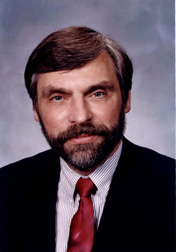
Teri and I send our best regards and Holiday Greetings.
As to predictions, I have two:
- Artificial intelligence will increasing affect the legal profession in several ways:
- Legal research with a focused manually-generated starting point will become more efficient as AI techniques as applied to legal research become more sophisticated.
- AI will be increasingly used to take a specified fact pattern and then generate on a jurisdiction by jurisdiction basis the applicable legal framework of applicable law, with generated citations and likely causes of action, probably also generating starting point transactional forms and pleadings. That will raise the standard of law practice, but only if lawyers are adept and precise in first ascertaining the provable, actual facts.
- AI, when fused with “Big Data” at the trial court level on a national and jurisdictional basis, will become more adept at predicting the outcome of a case, especially bench-tried cases, than even experienced practitioners.
- IBM is already starting to do this with its Watson software.
- All of the above will put even more financial and competitive pressure on the legal profession as a whole.
- Experienced lawyers who have the resources and background to embrace the above will be at a competitive advantage compared to younger lawyers who cannot afford or who cannot use new AI-based approaches as clients seek the reassurance of perceived personal experience and ability to connect with clients.
- The above will also generally tend to widen the gap between rich clients who can afford the expensive analytical approach to a trial and poor clients who cannot. However, AI-based analysis of fact patterns generating transactional forms and pleadings may be particularly helpful to smaller firms and less well-off clients who cannot afford to throw massive amounts of manpower at a particular matter.
- The ease with which now-predominant digital data such as digital photos and video, documents, texting etc can be now be easily altered will increase skepticism about such evidence, resulting in a need to have better authentication of digital evidence, particuarly photos and video.
Joe Kashi received his BS and MS degrees from MIT in 1973 and his JD from Georgetown Law School in 1976. He is a litigator in Soldotna, Alaska, and has extensively written and presented about legal technology throughout the US and Canada since 1990.
Kevin O’Keefe
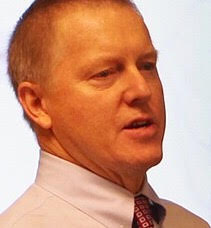
Bio: Kevin O’Keefe, a former practicing lawyer of seventeen years, is CEO and Founder of LexBlog, Inc., which helps lawyers build a name for themselves with the most comprehensive blog publishing solution in the legal industry.
Tom Spraggs

2017 Predictions
Thought the legal industry has reached a technological saturation point? Think again.
2017 will be the year where artificial intelligence (AI) makes its presence quietly ubiquitous. Lawyers already using any form of internet search are utilizing AI and feeding data to it. This will bring new and ever increasing security risks to lawyers who endeavour to keep information confidential. 2017 will require leadership from our industry to adapt, modernize and contextualize actual versus theoretical threats in this new computing age or we will be left behind as an industry.
Gone are the days where only somewhat interesting parties were tracked and data-mined. In 2017 the online activities of all interesting and uninteresting persons (including lawyers, haha) will be tracked simply by virtue of being a “wired-in” member of our society. Similarly, lawyers can expect more conversations to be clandestinely recorded by clients and non-clients alike. We expect (perhaps hope is the more accurate sentiment) savvy lawyers to respond by providing excellent service to all clients at all times.
Consumers require increased efficiencies in the delivery of legal services. Smart firms will capitalize and fill voids created by out-of-touch and out-of-date law firms. You’ve been warned (but do those firms read blogs anyway?). Similarly, law firms require dependable and secure avenues to communicate better with clients.
bio
In 2005 Mr. Spraggs took over Spraggs & Co. from his father and has since led the firm through significant growth. He holds a Bachelor of Laws, Master of Laws, and a Masters of Business Administration which has helped round out his expertise in running a successful personal injury firm among many other endeavors. Recently, his firm was acknowledged by the Canadian Bar Association with the 2016 Innovative Workplace Award. Within his practice, Mr. Spraggs works with a large team of experienced lawyers, investigators and claims managers to help British Columbians get access to justice. He is a litigator, arbitrator and technologist who has a passion for growth and the future. Mr. Spraggs is in the process of launching Solvere Inc., a digital platform aimed at increasing access to justice.
Amelia Rodin


As law student, who hasn’t “worked in the trenches” yet, I thought I’d simply comment on an area that I think law schools could benefit from focusing on:
I’d like to see law schools continue to build meaningful access to justice programs within their communities by partnering with local agencies to build more interdisciplinary connections. Law students have a lot to offer outside of the traditional “legal clinic” setting – and could contribute to local grassroots movements.
Access to justice movement over the next year will likely be shaped by both global and local events. Just recently, we’ve seen a pledge to increase the fund for Innocence Canada, in an effort to recognize those who have been wrongfully convicted. This may be a result of attempting to mitigate the effects of events across Canada and the US that have highlighted racial profiling and overrepresentation of minorities within the system. Commitments to continue immigration efforts will also affect the landscape of access to justice locally. There is certainly no shortage of ways in which students can become meaningfully involved in their community.
By doing so, students may feel more connected to actual legal practice, and identify a purpose, or at least an interest or passion, to incorporate into their future career.
Amelia Rodin is a law student with Russell Alexander Collaborative Family Lawyers, and begins Articling in 2017. Currently completing her final year of the Juris Doctor/Master of Social Work program at the University of Windsor, Amelia focuses her studies on the area of family law, including custody and access, child support, property issues and divorce.
Kate Gower
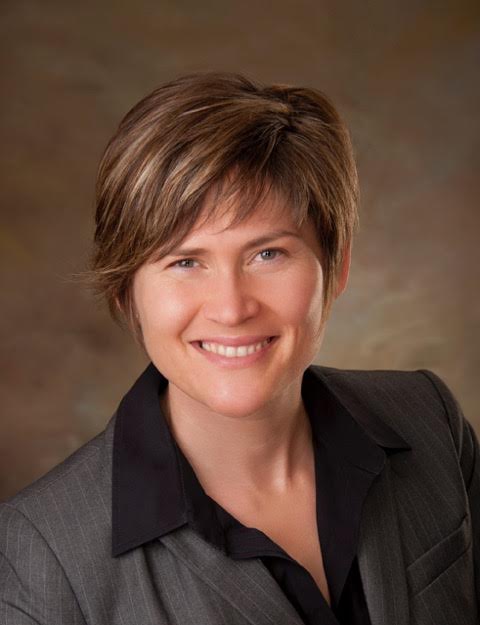
I am in Canada, so my predictions are for this country. We just successfully completed a 60-day electronic trial in Victoria, BC using a very simple e-trial platform I put together, so my predictions flow from what worked well there.
On the last day of our trial, the judge commented on the “flowing transcripts” coming from the Real Time reporter, saying “whoever decided to do that was a genius because they have been and will be irreplaceable.” The court and counsel from both big and small firms benefited from the Real Time reporting: it made it easier to participate in the trial, especially for small firms, since there was no need to take frantic notes during trial and it helped all parties with their direct and cross examinations.
I predict 50% of all trials over 3 days long will have Real Time reporting and – since right now I hear anecdotally that Real Time is “quite common” in larger courthouses, such as Vancouver – I predict that there will be a way to confirm if my first prediction has come true.
2. Simple technology in the courtroom will squeeze out the use of paper.
When I say “simple”, I mean a laptop at the front of the courtroom linked to “slave” monitors on the tables for all counsel, the judge and the witness. Counsel would bring their documents to court on a thumbdrive (or similar) and use this simple technology to review electronic evidence (PDFs) in the courtroom.
In our trial, the parties purchased and set up this simple technology in the courtroom. It meant we didn’t have to deal with the inconvenience of many binders of common book documents. It saved space and time. In Vancouver, two courtrooms are already set up with monitors on every table: there is a form parties can fill out regarding in-court technology.
I predict 50% of trials over 3 days long in Vancouver will use a laptop and monitors on all tables to review evidence electronically in court.
3. Full “electronic trial platforms” will be on everyone’s radar
In our trial, we had a SMART board to mark up documents and agreements between the parties so that the court could review and receive evidence entirely in an electronic format. Our trial proved it can be done with only “over the counter” technology in the courtroom (for a 3-minute video of the e-trial platform in action, see: http://dgwlaw.ca/tag/
Across Canada, other trials are being conducted by bringing databases of electronic evidence into court (For example: 1159465 Alberta Ltd. v. Adwood Manufacturing Ltd., 2010 ABQB 133). BC’s securities commission has been running trials this way for 10 years. There are also companies developing proprietary e-trial platforms (for example, Opus 2 in England and Court Innovations’ Matterhorn in the USA).
Both Colin Rule and Darin Thompson highlighted examples of how the tide is turning, bringing technology into the courtroom. Our judge repeatedly informed the parties during case management conferences that he would not welcome a “wall of binders” in the courtroom, which helped us lead the other parties to an e-trial. In 2014, an Ontario judge ordered the parties to conduct a trial electronically (Bank of Montreal v Faibish, 2014 ONSC 2178).
All parties in our trial agreed that our simple, full e-trial platform was a success and across Canada electronic trials are going forward. However, even though I predict a lot of simple technology will be used in BC’s courts, I only predict that there will be three fully-integrated electronic trials in Vancouver and Victoria in 2017. I predict I will be in the courtroom, avidly watching how they roll out.
About Kate Gower:
Kate works as a contract lawyer in all areas of Aboriginal Law, specializing in Aboriginal consultation and litigation. She has become a regular speaker on electronic trials since she helped DGW Law Corporation run a 60 day Aboriginal Treaty Interpretation Case as an electronic trial in the Supreme Court of British Columbia (West Moberly First Nation et al. v. B.C.). The case was the first electronic trial in Victoria. Trial ended in November 2016.
She has appeared before British Columbia, Federal and Northwest Territories courts. She also has experience as a neutral investigator in the resolution of workplace complaints under internal discrimination and harassment policies in the public and private sector. Kate did her law degree at the University of Victoria, articled at Fasken Martineau, and now has her own business contracting her legal skills to other law firms. Before law, Kate was a journalist for the CBC and CTV in Canada, and the BBC in the UK.
Contact Kate Gower:
Phone: (778) 384-6541
Email: kategower@mac.com
Contract Lawyer with
DGW Law Corporation
Barristers & Solicitors
2nd Floor, 736 Broughton Street
Victoria, BC V8W 1E1
Tel. 250.361.9469
Fax. 250.361.9429
Buzz Bruggerman

So here goes…
1. 2017 will be a year of political chaos in the US. I envision the country basically fragmenting into three groups. Those supporting Trump, those sane people in the middle trying to keep the Republic together and those on the left, fighting the political equivalent of guerilla war just the like the right wing Republicans have done over the last 8 years of the Obama administration. It will be interesting to see if Trump makes it to a second year without threat of impeachment for his venal willingness to comingle the public good with his private business interests.
For those willing to do future reading, see Juan Enriquez, “The Untied States of America” as a reference: https://www.amazon.com/Untied-States-America-Polarization-Fracturing/dp/0307237524
2. We will begin to AR/VR companies shipping life changing products. It’s still early, but some of the products I have seen are mind blowing. When and whether they will become commercially feasible and available is TBD
3. Products like Atlas Recall (www.atlas.co ) will completely change how we use our computers to search for information. We will begin to see the first round of AI programs that will have massive impact on what we now call “work”. I think Atlas Recall (www.atlas.co ) will rise to Unicorn status. It’s a bit like seeing and using it are like the first iterations of Google.
About Buzz:
First Happy Holidays!
Trying to change the world, and helping to connect great people.
ActiveWords Co-Founder, Tech Evangelist, connector, small town Minnesota boy, Duke grad, and serious Duke basketball fan.
Now working on getting Atlas Recall (www.atlas.co ) in front of his friends.
http://bit.ly/2fkLsIb has a bunch of links.
And David Pogue just posted a rave review about it on Yahoo Tech: https://yhoo.it/2eLCZ4l
And Verge covered it here: http://bit.ly/2gYSMuo
The app is dazzling.
Pablo Cortés

I hope all is well with you too. Here are my predictions:
- The UK Parliament will produce at the start of the year the Bill for the Online Court, which will be the largest of its kind and before the year ends the first tests will be scheduled. In the meantime the Canadian BC Civil Resolution Tribunal will be in full swing and it will represent the best model to follow and from which to learn valuable lessons.
- The publication of the data from the EU ODR platform will bring some disappointment because we will realize that few consumers have used it and that most merchants have refused to opt in. On the plus side, all the EU Member States will be joined by then, and the realisation of its limited success will lead to an investment effort to increase awareness and the use of public muscle to incentivise the merchant’s participation.
- I will publish another book on online dispute resolution but I will struggle to find funding, which will force me to go back into teaching full time with a new module on Dispute Resolution (and Technology!)
Look forward to read all the predictions for 2017.
Bio:
Pablo conducts research in the field of consumer law, civil procedure, ADR and ODR. He has advised the European Commission during the drafting of the ODR Regulation and ADR Directive and has been invited to write reports and to participate in expert meetings by the UN Commission on International Trade Law (UNCITRAL Working Group-III ODR), the European Commission Directorate-General for Health & Consumers (DG SANCO) and Justice (DG JUST) as well as by the European Parliament Internal Market and Consumer Protection Committee (IMCO) and the Legal Affairs Committee (JURI). Pablo serves on the advisory board of NetNeutrals and Youstice. He is a fellow of the National Centre for Technology and Dispute Resolutions (University of Massachusetts, Amherst) and in 2012 he was a Gould Research Fellow at Stanford University. He is also a member of the Online Dispute Resolution Taskforce of the International Mediation Institute and a member of the ODR Advisory Group of the Civil Justice Council in England and Wales. Pablo has published extensively and is now completing his third book on consumer redress.
Professor Pablo Cortés, Chair in Civil Justice
Leicester School of Law
University of Leicester, University Road, Leicester, LE1 7RH, UK
t: +44 (0)116 252 5332
e: pablo.cortes@le.ac.uk
w: http://www2.le.ac.uk/departments/law/people/pablo-cortes

Mitch Kowalski

Last year I did reasonably well in my predictions, which means I will be way off in 2017! Although the first one is easy:
- Dentons LLP will acquire at least one firm in 2017;
- Codify will win the Blakes Global Legal Innovation Challenge;
- Ryerson will be granted a law school;
- TWU will win in all jurisdictions at the Supreme Court of Canada; and
- Alberta will permit ABS for non-profit law firms.
Have a great holiday!!
About Mitch:
Mitchell Kowalski is the Gowling WLG Visiting Professor in Legal Innovation at the University of Calgary Law School, the Legal Innovation Columnist The National Post, and the Principal Consultant at Cross Pollen Advisory where he advises in-house legal departments and law firms on the redesign of legal service delivery. He is also the author of the critically-acclaimed book, Avoiding Extinction: Reimagining Legal Services for the 21st Century. His new book, The Great Legal Reformation: Notes from the Field will be published in early 2017. Follow him on Twitter @mekowalski or visit his website www.kowalski.ca
Mitchell E. Kowalski M.A. LL.M. ICD.D.
Barrister and Solicitor
Gowling WLG Visiting Professor in Legal Innovation, University of Calgary Law School
Author of: Avoiding Extinction: Reimagining Legal Services for the 21st Century
627 Bloor Street West 3/F
Toronto, Ontario
M6G 1K8
t: 416-294-6499
f: 877-689-0652
Deborah McMurray

In 2017, I predict that experience databases will finally get the due they deserve as a vital cultural and integration tool in law firm mergers.
As mergers and combinations of all sizes continue to fuel law firm growth, effectively capturing what’s in the brains of your top lawyers becomes even more mission-critical. For these combinations to be successful and profitable as early as possible, what lawyers have done and for whom must easily be discovered and extracted – and then put to great use: building trust, demonstrating relevant expertise and selling new work.
The most committed and aggressive firms have a mandate around experience collection and organization that starts with their firm chairs and executive committees. We have learned that top-down engagements have greater success than bottom-up.
100 percent of law firms want to manage this better. The firms that do it well give access to the lawyers – with a link to the experience database on their intranets, access to reporting features, even the ability to enter in details about a new matter. And lawyers who are serious about wanting to win more are accountable to keep their matter records current. Relevant, at-your-fingertips experience is critical to winning more practice-defining, or I should say, career-defining work.
In the very best systems (judged by the amount, quality, and relevance of data), lawyers are involved in the data-capture process in one way or another. To win more, this cannot be a marketing department “initiative” – it must have full support of and engagement by lawyers in the firm. And it must have active support from the firm’s C-suite or it won’t get done.
Trust doesn’t automatically transfer from one firm to another as soon as merger documents are inked. It gets a proven boost, however, when lawyers can instantly investigate the experience of their new colleagues, 24/7 and regardless of time zone. This is a sure-fire way for key lawyers around the globe to trust the strength and qualifications of each new lateral, and for each one to feel embedded and valued in your firm.
Deborah McMurray is founder and CEO of Content Pilot LLC, a strategy, design, content and technology company. Clients include the largest law firms in the world, as well as national, regional and powerful local firms. A former law firm CMO, Deborah and her team specialize in award-winning design of websites, proposal centers and experience databases, and important strategic initiatives, such as content strategy design and positioning/branding campaigns. In 2008, she was inducted into the Legal Marketing Association’s Hall of Fame and in 2007, was elected as a Fellow in the College of Law Practice Management. In December 2013, she was named as one of National Law Journal’s “2013 Top 50 Legal Business Trailblazers & Pioneers.”
Richard Granat

Here are my thoughts for 2017:
Introduction
I am a bit preoccupied by the coming chaos in the U.S. to be caused by the new administration so that lenses affects my thinking, probably more than it should. The Trump Administration will have an impact on the legal market in many different ways.
—The access to justice movement in the US will receive a setback. A President who had no respect for the first amendment is not likely to have much respect for the sixth amendment either. Authoritarian regimes resist empowering people to have more access to the legal system. The appropriation for the U.S. Legal Services Corporation will be cut or endangered, putting more pressure on the private bar to provide services who those who cannot afford a lawyer.
—If the U.S. Federal Trade Commission assumes a more free market bias, that may put pressure on state bar authorities to license or enable nonlawyers to provide legal services directly to the public. This limited deregulation will result in further eroding the market share of solos and small law firms.
–Litigation against the Federal Government will increase making more work for boutique law firms who represent interests that are opposed to the new administration policies. Expect much more litigation at the state and local level as well.
–Law firms based in Washington, D.C. that represent special interests will also do very well.
–Non-lawyer ownership of law firms will continue to be a “non-starter” in the U.S.
Profit-making law schools will go out of existence in the U.S., unless the Trump administration reverses the regulatory framework now it places that makes educational institutions more accountable. The recent withdrawal of eligibility for federal student loans for Charlotte School of Law, is the death knell for these institutions.
Funding for legal startups will dry up as funding sources (VC, Angel investors) become more aware of the difficult regulatory environment and the approach of states, like North Carolina, that seek to over-regulate legal software that serves the public directly.
ABA membership will continue to decline as it struggles to remain irrelevant in a rapidly changing environment. Declining membership is a good overall metric for the reputational decline of the legal profession in the US.
Bio:
Richard S. Granat is the founder and CEO of DirectLaw, Inc., a virtual law firm platform provider.
Richard S. Granat, Esq. CEO/Founder
DirectLaw, Inc. | SmartLegalForms, Inc.
http://www.directlaw.com
PH: 800-481-1025
Direct: 561 – 622-9971
Cell: 561-214-1306
E-mail: richard@directlaw.com |
Connect With DirectLaw:
| DirectLaw Blog |
Connect With eLawyering:
| eLawyering Blog
ABA Journal – Legal Rebel -2009
ABA Louis M Brown Lifetime Achievement
Award for Legal Access – 2010
ABA Keane Award for Excellence
in eLawyering – 2013
FastCase50 Winner – 2013
DirectLaw offers a virtual law firm platform that
enables solos and small law firms to deliver legal services online.
David J. Bilinsky


Looking back at my predictions for 2016, I think the majority fall in the ‘coming true’ category. Perhaps the time line is a bit longer than I thought…
This year I would like to address what I believe are structural fault lines in the legal profession and how these could impact us.
- Access to Justice. Many of the predictions have dealt with this issue, but this is my take on it. The public’s appetite for real access to justice has never been stronger. Put it another way: legal fees are deemed too high and court delays are deemed much too long for Joe Average. While judges, courts and lawyers are taking steps to address these issues, I think the real change is going to be happening outside the traditional legal arena. There are two projects in particular that I am keeping my eye on.
- The first is BC’s Civil Resolution Tribunal. This is the first legislated alternative to going to court and is built around new alternative ways to find a way to resolve disputes. It is now operational in strata (condominium) disputes and will shortly proceed to small claims cases. Once the Tribunal has demonstrated success (without judges and yes, without lawyers) then other cash-strapped governments will follow suit and create tribunals in particular niches that will remove more and more cases from the courts. The UK will shortly follow suit with Her Majesties Online Court. This demonstrates a fine example of Albert Einstein’s quote: “We can not solve our problems with the same level of thinking that created them.” In other words, continuing to flog the pro bono dead horse will produce about the same level of results for access to justice that it presently produces with about the same impact on society. As a result, the patience of the public is running thin. The public is wanting access to legal services at rates they can afford and that delivers results in a reasonable time.
- The second is the Rechtwijzwer website in the Netherlands. This is another example of how technology and a fresh way of thinking can produce meaningful results for the public in terms of resolution of legal problems. In this case, it is the issue of divorcing and separating couples. I understand that this project currently has helped over 700 dutch couples divorce for a total spend of €400 per couple. Compare the costs in 2013 in Canada: “Average fees for uncontested divorces have dipped to $1,018 from $1,500 and for separation agreements, $1,985 from $2,106. (editor: note that this is per person, not per couple” (per Canadian Lawyer Magazine).
- In BC I believe the Government will be looking to expand the powers of BC Notaries under the Notaries Act, under the rubric of expanding the range of providers that can provide basic legal services to the public. Notwithstanding this change, I don’t expect the cost of these legal services to drop, whether provided by notaries or lawyers. I also expect to see more and more organizations housing both lawyers and notaries under the same roof, as they recognize that this can complement each other’s range of services.
- There will be a rapid expansion in lawyers providing legal assistance to the legal marijuana industry in Canada (and also in the USA).
- Canadian lawyers (and their American counterparts) will continue to search for the desktop equivalent of the Holy Grail…that offers full featured practice management (calendaring, email integration, conflict checking, file management, document management, document generation), fully integrated general and trust accounting, time and billing, cloud storage, backup, portal and collaboration services and more from one vendor, rather than trying to link up disparate services.
- Artificial Intelligence (AI) will continue to invade the legal sphere. The effect on practising lawyers remains to be seen, but I think it is a ‘disruptive force’ once its power becomes better utilized and focused.
- Security, malware and ransomwear will continue to be a weak point for lawyers and law firms. Conversely, full-disk encryption and zero-knowledge backup services will assume greater importance for the firms that recognize their advantages.
- Lawyers will continue to grapple with how to drag their partners into the late 20th century from the technology standpoint and adopt firm-wide technologies that benefit the entire organization but which require the dinosaurs to change with the times.
- Lastly I think law is about to undergo some fundamental change. Young bright minds are realizing that better opportunities lie in emerging (technology and related) careers rather than in the traditional role of a lawyer. Law related organizations such as the American Bar Association are facing a decline in membership [“According to the Annual Report of ABA Executive Director Jack L. Rives as delivered to the House of Delegates at this year’s Annual Meeting in Chicago, dues paying ABA Membership is declining steeply. When I joined the Board of Governors in 2005, some 282,954 lawyers were dues-paying, card carrying ABA members. This year, the projected count is down to 232,538 lawyers” [2015]. I believe the Canadian Bar Association’s numbers are remaining static or similarly declining (Wikipedia states: The Canadian Bar Association represents over 37,000 lawyers, judges, notaries, law teachers, and law students from across Canada. According to the Wayback Machine, the CBA’s membership was 36,000 in 2000). While there will be a need for lawyers in the future, the rewards that law offers relative to the long hours and personal toil on lives will cause many to reflect and reconsider.
I believe as a profession we can change the profession for the better. We need leadership, vision and thoughtful action, perhaps now more than ever before. We can change if we learn, as judges, lawyers, court administrators and the public, to work together to help solve the bigger legal issues facing our communities and our culture. We can achieve much more working together than we can working apart. We owe it to our colleagues, our friends, our families and our communities.
David J. Bilinsky is a Practice Management Advisor and lawyer for the Law Society of British Columbia.
He is a Fellow of the National Center for Technology and Dispute Resolution (NCTDR) at the University of Massachusetts. He is also a Fellow of the College of Law Practice Management and past Editor-in-Chief of ABA’s Law Practice Magazine.
David is an adjunct professor at Simon Fraser University teaching a totally online, graduate level course in the Masters of Arts in Applied Legal Studies program. This MA program received the 2011 Award of Excellence from the Canadian Association for University Continuing Education. He designed and taught the first legal technology course in Canada for the University of Toronto Law School.
Dave’s mission in life is to empower lawyers to anticipate the changes, realize the opportunities, face the challenges and embrace the expanding possibilities of the application of practice management concepts to the practice of law in innovative ways that provide service excellence.
Dave is the founder and Chair of the Pacific Legal Technology Conference and a past Co-Chair of the American Bar Association’s TECHSHOW.
Dave writes regularly for many publications in the USA and Canada including being a contributor to the award-winning blog www.slaw.ca, its sister blog, tips.slaw.ca as well as his own blog: www.thoughtfullaw.com.
Dave has keynoted and delivered dynamic and thoughtful presentations to legal and judicial conferences, practice groups, legal organizations and law schools across the globe and is considered a visionary in terms of how technology and other forces are changing the practice of law and how legal organizations can take advantage of these changes.
His articles have been translated into several languages and republished across the globe. He has a Bachelor of Science and a Bachelor of Law from the University of Manitoba and a Masters of Business Administration from the University of British Columbia.
Dave is a long-distance runner who has completed 11 marathons including: Boston, Chicago, New York, Portland, Vancouver, Victoria; many half-marathons and other events. He is an avid downhill and cross-country skier and was a volunteer ski-patroller for many years.
You can contact him at daveb@thoughtfullaw.com.
♫ It’s coming on
It’s coming on
It’s coming on
It’s coming on
My future is coming on…♫
Lyrics and music by: Damon Albarn, Teren Devlon Jones, Jamie Hewlett, recorded by The Gorillaz.

(photo by Sean Creamer, used under a Creative Commons Licence)
The predictions are coming in fast and furious! In this Part 2, we have prognostications from:
- Jeremy Hessing-Lewis
- Stephen P. Gallagher
- Colin Lachance
- Jared Correia
- Tim Baran
- Niki Black
- Jordan Furlong
- Larry Bodine
- Darin Thompson
Jeremy Hessing-Lewis

Introduction:
- Law as a Lifestyle Company: Traditional commitments to the billable hour meant that the practice of law rarely worked in half measures. As a lawyer in private practice, your options tended to be 0% employment or 130% employment. With the emergence of creatively structured alternative fee agreements (AFAs), we will see more lawyers opt for less than full-time practices. This will include increasing numbers of practitioners pursuing phased retirement, parents with young children, and those with employment or interests outside of the practice of law. While AFAs and new technologies will give law firms the option of becoming lifestyle businesses, regulatory bodies will struggle to keep-up with these changing practices.
- If This, Then…: With practice management technology fragmented among an increasing number of web applications, lawyers will become increasingly interested in the connections between these applications (the application programming interfaces or APIs). Direct APIs allow independent applications to share information. More complex intermediary tools (e.g. Zapier, IFTT), will increasingly be used to weave together multiple APIs and automate administrative tasks within a practice. Ronco’s dream will finally be fulfilled: “Just set it and forget it.”
- Demographic Shifts: Baby boomer lawyers are starting to read obituaries of law school colleagues. There is no better motivation to reevaluate priorities than the passing of peers. The valuation and sale of practices will decline, to be replaced by younger lawyers who are simply willing to take on the files. For every client that is an asset, there is another that is a liability. We will see more succession planning that addresses continuity rather than cash.
- Renewed Commitment to Justice: Following Donald Trump’s electoral victory, the Lawyers of the Left secret Facebook group has accumulated over 188k members. Many of the posts to this group have featured lawyers from all practice areas renewing their commitments to justice. In particular, many mid-career lawyers have expressed a rekindled appreciation for why they went to law school in the first place.
Thanks Dave and best of luck in the new year!
- a business lawyer with Vancouver-based Small Law;
- a legal practice management consultant through Appropriate Legal Technology; and
- the Senior Digital Advisor at the legal marketing agency, Skunkworks Creative Group.
 |
Jeremy Hessing-Lewis / Senior Digital Advisor jeremy@skunkworks.caSkunkworks Creative Group Inc. 604.739.8976 600 – 55 Water StreetVancouver, BC V6B 1A1 http://skunkworks.ca |
Stephen P. Gallagher

Aging of the legal workforce has finally hit the “proverbial brink wall.” According to a recent Oregon Attorney Assistance Program (OAAP) Retirement Survey, of the 6000 members over 50 who filled out the survey, bar members 60 – 69 represented over half (53%) of survey participants. To add insult to injury, 50% of these respondents report that they are planning on retiring from legal practice in the next five years. The brain-drain is clearly underway.
- In order to continue to attract talent, law firms will have to demonstrate concern for senior partners who need support in moving away from full-time practice. Young lawyers will be watching this very quickly. The worst thing that a firm can do is to do nothing about it.
- In order to continue to attract talent, law firms will have to adopt more flexible career paths for all lawyers that include formal flex-time guarantees for both aging lawyer as well as mid-career lawyers, who may not want to “Die at their Desks”.
Stephen P. Gallagher sees himself as a student of the legal profession. I am a former Director of Law Practice Management for the New York State Bar Association. Currently, I am a Baby-boomer born in 1946, and since I have been working in the legal profession for the past thirty-years, I consider myself a bit of a transition expert. I am an adjunct instructor of marketing at a Jesuit university, and I work with law firms and bar associations, to help get conversations started regarding the Aging of the Legal Marketplace. I have a limited coaching practice built around grandchildren’s schedules. sgallagher@leadershipcoach.us
Colin Lachance

My first inclination in looking ahead to the future of law in 2017 is to look into what has happened in other industries over the past 5 to 10 years and pick from there the changes that the legal industry might be ready to face. But as even that might be too fanciful a thought, I’ll instead over some broad predictions of what’s ahead without going too deeply into whether or which might hit the business of law.
- Cloud backlash. No I’m not talking about arguments against moving services to the cloud in the first place, but backlash and exhaustion from those who have been there for some time. Two triggers here: sheer volume and unwanted sharing. Honestly, I don’t seem to go very long without having or choosing to sign-up to a new cloud-based service to carry on my business and personal life. But what really begins to concern me is losing visibility and control of cross-service data sharing (i.m looking at you, G-Suite!). Surely, I’m not alone in this. But we press further into this world even as the news mounts of privacy breaches at one after another provider, and even as the daisy chain of our digital identities exposes our complete selves to the weakness of security practices at any link. I can’t tell you what form the backlash will take or what options exist, just that anxieties will be high and that 2017 will be the year we start to figure out what to do.
- Alexa, Siri and their friends move into the corporate world. As leaps in voice recognition begin to combine naturally with leaps in Natural Language Processing, machine/deep learning and knowledge management, the corporate world will start to wonder why it’s spending so much time typing things into in-house search and document management systems. With prime time for this still a few years down the road, 2017 will feature plenty of articles and profiles of companies that operate on voice commands to call up corporate knowledge. Think: “Computer, put the 2016 Johnson – Smith contract on screen. Read me Paragraph 4.”
- Giants begin to fall. Jack Welch of GE fame was found of saying he only wanted the company to be in businesses where they could be the number 1 or number 2 player. 2017 is the year a lot of number 2 players lose their spots or at the very least find that being number 2 ain’t all that special. In all domains, but especially in those reliant on the burgeoning AI field, innovators will lower or remove barriers and undermine pricing strategies of market incumbents.
Bio and contact info:
Colin Lachance, as CEO of Maritime Law Book, is currently leading the launch of Canada’s newest case law research platform (Compass) through which he hopes to contribute to the realization of his third prediction. A business advisor and lawyer, Colin served as CEO of the Canadian Legal Information Institute (CanLII) from 2011 to 2015 and in that capacity was profiled by the ABA Journal as a “Legal Rebel” (2014), by Canadian Lawyer Magazine as among the “Top 25 Most Influential” (2014), by the Canadian Bar Association as an innovator who is “Doing Law Differently”, and by Fastcase as a member of the 2013 Fastcase 50 class of legal innovators and visionaries. Prior roles included senior positions in advocacy, marketing and lobbying with a national telecommunications company. An average and unimpressive student in all his schooling, he added a technology-focused LL.M. in 2013 to the degrees in business and law obtained in the bloom of youth.
A frequent speaker and author on legal information, technology and market development topics, his recent professional commitments included consulting with firms, corporate legal departments, access to justice organizations, courts, law associations and others through PGYA Consulting. In 2016 he served as an advisor to numerous legal tech startups, to a government-funded research study into access to justice mobile apps, and was an industry advisor to the legalX cluster at Toronto’s MaRS Development District during its first year of operation. He practices communications law part-time in association with Momentum Business Law in Ottawa, Canada, but otherwise is of little use as a lawyer.
Colin can be reached by email Colin@pgya.ca, phone 613-316-3290 and Twitter @ColinLachance
Jared Correia
- Seeking reduced competition, more favorable cost of living and improved lifestyle components, more solo and small firm lawyers will open practices in rural areas.
- The use of modern technology, including cloud software, will allow them to remain competitive as against law firms located in large, urban centers.
- And, these lawyers, freed from the hive mind mentality of big city lawyering, will be freed to try innovative approaches to marketing, client service and billing.
Jared D. Correia, Esq. is the CEO of Red Cave Law Firm Consulting, which offers subscription-based law firm business management consulting and technology services for solo and small law firms. Red Cave also works with legal institutions and legal-facing corporations to develop programming and content. A former practicing attorney, Jared has been advising lawyers and law firms for over a decade. He is a regular presenter at local, regional and national events, including ABA TECHSHOW. He regularly contributes to legal publications, including his column, ‘Managing,’ for Attorney at Work and a forthcoming advice column for Lawyerist. Jared is the author of the American Bar Association publication ‘Twitter in One Hour for Lawyers’. He is the host of the Legal Toolkit podcast on Legal Talk Network. Jared also teaches for Concord Law School, Suffolk University Law School and Solo Practice University. He loves James Taylor, but respects Ron Swanson; and, he tries to sneak Rolos when no one is looking.
Tim Baran

I’m more of a here-and-now than a futurist. There are folks who are much, much smarter prognosticators, so I’ll leave it to them. However, here’s what I would like to see happen in 2017.
Access to Justice – Good people are doing good work hosting hackathons, creating apps, and offering free and low cost criminal and civil legal help to those for whom justice is less than blind. Thing is, many of the folks who could use these services don’t even know they exist.
I’d like to see justice warriors go to underserved areas and spread the word to folks who don’t know what they don’t know and spread the word. Like churches, synagogues, mosques, and other places of worship. Community centers, movie theaters, and street corners. Perhaps even an old retrofitted van or bus providing mobile justice. If you’re interested in starting a city by city movement, get in touch with me and let’s do this.
Diversity – Again, lots of good work happening here but I’d like to see us take the long view. Start in high school. Lawyers beget lawyers and many of the rest can’t even visualize themselves in court or firms. College is too late. Many won’t get there without mentorship and the confidence that they belong.
I’d like to see every Am Law 200 firm, corporate department, and federal and state court, offer a hands-on program for high schoolers including scholarships, mentorship, and internships. Yep, scholarships. Cold hard cash. Gotta walk the talk.
Marketing – There needs to be less content and more connecting. And I’m a content guy. Everyone’s doing the same damn thing. It’s a no-win proposition. Webinars, E-Books, Blogging, Data Analysis? Everyone’s doing it, and someone’s doing it better than you.
What would I like to see in 2017? Keep writing but do less of it and go deep. Don’t let your insatiable desire for bloody traffic water down your writing and distort your message and add to the noise. Use content to facilitate connections – like the invite to this collaborative post. Look outward for connections across clients, products and functions. Use content to facilitate the effort. Lots to unpack here. For more on this check out The Content Trap: A Strategist’s Guide to Digital Change by Bharat Anand. End of rant.
Well, almost. Video seems to be the hot thing so of course everyone is jumping on that bandwagon. Go for it but make sure it’s useful for your intended audience and not salesy or narcissistic, the latter of which seems to be proliferating.
Technology – So many good companies and applications in the legal space, so little time to test them all to determine which is best for you and your firm. I’d like to see some overdue consolidation in the industry. ‘nuff said.
Tim Baran is all about community. He’s engaged in improving the management and delivery of legal services and access to justice. He works on content, connections, and relationships with Rocket Matter. Tim is the author of Evernote for Lawyers and was named to the 2016 Fastcase 50 honoring the law’s techies, visionaries, and leaders.
Niki Black
Technology is changing the legal landscape and providing lawyers with more options and better tools than ever before. Improvements and advances in software are making it possible for lawyers to be more mobile, collaborative, and responsive, while focusing on the work they truly enjoy. Lawyers will have more options than ever in 2017 to help streamline and improve their day-to-day work processes.
For example, lawyers will have more options than ever when it comes to collaborating online. Litigators, in particular will benefits from software designed to facilitate collaboration between litigation teams. Using litigation case management software, teams of lawyers can collaborate and share notes about case-related evidence and documents in a secure web-based platform. Litigation collaboration by simplified and streamlined, thus reducing redundancies and inefficiencies in the litigation preparation process.
And, advances in AI that reduce the repetitive tasks of day-to-day practice will increase exponentially in 2017. Using machine learning and advanced analytics, AI software is being designed to impact many areas of practice by reducing the amount of rote work often performed by lawyers. For example, there are new software tools on the market that take advantage of AI to streamline timekeeping, contract review, due diligence analysis, and legal analytics for litigation. In 2017, you can expect to see many other new AI software products that will assist lawyers with any number of different functions. Of course, it’s important to emphasize that AI software will not replace lawyers; instead, it will remove some of the drudgery of practicing law from lawyers’ lives, allowing them to focus on higher level analytical thinking and on the needs of their clients.
Here’s my bio:
Nicole Black is a Rochester, New York attorney and the Legal Technology Evangelist at MyCase.com, legal practice management software. She is the nationally-recognized author of “Cloud Computing for Lawyers” (2012) and co-authors “Social Media for Lawyers: The Next Frontier” (2010), both published by the American Bar Association. She also co-authors “Criminal Law in New York,” a Thomson West treatise. She writes a regular columns for The Daily Record, Above the Law, and Legal IT Pros, and has authored hundreds of articles for other publications, and regularly speaks at conferences regarding the intersection of law, mobile computing, and Internet-based technology. She can be contacted at niki.black@mycase.com.
Jordan Furlong



I admit, this might be wishful thinking. But I have a feeling that 2017 will turn out to be the year we reach a tipping point in the campaign to improve access to justice. I’m now encountering A2J in many different contexts outside the legal profession — in the mainstream press, at technology conferences, and among governments, think tanks, policymakers and corporations. It looks to me like access to justice, about which the legal profession has said a great deal but accomplished relatively little over the past few decades, has finally breached the consciousness of society at large.
This may prove to be a double-edged sword for lawyers. On the positive side, bringing many more resources and many different and diverse perspectives to the A2J problem can only accelerate us towards a solution. On the negative side, as Lawyerist’s Sam Glover pointed out a few years back, we can close the access-to-justice gap, but lawyers aren’t going to like it.
It is very clear to people outside the legal profession that lawyers are demonstrably unable or unwilling to make adjustments to their business model that would make their services more affordable to more people. It’s equally clear to these observers that the legal profession intends to indefinitely maintain barriers against “non-lawyer” service providers who could help enable more access to legal services. Whatever merits these positions might have when viewed from within the profession, I can assure you they have almost no traction outside it.
Access to justice is about to become a mainstream social issue. When it does, it will leave the orbit of the legal profession, and along with it will go the profession’s ability to dictate or even influence the solutions that are eventually found. Those solutions will have consequences for lawyers, both intended and unintended, and not all of them will be good. But I suspect our window of opportunity to do much about that, a window that has been open for many years, is finally going to close.
Jordan Furlong
Jordan Furlong is an internationally recognized consultant and legal market analyst who forecasts the impact of changing market conditions on lawyers and law firms. He has addressed audiences throughout Canada, the U.S., Great Britain, Europe and Australia over the past several years, including law firms, law societies, state bars, courts, law schools, and numerous legal associations. Jordan is a Fellow of the College of Law Practice Management and a member of the Advisory Board of the American Bar Association’s Center for Innovation. He writes regularly about the changing legal market at his website, law21.ca.
Larry Bodine

Here you go David. Happy holidays!
2017 will see more plaintiff trial attorneys opening a mass torts practice area. There are already 250 federal mass tort dockets with 135,000 actions, primarily product liability cases involving defective medical devices and dangerous drugs. In fact, 36% of the entire federal caseload is composed of mass tort actions. Some of the better-known cases involve defective hip implants, talcum powder, blood clot filters, pelvic mesh implants, and drugs like Lipitor, Xarelto and Abilify. Mass torts, where multiple actions are consolidated before one judge, have surpassed class actions as the best approach for attorneys to hold giant corporations responsible. Listen to my webinar at https://goo.gl/R0SUOk.
Attorneys will throw away less money on pay-per-click advertising, search engine optimization and other disposable forms of marketing. Instead, they’ll embrace content marketing, which creates a permanent online asset that grows with each new blog post. A basic website needs a minimum of 5,000 words to make a dent; to dominate a market an attorney should have 50,000 words online. And yes, lawyers are hiring attorneys to write all that copy for them. For a content clinic see https://goo.gl/sHcz82
- Attorney admitted in Wisconsin in 1981
- Sr. Legal Marketing Strategist, LawLytics Legal Marketing Suite, Tucson, AZ
- Editor, The National Trial Lawyers – http://www.thenationaltriallawyers.org/legal-news/
- Editor, Mass Tort Nexus – https://www.masstortnexus.com/mass-torts-news/
- Former Editor of Lawyers.com, a LexisNexis website
- Former Editor of The ABA Journal
- Former Director of Marketing, Sidley Austin
- Legal marketing blogger, www.LarryBodine.com/blog
Darin Thompson

Legal expert systems will continue to increase access to justice
Access to justice will increase thanks to expanded use of legal expert systems. In BC, we already have 3 great examples. The Legal Services Society’s MyLawBC platform supports users in the area of family law, foreclosures, and wills & estates. The Civil Resolution Tribunal’s Solution Explorer platform is supporting users with condominium disputes, with small claims coming soon. BC’s Residential Tenancy Branch recently launched a new expert system for landlord-tenant disputes, also using the Solution Explorer platform.
As a by-product of this expanded use of legal expert systems, we will see the emergence of new ‘legal knowledge engineers’ who are trained to put expert legal reasoning and guidance in the hands of non-expert users (i.e. the public). If you’ve read any of Richard Susskind’s works lately, you’ll be familiar with his description of the new role of the legal knowledge engineer. Several knowledge engineers have already been trained to create and maintain Solution Explorer content. And Thompson Rivers University Law’s new course led by Prof. Katie Sykes will bring this training directly to the law school environment.
Expert systems are also being used for triaging legal aid users in places like New Mexico. The recently announced Microsoft Statewide Legal Access Portal Project, which includes at least $1 million in technical development from Microsoft to create a legal access portal will also include a legal expert system component. This initiative could add considerable momentum to the development and deployment of expert systems in the legal domain.
Online Dispute Resolution (ODR) will become more ‘normal’ for public justice
Colin Rule covered this better than anyone can in the 2017 Predictions – Part 1 post. But I’m going to +1 him on it anyway.
The digital-first model of the Civil Resolution Tribunal represents a big leap forward in this area. BC’s first public justice ODR service created by the Property Assessment Appeal Board in 2011 helped to pave the way for the CRT, thanks in a large part to the work of Colin Rule’s company Modria.
Now that England and Wales has crystallized its intention to create online courts, it will make it harder for courts in other jurisdictions to argue that ODR is somehow unsuitable for public justice processes.
I agree with Colin that 2017 will see ODR continue to move forward in courts, tribunals and other key public justice services.
People will stop asking “Should we do ODR in the public justice system?” and start asking instead “What will it look like, and when do we start?”
Bio:
Darin Thompson is a lawyer with the BC Ministry of Justice. He has helped to initiate multiple projects using online dispute resolution (ODR) and is a former member of the Canadian delegation to the United Nations Working Group on ODR. He is also part of a team that developed a knowledge engineering process for legal expert systems.
Darin is also an adjunct professor of Legal Information Technology at Osgoode Hall Law School and the University of Victoria Faculty of Law. He holds a BA (with distinction) and a JD degree from the University of Victoria and an LLM (with distinction) in Innovation, Technology & Law from the University of Edinburgh.
More at: http://darinthompson.ca/about/
More predictions are to come in Part 3! Stay tuned!
♫ Hey, how you like it?
How you like it?
I see the future, baby
You and I, better with time…♫
Lyrics and music by: Bryan Michael Paul Cox, Johnta M. Austin, Kendrick Ashley Jevon Dean, Mary J. Blige, recorded by Mary J. Blige.

In this first instalment of the predictions for 2017 ( I just asked for submissions yesterday! ), we have predictions from:
- Colin Rule
- André Coetzee
- Ross Fishman
- Bob Denney
- Sharon Nelson and John Simek
More predictions will follow in Part 2!
Colin Rule:
![crule at cpr[1]](http://thoughtfullaw.com/wp-content/uploads/2015/12/crule-at-cpr1.jpg)
Wow, Buzz nailed it last year! I was overly optimistic about timing, but I still feel my 2016 prediction is on track.
About Colin:
Colin Rule is Co-Founder and COO of Modria.com, an ODR provider based in Silicon Valley. From 2003 to 2011 he was Director of Online Dispute Resolution for eBay and PayPal. He has worked in the dispute resolution field for more than a decade as a mediator, trainer, and consultant. He is currently Co-Chair of the Advisory Board of the National Center for Technology and Dispute Resolution at UMass-Amherst and a Non-Resident Fellow at the Gould Center for Conflict Resolution at Stanford Law School.
Colin co-founded Online Resolution, one of the first online dispute resolution (ODR) providers, in 1999 and served as its CEO (2000) and President. In 2002 Colin co-founded the Online Public Disputes Project (now eDeliberation.com) which applies ODR to multiparty, public disputes. Previously, Colin was General Manager of Mediate.com, the largest online resource for the dispute resolution field. Colin also worked for several years with the National Institute for Dispute Resolution (now ACR) in Washington, D.C. and the Consensus Building Institute in Cambridge, MA.
Colin has presented and trained throughout Europe and North America for organizations including the Federal Mediation and Conciliation Service, the Department of State, the International Chamber of Commerce, and the CPR Institute for Dispute Resolution. He has also lectured and taught at UMass-Amherst, Stanford, MIT, Pepperdine University, Creighton University, Southern Methodist University, the University of Ottawa, and Brandeis University.
Colin is the author of Online Dispute Resolution for Business, published by Jossey-Bass in September 2002. He has contributed more than 50 articles to prestigious ADR publications such as Consensus, The Fourth R, ACResolution Magazine, and Peace Review. He serves on the boards of the Consensus Building Institute and the PeaceTech Lab at the United States Institute of Peace. He holds a Master’s degree from Harvard University’s Kennedy School of Government in conflict resolution and technology, a graduate certificate in dispute resolution from UMass-Boston, a B.A. from Haverford College, and he served as a Peace Corps volunteer in Eritrea from 1995-1997.

Predictions for 2017
- Firms instead of adding more square footage to their office space as they grow, will turn to hosted services to create a hybrid of physical office space with legal professionals working virtually, saving time, money and creating a great modern working environment;
- Technology being flexible, mobile and nimble are all expected from legal professionals. Being able to work from anywhere and enjoying flexible hours will assist firms in attracting top young talent who not only want a successful career but also work life balance;
- Powerful mobile devices allow firms to leverage technology advancements in web based video conferencing to more efficiently communicate with clients and staff alike;
- An even greater push to go paperless resulting in reduced cost, better efficiencies and the added bonus of saving the planet. By moving to paperless offices there will be more demand for document management software that allows firms to access and search for digital documents quickly and easily;
- Continued focus on security and protection of data:
- greater adoption of two factor authentication;
- more centralized user access management and single sign on to the myriad of applications people use i.e. getting the user access to what they need at the right time with the right privileges;
- predictive security software and tools to protect firm’s data against ransomware and other malicious attacks;
- Applications that extract data from multiple legal and business applications\data sources and then mines and analyzes the data to pick up trends and perform predictive forecasting. This will lead to better serving clients and potentially finding new ones;
- Integration of CRM based applications with VoIP on a hosted desktop i.e. being able to call a client by clicking on their number in your CRM application and dialing from your VoIP soft phone loaded on your hosted desktop. When a client calls in it will automatically pick up their company and contact information and pop up on your screen before you answer the call;
- The way we interact with technology is going to be more experiential and tactile driven by Artificial Intelligence, Augmented Reality and Virtual Reality. Check out Magic Leap for a glimpse of the not too distant future – www.magicleap.com;
André Coetzee, MBA, PMP, BA, H.Dip.Ed.
(Master’s in Business Administration, Project Management Professional, Bachelor of Arts, Higher Diploma in Education)
Andre Coetzee is a Director and a founding partner of i-worx, a Premium Hosting Service Provider for law firms. Andre is constantly researching and exploring new and better Hosted IT services with the goal of continuously providing legal firms a premier IT experience. As a result i-worx has developed a reputation for delivering innovative Hosted IT services to law firms, including Hosted Desktops, Hosted Email and secure file sharing with exceptional personalized service. For more information or to learn more about how hosted services could benefit your Firm, call 604.639.6300 or email andre@i-worx.ca.
Ross Fishman

Although future predictions are always challenging, my 2017 crystal ball is looking more like a Magic 8 Ball — “Try again later.” At the moment, Cassandra can’t even foresee what she’s going to have for lunch. (And who’d believe her anyway?)
That being said, in light of the new political environment, I’m feeling pretty confident about my predictions, below. Here are the practice areas I feel are going to be especially hot in 2017, and why:
- In 2017, the new administration will enact harsh new regulations, risking a trade war with China, and making international trade an especially hot practice. Unless, you know, they don’t. And it isn’t.
- We’ll start building a wall with Mexico, generating high demand for both construction and immigration lawyers. Unless we don’t. And they aren’t.
- The US Supreme Court nominee will be provocative and polarizing, increasing demand for Supreme Court specialists. Unless s/he isn’t. And it doesn’t.
- A major Twitter faux pas will create an international incident in Latin America, expanding Florida-based Latin American practices. Unless that never happens.
Hell, I don’t know. I got nuthin’.
BIO:
“Many people consider [Ross] to be the nation’s foremost expert on law firm marketing.” – Of Counsel magazine
Ross Fishman, JD, is CEO of Fishman Marketing, specializing in strategy, branding, and websites for law firms. A former litigator, marketing director, and marketing partner, he has helped 200 firms stand out from the competition and generate revenue (see fishmanmarketing.com/results for 100 case studies). A popular keynote speaker and Ethics CLE presenter, he has given 250 presentations worldwide. Ross’s popular “The Ultimate Law Firm Associate’s Marketing Checklist,” called a “marketing bible” by Of Counsel magazine, is available on Amazon at https://goo.gl/HsrmbE.
A Fellow of the College of Law Practice Management, he was the first inductee into the Legal Marketing Association’s “Hall of Fame.” Contact him at ross@fishmanmarketing.com or +1.847.432.3546. Follow him on LinkedIn (linkedin.com/in/rossfishman) and Twitter @rossfishman), and subscribe to Fishmanmarketing.com/BLOG.
Bob Denney
Here are my humble – and not-so-humble – predictions:
- There are always changes in the legal profession, particularly in
the United States, when there is a change in Administration. There
will be more than ever in the next few years under the Trump
Administration. - Immigration and cybersecurity will have the most dramatic growth.
- The push for Alternate Energy will cool down, at least in the U.S.
- Law firms will hire more professional business developers, i.e.
non-lawyer sales executives, following what has been a common
strategy in the accounting profession for decades. - Some law schools will close because of the continued decline in
jobs for their graduates. - The number of Alternate Business Providers – non-lawyer entities
– and the services they provide will continue to grow. - Alternate Business Structures (ABSs) with non-lawyer ownership or
investment will be approved in Canada but not yet in the U.S. - The number of non-lawyer management and administrative positions
in even mid-size firms will grow.
ROBERT W. DENNEY
President,
Bob Denney has provided incisive management, business development and leadership counsel to over 400 law firms and legal organizations throughout the United States and parts of Canada He is the author of the highly regarded reports on “What’s Hot and What’s Not in the Legal Profession.”
He has been a Fellow in the College of Law Practice Management, has served on the Board of the Legal Marketing Association and is a member of the LMA’s Hall of fame. He has written or co-authored seven books, two of which were published by the American Bar Association, as well as articles that have appeared in many legal publications. He has been interviewed by the ABA Journal, The Wall Street Journal, The Philadelphia Inquirer and The New York Times and has conducted webinars and national TV seminars on law firm management and business development.
Bob has addressed conferences sponsored by The American Lawyer, the ABA, the Canadian Bar Association, the Law Society of British Columbia, the Association of Legal Administrators, the Legal Marketing Association and numerous state bar associations. He has also been a guest speaker at several law schools.
He graduated with honors from the University of Pennsylvania. After serving as an officer in the Navy, he did post-graduate work at the Wharton School towards an MBA. In the first phase of his career, Bob was President of a national cosmetics company and was also Vice-Chairman of that industry’s principal trade association. In that capacity, along with Ralph Nader, he testified before a Senate sub-committee.
In addition to being active in charitable and professional organizations, Bob and his wife have raised nine children and live in suburban Philadelphia.
Note: Some of Bob’s articles as well as many of his Legal Communiques are published on his web site, www.robertdenney.com, 154 Chandler Drive, West Chester, PA 19380• 610-431-2077 • cell 610-804-7850, email: bob@robertdenney.com • web site: www.robertdenney.com
Sharon Nelson and John Simek


Predictions for Dave Bilinsky
- Our first prediction is that no one will know what cybersecurity will look like until the Trump presidency is well underway. Mr. Trump is an unknown. If what he says is true, he does not value privacy in the context of what he sees as the fight against ISIS and others – and this does not bode well for the Constitution. Mind you, we were not happy with some of the privacy invasions which took place under Mr. Obama’s administration.
- Ransomware will get ever MORE crafty – and ransoms, which have gone up sharply in 2016, are likely to go even higher. It is not unusual at this point to see bitcoin ransoms in the $2500 range where law firms are compromised.
- The media has begun to report that the luster is off Apple and we believe that trend will continue. The truly innovative days of Steve Jobs appear to be gone. We have seen many clients switch from iPhones to Androids and embrace the Surface Pro.
- An increasing focus on tech CLEs seems likely. Florida, in 2016, mandated tech CLEs and we, in Virginia, have seen VSB TECHSHOW (capped at 500 attendees) sell out twice – and we expect to see it fully sold out again in April of 2017 – there is a great hunger among lawyers for good tech CLEs by speakers they can understand.
- We expect more major IoT breaches of personally identifiable information. We are at the point where it may cause actual physical harm or a huge financial impact.
- Continued implementation of encryption everywhere is very likely. Encryption by default is now standard in so many places.
- We predict, sadly, that a lot of solo and small practitioners will find that they are not selling what clients want to buy – primarily lower prices when technology is effectively leveraged.
- We also expect to see a greater usage of client portals – another way of protecting confidential data – and a feature that clients absolutely love.
- Block chain technology will begin to make inroads in the legal process as a method of authentication.
- Lawyers will increasingly understand that they must “fish where the fish are” – in social media. We have seen a great interest in CLEs which teach attorneys how to effectively manage and leverage social media.
About John and Sharon:
Sharon D. Nelson, Esq.
Sharon D. Nelson, Esq., is the President of Sensei Enterprises, Inc., a digital forensics, information security and information technology firm in Fairfax, Virginia.
Ms. Nelson is the author of the noted electronic evidence blog, Ride the Lightning and is a co-host of the Legal Talk Network podcast series called “The Digital Edge: Lawyers and Technology” as well as “Digital Detectives.”
She is a frequent author (fifteen books published by the ABA and hundreds of articles) and speaker on legal technology, information security and electronic evidence topics. She was the President of the Virginia State Bar June 2013 – June 2014 and a past President of the Fairfax Law Foundation.
She may be reached at snelson@senseient.com
John W. Simek
Mr. Simek is the Vice President of Sensei Enterprises, Inc., an information technology, digital forensics and information security firm located in Fairfax, VA. Mr. Simek has a national reputation as a digital forensics technologist and has testified as an expert witness throughout the United States. He holds a degree in engineering from the United States Merchant Marine Academy and an MBA in finance from Saint Joseph’s University.
Mr. Simek holds the prestigious Certified Information Systems Security Professional (CISSP) and EnCase Certified Examiner (EnCE) certifications in addition to multiple other technical certifications. He currently provides information technology support to hundreds of Washington, DC area law firms, legal entities and corporations. He is a co-host of the Legal Talk Network podcast Digital Detectives. He is a frequent author (fifteen books published by the ABA and hundreds of articles) and speaker on legal technology, information security and electronic evidence topics.
He may be reached at jsimek@senseient.com.
Thank you to all the authors! We will gaze further into the future in Part 2!
♫ Tell me, tell me where I’m going
I don’t know where I’ve been
Tell me, tell me, won’t you tell me
And then tell me again
My heart is breaking, my body’s aching
And I don’t know where to go
Tell me, tell me, won’t you tell me
I’ve just got to know
Crystal ball
There’s so many things I need to know…♫
Music and lyrics by: Tommy Shaw, recorded by Styx.

At this time of the year, I call for our gentle readers to submit their predictions for 2017.
I would love to hear from you and read your thoughts on what the year will hold for the legal community.
Topics can range from: access to justice, security, legal software, justice and online dispute resolution, big law, solo and small firm issues, alternative business structures, changes in legal regulations, business development, legal marketing, change management, firm governance, moving to paperless or moving to Mac (or back to Windows), quality of life, tips and trends …all these topics and more are on the table.
Results will be posted in a series of articles near the end of December.
I would love it if you put your thinking cap on and send me your prediction. Let’s see what we can do together as there are so many things we need to know!
♫ I ain’t gonna do you wrong while you’re gone
Ain’t gonna do you wrong ’cause I don’t wanna
All I’m askin’
Is for a little respect…♫
Lyrics and music by Otis Redding, recorded by Aretha Franklin.

How can you fully advise the client who may have diminished capacity or who may be someone with differing abilities? There are many aspects to this issue, such as advising the client who may:
- Have a diminished mental capacity due to age, disease, injury, psychological or other condition which may change or vary from day to day or perhaps during the day, such as being better in the mornings than they are in the afternoons;
- Have different physical abilities, such as being confined to a wheelchair or be unable to read, hear or move in one or more ways;
- Be under a legal disability (such as a minor);
- Be dependent on the physical or mental support or guidance of another (whether or not there is in place a power of attorney or other legal document authorizing such support);
- Be in a situation where they are facing a quickly declining physical and/or mental capacity;
- Be someone who does not speak, read or understand English;
- Be someone from a different culture with different cultural norms and experience with a different legal system;
- May have the ability to only be able to focus for a short while or only comprehend issues when they are expressed in their simplest terms;
A lawyer presupposes that they are dealing with a fully competent individual who has the full mental and physical capabilities to comprehend her or her legal affairs, who can appreciate the reasonably foreseeable consequences of their decision or lack of a decision, who can fully comprehend what is communicated to them and who can provide instructions to the lawyer sufficient to allow the lawyer to act in their best interests. Where these assumptions are placed in jeopardy, the lawyer has to assess if he or she is in a position where they are incapable of getting instructions from the client or entering into binding legal relationships.
There is much that can be done for someone under a physical disability. Your office can be designed to be accessible with an elevator, disabled parking, accessible washrooms and have accessible private meeting spaces where the client can use any aids that may assist in their reading, listening or comprehending your instructions with dignity.
For those clients who do not identify within the binary male-or-female system, then consider increasing gender-inclusive terminology and gender-neutral facilities. Fill-in forms can use terminology such as “Male”, “Female” and “Other”. Clients can be given the space to choose their own pronouns. Steps such as these would go a long way towards creating an inclusive environment to a community struggling for acceptance and provide them with the assurance they need to seek legal advice.
When it comes to a possible mental capacity, the lawyer must determine if the client has sufficient capacity to properly instruct you as their lawyer. Capacity can vary with any number of factors from medication, to physical conditions that affect mental acuity, cognition issues relative to the time of day and the like. You may need to enlist the support of family members and/or the Public Guardian and Trustee to ensure that the interests of the client are protected (and that the client is not subject to undue influence).
Comprehension of our legal system as compared to other legal systems that the client may have experienced must be gauged on a case by case basis to ensure that your client fully understands the consequences of taking a decision or failing to do so under our legal system to ensure that they are not operating from a mistaken belief or misapprehension of how the law is applied in any particular situation.
Legal disabilities can be addressed by seeking litigation guardians, committees and the such to serve as people legally designated to make decisions on behalf of your client, always guarding against the possibility that this legal representative may not be always acting in good faith or with the best interests of the client in mind.
If your client is facing an anticipated quick decline in physical or mental capacity, then if you accept the retainer, you would wish to ensure that you could compete the retainer such that your client’s wishes are fully carried out prior to the loss of capacity.
If you have a client with a limited ability to comprehend or focus, then to as great a degree as possible you would want to simplify the issues while still being able to receive instructions that allow you to protect the interests of the client. Furthermore, you may be dealing with a client who is fearful that their costs would escalate due to the increased time they require to process information and make decisions.
Ask yourself: When it comes to advising the client who may have special needs and/or capabilities, as lawyers, to the greatest degree possible, are we able to give them what they are asking for, namely a little bit of inclusion and respect?
-Hat tip to my daughter Lauren, medical student, for collaborating with me on this column.
Cross-posted to tips.slaw.ca.
♫ Their habits, I confess
None can guess with the couple…♫
Lyrics and music by Sammy Cahn and Neal Hefti.

Look at your desk and office. Whose office does yours resemble? Oscar Madison’s or Felix Unger’s? Is your desk neat and tidy or more a hodgepodge of piles of paper, old coffee cups and files stacked everywhere with food wrappers interspersed? Of course The Odd Couple accented the extreme personal differences between Oscar, who is perhaps the world’s most famous slob and Felix, the extreme clean freak, as a way to create an underlying comedic friction as the backdrop for the show.
But according to George Rains, your desk says a lot about you and your work habits. George states that there are at least 3 reasons to keep a clean work space:
#1 A clean work space projects a Professional and Personal Image
#2 Your office reflects on the image of your firm
#3 A clean office can help maintain personal health
George is not alone in advocating for a clean and tidy workspace. Pat Heydlauff states:
According to the National Association of Professional Organizations, paper clutter is the No. 1 problem for most businesses. Studies show the average person wastes 4.3 hours per week searching for papers, which adds stress and frustration to the workplace while reducing concentration and creative thinking.
Renae Nicole states that a clean workspace reflects on the overall morale of the organization. A clean and tidy desk reflects on how someone views their job. She also reinforces that a chaotic workspace can hinder efficiency.
So look at your desk and office. Are you more like Felix or Oscar? Fortunately it isn’t too late – salvation is at hand – all of us can aspire to better habits – starting today!
(if you want to take a short online test to see if you are more Felix or Oscar, click here).
(concurrently published on tips.slaw.ca)