


















♫ All the little birdies on Jaybird Street
Love to hear the robin go tweet tweet tweet…♫
Music and Lyrics by Thomas Jimmie, recorded by Michael Jackson.
Would you pay attention to an emerging marketing platform that has seen a 663% increase in people over the last two years looking for recommendations around professional services? I would imagine you would. Twitter is that platform. Now: how many of you have a thoughtful, continual and strategic presence on Twitter that engages the community from which you draw your clients? While we are at it, how many of you have a digital media marketing plan that includes Twitter and other social media platforms? If not, according to research carried out in the UK by Orange Business, you may be overlooking a big opportunity: “[S]econd on the list are solicitors, who may not be aware of the fees they could be missing out on by not engaging with the public and other businesses via Twitter,” (https://www.legalfutures.co.uk/latest-news/twitter-becoming-key-referral-source-for-solicitors-says-research).
Orange notes that lawyers need to do more than just be ‘on’ Twitter. You need to demonstrate your expertise, show that you know what you are talking about and share information far and wide. In other words, your Twitter presence should be part of a comprehensive and strategic social media marketing plan (a “SMMP”).
How do you build your SMMP?
First, you need to learn about how SM is being used by lawyers in your area(s) or practice. Look inwards and determine which services you provide that you wish to market and learn how other lawyers (perhaps in other jurisdictions) are using SM in relation to these services. Are they engaging on Twitter and if so, what hashtags are they using? Did they create YouTube videos that speak to their knowledge of an area of law? Are they on Facebook and if so, have they posted videos, articles or interviews? How about Instagram? Reddit? Quora? Snapchat? The idea is to think beyond LinkedIn, which frankly, every lawyer should already be on.
Now, determine what people are saying about you and your firm on SM. Research using Google, Facebook, Twitter and other SM platforms and see what is being said about you and your firm, if anything. This gives you a starting point together with an assessment of the SM landscape.
Determine how your target clients are holding conversations in SM that are relevant to you and your firm. What topics are they discussing? This gives you a target of where you need to be in terms of platforms and topics.
Now set your strategy. How are you going to go about SM posts? Videos? Photos? Articles? Will you engage in Twitter conversations on select topics? Comment on recent cases (hint: don’t use your recent cases – too easy to breach client confidentiality). Establish SM goals for your marketing focus.
Schedule your time and updates for SM. You will need regular, consistent and timely updates. How much time and money will you expend? Set a budget.
Set up the metrics that you will use in determining if you are meeting your goals. You need to see if you efforts are bearing fruit.
Reach out and experiment and start to build your SM networks. Follow people. Comment. Experiment. Learn how people use the different platforms and become part of the community. Don’t hesitate to consult with SM experts to save time and speed up the process.
Your SM presence should aim to refer people back to your blog where your more detailed content is located and where people can learn about you (after all this is social media). Your blog is where you demonstrate your in-depth knowledge via the posts that you have written and people can find your contact information.
Unlike an advertisement, SM is a dialogue with your potential clients. Your skillful tweet tweet tweet can take you from being just another birdie in the tree to a rocking robin.
—
Who are the knowledgeable legal marketing personalities and organizations that are available to assist you in your marketing journey?
LMA: The Legal Marketing Association is an international organization composed of consultants, vendors, lawyers, marketers from other professions, and marketing students. It has a Western Canadian Regional Governing Board, with Vancouver’s own Susan Van Dyke of Van Dyke Marketing & Communications as the 2019 President. They are a tremendous resource for all areas of legal marketing. Follow their blog to stay current on news, trends and more. blog.legalmarketing.org
In terms of on-line presence, you should be able to learn a great deal about legal marketing by seeing what advice experts in the field place on their blogs and web pages – for free. Examples of their work allows you to gauge the impact of their work; awards allow you to determine what their peers are saying about them. Here is a sampling of those people and organizations that I and others, consider strongly influential.
Skunkworks: The team at Skunkworks have become a local tour de force for lawyers and law firms here in BC. Doug Jasinski, Marnie MacLeod and Jeremy Hessing-Lewis have all done their time in the legal trenches and speak the language of lawyers and marketing. Their blog and examples of their work are a good place to start to see what local firms have achieved in thinking about their marketing message. https://skunkworks.ca/blog/
Stemlegal: Steve Matthews and his group form a web development, publishing and strategy juggernaut for the legal profession. They are a local company with a national presence and influence. Steve is tireless – not only does he look after his legal marketing company, he manages slaw.ca – Canada’s online legal magazine, he runs lawblogs.ca – Canada’s comprehensive listing of Canadian Legal Blogs, legalpubs.ca – which tracks the latest in Canadian legal publications and runs ClawBies.ca – Canada’s annual legal blogging awards.
Eva Chan: After practising advertising, marketing, and IT law at a national Canadian law firm for over 10 years, Eva is now a social media strategist, consultant and trainer. More to the point she provides social media-related services to lawyers and law firms. A ClawBie award winner, her blog https://www.evachanweb.ca/blog/ has articles such as Social Media Opportunities and Risks, How To Write an Engaging Social Media Post and Twitter tricks and treats (aka tips). She asks (and answers) such questions as: What One Thing to Advance Women in Law Will You Do?
Fishman Marketing: Ross Fishman, although located in Chicago, has a strong presence here in Vancouver. His web site is loaded with great advice and insights into the world of legal marketing. Review his numerous case studies to gain insights into his thinking and work. Subscribe to his blog to stay current on his innovative ideas. https://www.fishmanmarketing.com/blog-2/
The Rainmakers Blog: Stephen Fairley consistently receives accolades for perhaps the best legal marketing blog on the Internet. A recent post was one of my favourites: 5 Ways to Attract your Ideal Client. Another was: How to Determine Which Social Media Networks Work Best for Your Firm. https://www.therainmakerblog.com
(Published by the Canadian Bar Association in their publication Bartalk in the columns: PracticeTalk and Dave’s Tech Tips in December 2019. The post has been updated slightly.)
“Some changes are so slow, you don’t notice them, others are so fast, they don’t notice you.” —Ashleigh Brilliant

BC’s Innovative online system resolves thousands of legal disputes—usually without lawyers.
On July 13, 2016, the legal world changed in a small but significant way when an Online Dispute Resolution (ODR) Tribunal started taking its first cases in British Columbia, Canada. BC’s Civil Resolution Tribunal (CRT) drew on prior private law examples such as eBay and PayPal’s ODR resolution platform. EBay was the proof of concept of ODR: By 2010, it was handling over 60 million disputes each year, most of which were fully resolved by the parties without any additional human intervention.
This development came after academics, scholars, the United Nations, universities, governments, private industry, lawyers and nonlawyers long debated the potential of using the power, reach and resources of the internet to settle legal disputes. This was the first time government provided a mechanism for parties to settle a dispute in a totally online forum.
THE ORIGINS OF ODR
Colin Rule, who played a leading role in the creation of PayPal’s ODR platform, is one of two recipients of the 2020 inaugural Frank E.A. Sander Innovation in ADR Award from the ABA Center for Innovation and the ABA Section of Dispute Resolution. Rule has led the development and expansion of ODR since 1999, but over the past five years he has been a key driver behind international efforts to expand access to justice by integrating court ODR into the legal system.
Much of the work in the field of ODR is based, directly or indirectly, on Rule’s innovative thinking and work in this area while first at eBay, then Modria, an ODR provider, and latterly as vice president for ODR at Tyler Technologies, together with his colleagues’ work from the National Center for Technology & Dispute Resolution (http://odr.info) at the University of Massachusetts Amherst.
There are two general types of ODR. One type focuses on using the algorithmic power of computers to help people resolve their issues. This branch uses computing power to help parties reach an optimized solution that both sides can accept, or it can help parties overcome obstacles and reach agreement.
And per a 2013 Canadian Arbitration and Mediation Journal column, “Online Dispute Resolution: The Future of ADR,” written in conjunction with Rule and Dr. Frank Fowlie:
The second [type of ODR] focuses on using computers to facilitate human communication. Instead of having the computer processor analyze data and make recommendations, this branch uses information and communications technologies to assist the interaction between the parties, helping them to reach mutually acceptable solutions. … The computer is used to create a virtual meeting space, one specifically tailored to best meet the needs of the disputants.
This second type of ODR is what the CRT is patterned on.
IMPLEMENTATION OF THE CRT
Since its launch, the CRT’s jurisdiction has steadily expanded. On July 13, 2016, the system began accepting disputes involving owners and tenants of condominium properties and corporations. On June 1, 2017, its jurisdiction expanded to small claims (all disputes $5,000 and under, such as debt or damages, recovery of personal property, personal injury and specific performance of agreements involving personal property or services). On April 1, 2019, its jurisdiction was expanded again to include certain motor vehicle accident disputes. For instance, if the CRT determines that a person’s injury is minor, damages for pain and suffering are limited to $5,500.
Importantly, the CRT’s jurisdiction is not concurrent with the courts; it is exclusive—and the vast majority of CRT decisions are final and binding on the parties. Within its legal jurisdiction, a claimant has a very limited ability to move a dispute out of the CRT to the courts. Furthermore, there is limited ability to challenge the decision of the CRT; a party unhappy with the outcome can, in most cases, only apply for judicial review of the decision on a standard of patent unreasonableness. In small claims matters, a party may file a notice of objection, which results in a new process being started in the Provincial Court. However, a financial deposit may need to be made, and the Provincial Court may assess a penalty if the person objecting doesn’t receive a better outcome than the CRT decision.
THE CRT PROCESS
As a starting place, the CRT platform contains a Solution Explorer that includes legal information and self-help tools in such areas as buying and selling, housing, loans and debts, construction, employment, insurance and property, as well as general disputes. The platform then guides potential parties through a question-and-answer protocol to lead them to relevant legal information.
For example, assume someone had a prepaid purchase card (a gift card preloaded with a certain amount of money) and was charged a fee by a merchant for using the card. The Solution Explorer would guide the party to information that would inform them that, under British Columbia law, such a fee may not be charged, and explains to the party how to claim a refund by writing to Consumer Protection BC and filing a complaint.
If the nature of the complaint is such that a legal claim needs to be initiated, then the Solution Explorer provides online guides on how to file a claim. A case is initiated by completing the appropriate form from the “Make a Claim with the CRT” webpage. The CRT is designed to try to assist the parties to craft their own solution. If a solution cannot be reached by negotiation between the parties or facilitated by a CRT case manager, then a hearing can be held by the CRT. This hearing can take place by email, by electronic submissions, paper submissions or, in rare occasions, via an oral hearing by telephone, videoconference or in person. Evidence can be submitted, including expert evidence.
The CRT is certainly applying a different mindset to the process of civil dispute resolution––largely without lawyers. In proceedings before the CRT, the ability to be represented by a lawyer is curtailed.
THE ROLE OF ATTORNEYS
As of June 2020 [ED: the original article has earlier stats, this version has been updated], the CRT has handled 17,238 disputes—14,362 small claims and 2,701 strata property disputes. The system has closed 15,644 disputes, including 13,187 small claims disputes, and 2,333 strata disputes were closed and of those, 907 strata property disputes were determined by adjudication. There were much smaller numbers of motor vehicle disputes and society and cooperative association disputes, and 78 percent of participants would recommend the CRT to others, according to the Civil Resolution Tribunal’s April 2020 Participant Satisfaction Survey.
Albert Einstein once said: “A new type of thinking is essential if mankind is to survive and move to higher levels.” The CRT is certainly applying a different mindset to the process of civil dispute resolution—largely without lawyers. In proceedings before the CRT, the ability to be represented by a lawyer is curtailed.
In motor vehicle injury disputes, litigants can automatically be represented by a lawyer. However, in most other cases, parties need to ask the CRT for permission if they want to be represented by a lawyer. And, in all cases, if a party wants someone other than a lawyer to represent them, they must receive permission. There are exceptions for minors and persons with impaired mental capacity. At any time during the tribunal process, a case manager or tribunal member can restrict the participation of a person providing representation or assistance in the tribunal process.
Traditionally, lawyers have opposed changes to the adversarial method of dispute resolution. Lawyers can continue to oppose meaningful changes to the legal and justice system that would result in greater access to justice; however, they do so at their peril. They may just wake up one day and find that change happened, and that change did not include them. The example of the CRT is just one of those changes that is likely to expand and fundamentally change the process of dispute resolution. LP
(This article appeared originally in the Big Ideas Issue, Law Practice Magazine, July 1, 2020 (https://www.americanbar.org/groups/law_practice/publications/law_practice_magazine/2020/ja2020/ja20bilinsky/).
♫ And if it’s bad
Don’t let it get you down, you can take it..
Hold your head up, oh hold your head high… ♫
Music and Lyrics by Junod Etienne and Sean Price, recorded by Steppenwolf.

(Image by Gerd Altmann from Pixabay).
When one thinks of toxic environments, one doesn’t tend to think of law offices as falling into that category. Yet I get calls from partners, associates and staff alike who are having to cope with working in such situations. In some offices matters are dire; the stress of working in these environments are taking their toll on the person’s health and well-being, on their careers and certainly on their home life as well as they can’t help but carry the effects home. After a time some of these people reach the breaking point and leave. Others are not so fortunate and are looking for tips on how to cope with being in such a situation.
The first thing to remember if you are caught in such an office is that you cannot control other people’s behaviour; you can only control how you respond. Passive-aggressiveness, destructive and negative comments, conniving politics, terrible leadership, partners that are insensitive to personal boundaries or worse are not things that are a reflection of who you are; you are simply caught in the toxic vortex. So here is a collection of tips for coping in a toxic environment:
- You need to stay positive and upbeat. The person you are most able to influence is yourself so don’t allow the toxicity to drag you down.
- Learn from the experience. Every bad situation allows you to grow as an individual and take home lessons – even if those are about things that you would never repeat. Learn how to apply The Golden Rule – ie how to treat others as you yourself would wish to be treated – as it is a powerful guide to help you grow when you are in such a situation.
- Do the best that you can do. You want to preserve your integrity and your good name. It is no surprise that word gets around in the legal community and being able to cope in a bad environment only enhances your reputation, your work ethic and your character.
- Create a ‘thank you’ file. While it may perhaps be the thinnest file in the office, a collection of letters and cards that endorse the value of your work could be the most valuable file in the office. It will grow over time and leafing through the physical embodiment of good wishes and thanks is a personal validation of your own self-worth and assistance to others.
- Get a supportive network outside of the office. Having someone to talk to about the situation certainly helps and their advice and support can get you through some dark days.
Continue to search for a better workplace while keeping your shoulders squared and your spirit up. Keep looking for a more positive situation. Remember that no matter what, continue to hold your head high.
What online resources are available if you find yourself in a toxic environment? Here are a selection:
Workplace Bullying Institute “WBI is the first and only U.S. organization dedicated to the eradication of workplace bullying that combines help for individuals, research, books, public education, training for professionals-unions-employers, legislative advocacy, and consulting solutions for organizations.” It was founded by Drs. Gary & Ruth Namie. They state:
“Workplace Bullying is repeated, health-harming mistreatment of one or more persons (the targets) by one or more perpetrators that takes one or more of the following forms:
- Verbal abuse
- Offensive conduct/behaviors (including nonverbal) which are threatening, humiliating, or intimidating…”
This site has wonderful resources for people caught in these situations including an ‘action plan’ which includes the great piece of advice: “Have your escape route planned…
The World of Psychology Web site in the article “When Your Workplace is Toxic” has this bit of advice regarding having a personal renewal program in place. They state:
“We must have a self-care protocol in place that we can employ as a daily guide, while being alert to rationalizations and excuses for not doing it. Not to have such a personal renewal program may court disaster for both our personal and professional lives. It is also, at its core, an act of profound disrespect for the gift of life we have been give.”
The Future of CIO website: in an article entitled “Five Characteristics of a Toxic Workplace” states:
“One of the most toxic characteristics of workplace, is that of management making decisions without the consideration of the people.”
It goes on and states:
“A lack of real support for employees can be an issue: Who do you go to if there’s a problem with your boss or someone in a senior role? Often, there’s an ‘elephant in the room’ that no-one wants to address until the problem begins to spiral. Unhelpful behavior that leads to general gossip, can very quickly create a toxic environment.”
If you are a leader in a firm that is starting to show signs of toxicity, this website has another good article that speaks about a 4 step methodology for analyzing, assessing, and redesigning the culture of an organization in a consistent manner: Corporate Culture Re-inventing: Is Hybrid Model the Best?
Lastly, when it comes time to craft your exit strategy from the toxic workplace, Forbes Magazine has an article online entitled “Five Critical Steps to Finding a Job Fast!” It lists such things to consider as fine tuning your LinkedIn profile as well as checking any publicly available information about yourself that may turn up on a Google search.
(Originally published by the Canadian Bar Association in their publication Bartalk in the columns: PracticeTalk and Dave’s Tech Tips in February 2014.)

Progress by Nick Youngson CC BY-SA 3.0 ImageCreator
♫ If not today
Maybe tomorrow
If not tomorrow
Maybe in a week
No matter how far I push it
It needs to find me
Progress ♫
Lyrics and Music by Booker T. Jones, James Edward JR Olliges, recorded by Booker T. Jones.
Sometimes change happens so slowly, you don’t notice it. Sometimes change happens so quickly, it doesn’t notice you (Ashley Brilliant)
Oct. 28, 2019 was a day in Canada unlike most others. You may not have noticed anything different, even if you were in the legal community. On that day, Provincial Court of BC’s Chief Judge Melissa Gillespie hosted the province’s Chief Justice, Robert Bauman, and Jennifer Muller, a former self-represented litigant (SRL), in a live Twitter Town Hall. For two hours, the group engaged in twitter discussions with their Twitter audience from not only in BC, but across Canada and the world.
A good review of the proceedings, parties participating and topics discussed can be found here: https://www.provincialcourt.bc.ca/enews/enews-19-11-2019.
Since the proceedings have been covered in depth in the noted article, I wanted to discuss what I find momentous about this event and possibly, comment on its future implications.
Without deviation from the norm, progress is not possible (Frank Zappa)
There is no denying that we have an access to justice issue in the courts and society, not only in BC or Canada, but world-wide. Different approaches are being tried in many locations with the best of intentions, aiming to improve access to justice. However, if these approaches fall into the category of ‘more of the same’, then one is left with the distinct impression that these efforts are little more than flogging a dead horse. Or as Albert Einstein famously said: “Problems cannot be solved with the same mind set that created them.”
One thing that happens when you reach out to the world. You receive information about approaches that have been developed elsewhere and then enter into a meaningful discussion as to their applicability here. For example, there was the tweet:
“Domestic Violence courts are really amazing! Toronto’s integrated domestic violence court pilot (criminal and family under one judge) was a huge success. When will we see something like it in BC?”
Ron Usher noted in another tweet:
“The use of technology in B.C. Securities Commission hearings is impressive, well worth taking the time to sit in on a hearing.”
These tweets and others like them lubricate the pump of thinking outside of the box. Studies and research articles were mentioned and noted and helped raise the level of awareness of the current thinking of the subject of access to justice world wide.
In fact this Town Hall not only generated thought inside of the Province, it reached far beyond. Chief Justice Michael Wood in Nova Scotia had a question that was asked via video clip embedded in a Tweet. His question (here I have paraphrased) was, given BC’s huge geographic distances, whether BC courts have found ways to make meaningful use of technologies to assist in outreach out to remote communities without losing the personal touch that they have found in Nova Scotia to be so important.
The Justice Education Society replied that they were working to assist judges in BC reaching out through the use of live streaming technology.
Change always means no longer doing things in the ways that you have always done them. Or to quote Christopher Robin, I always get to where I am going by walking away from where I have been.
Think, then Think Differently
In the Town Hall Discussion, there was inherently a recognition that the solutions lay in ideas that are outside of the traditional ‘way of business”.
For example, this tweet from Jennifer Muller:
“^JM: #A2JChatBC For there to be real change in the ways users of the system can access justice, justice stakeholders need to decide to act on A2J and do it differently – collaboratively and experimentally – putting users at the centre.”
The problem, in part, is due to the fact that the justice system has a long history and tradition. Change, in other words, comes slowly. Consider that the Air India Trial started in April 2003 in Courtroom 20 in the Vancouver Law Courts. That courtroom, along with being a high-security courtroom, facilitated a long high-tech criminal trial using an array of technologies. Yet in the 16 years since, there have only been a handful of cases using similar technologies, despite all the evidence that these technologies not only sped up the trial but facilitated many aspects of the work of the lawyers, of the judge and of court administration.
When it comes to technology, one could be faulted for saying that the justice system does not seem to turn to technology for solutions.
Accordingly it is refreshing then, to see Chief Judge Melissa Gillespie and Chief Justice Robert Bauman turning to Twitter to conduct their Town Hall with the world.
Jennifer Muller stated:
“We need to do things differently and try things that haven’t been tried. Collaborative approaches vs. adversarial should be the default, let’s start with small things: improve court scheduling with tech to save users time and money.”
Change, like justice, must be seen and not just heard …aka…don’t just talk the talk, walk the walk.
Technology is only a tool. Yet it is a very powerful and societal changing tool. The application of technology has been responsible for bringing into being the next phase of human progress, namely the Information Age. Yet the changes wrought by information technology in the legal sphere in general and the justice system in particular, have been relatively minor compared to the disruption that has occurred in other professions and industries. Judges, court administrators, lawyers and of course, the public have called up all participants to address the access to justice problem. Questions are many; answers are few. The justice system must not only be seen to be actively calling for and supportive of solutions to address access to justice; it must also be seen to moving towards changing itself to be part of any real efforts to seek change. In this regard it must demonstrate that it is open to technological change or be subject to criticism that it itself is part of the problem.
Certainly the courtroom of today must be prepared to handle the move to paperless trials and video evidence. Court processes can benefit from full or partial automation in much the same way that law firms have done. Conferences that focus on emerging systems aiding court processes inform judges and court administration worldwide and help bring about knowledge, alignment of systems and with it, change. Furthermore the movement world-wide to online dispute resolution (such as our Civil Resolution Tribunal in BC) completely depends on the use of internet and communication technologies. Moreover, judges, as the pinnacle of the system, must not only support the call for change, they must be seen to be active change agents within it.
The Twitter Town Hall could not have taken place without The Internet and enabling technologies. A different social media platform could have been chosen with differing results. Twitter allowed a diverse audience from all points on the compass to join in, see the questions, read the answers and in turn, ask and have their questions answered. Ask yourself where, on or off the Internet, is it possible to engage in a discussion such as the one that occurred on Twitter, with judges and others? Possibly in a conference where judges are invited to speak and take questions, but those events would be limited to those who could attend in the same physical location at the same time. In the Twitter Town Hall, the conversations were asymmetric, meaning that one speaker did not have to wait in line at a microphone to ask his/her question one after another. Furthermore the record of the tweets, asked and answered, is fully available now to anyone by going to Twitter and searching under the hashtag #a2JChatBC. The record clearly shows the level of engagement that took place.
No machine is above the law
How do you judge (pardon the pun) that the Twitter Town Hall was a success? What are the criteria?
For one, it is rare for any member of the legal profession, much less the public, to be able to ask questions of a judge. Even in courtroom engagements, it is the judge that is able to ask questions of counsel and at times, witnesses. No dialogue such as an open discussion takes place in court and rarely outside of it. Public social events involving judges are, not surprisingly, limited. The sheer ability to “talk” to a judge on Twitter, in public, and ask questions and receive answers, in particular, is practically unprecedented.
This engagement was recognized in this tweet by the Chief Justice of BC:
“^CJBC Communication between the judiciary and the public it serves is critical to maintaining trust and confidence in our judicial institutions. And importantly it is the judiciary’s duty to pursue these opportunities. #A2JChatBC”
In an article entitled “The Qualities of a Good Judge” by Judge Steven L. Platt, who presided over one of Maryland’s trial courts for nearly three decades (Orphan’s Court, 1978-1986; District Court, 1986-1990; Circuit Court, 1990-2007), it is set forth:
“Chief Judge Robert M. Bell [of the Maryland Court of Appeals] has emphasized the need for judges to communicate not just in the courtroom but also in the communities in which they serve and to the other branches of government.”
While judges giving talks or speeches in communities are vital, this method of communication is rather one-sided. The ability to ask questions by the public is usually limited and often there is no opportunity for a discussion to take place. The Twitter Town Hall was a major step forward in allowing a multi-party, diverse and wide-ranging engagement to take place.
If you think you are too small to be effective, you have never been in the dark with a mosquito (Betty Reese).
There were many suggestions and approaches outlined to address access to justice. Benchers, The Law Society, PovNet, BC’s Office of the Ombudsman, Legal Aid BC, the CBABC, the Courthouse Library, TLABC, Mediate BC, the BC Utilities Commission, the BC Law Institute, the BC Family Innovations Lab, Access to Justice BC, The Society of Notaries, lawyers, notaries, and many others joined in the wide-ranging discussions.
Like a pebble dropped in a still pool of water, the ripples of the Twitter Town Hall have spread far and wide. Initiatives such as these help push the access to justice boulder a little higher up the hill.
Indeed, inherent in the discussions was the recognition that Access to Justice solutions may actually, in part, lie outside of the courtroom.
MediateBC posted this tweet:
“Shameless plug: Mediation and other collaborative dispute resolution processes are critical to #A2J (i.e. more affordable, removes strain on the courts, etc.). There could probably be a bit more in the media about that. #A2JChatBC ^WB”
Progress lies not in enhancing what is, but in advancing toward what will be (Khalil Gibran).
The Hardest thing to open is a closed mind (Graham Andrews)
What of the people who weren’t there, who didn’t participate, who are part of the justice system but turn a blind eye to change and in particular, enhancing access to justice? The ones who, due to indifference, adherence to the past or dislike of change, seek to stand in the road and obstruct progress.
Margaret Mead stated that:
“Never doubt that a small group of thoughtful, committed citizens can change the world; indeed, it’s the only thing that ever has.”
or reaching back in time:
Never discourage anyone who continually makes progress, no matter how slow (Plato).
If not today, maybe tomorrow. If not tomorrow, maybe in a week. No matter how far we push it, it needs to find us. Progress.
(concurrently published in slaw.ca)

♫ It’s time we stop, hey,
what’s that sound
Everybody look what’s going down… ♫
– Music and lyrics by Stephen Stills,
recorded by Buffalo Springfield.
There is something happening here. Traditional lawyer regulation “has not proven to foster innovation” and this in turn is seen as holding back innovations that could increase access to justice. For example, in 2018, The Board of Trustees of the State Bar of California (“Board”) received a Legal Market Landscape Report (bit.ly/bt1019p26-3) suggesting that “some of the rules and laws governing the legal profession may be hindering innovations that could expand the availability of legal services.” As a result, the Board appointed a Task Force on Access Through Innovation of Legal Services (“ATILS”) and assigned it to identify possible regulatory changes to remove barriers to innovation in the delivery of legal services by lawyers and others. ATILS was charged with balancing dual goals: consumer protection and increased access to legal services. They came up with 16 concept options for regulatory changes.
The report (bit.ly/bt1019p26-1) found that: “The slow evolution of the rules governing lawyers, including, but not limited to, lawyer advertising and solicitation, fee sharing/fee splitting, and UPL, are examples of regulatory reforms failing to keep pace with changes in the legal services market, including changes in the market driven by evolving innovation and technology and related consumer behaviour and preferences.”
But California is not alone.
Utah and Arizona are also looking at the issue of the regulation of lawyers and its effect on access to justice, in particular the issue of Alternative Business Structures (“ABSs”):
The Utah group – which was heavily influenced by the experience in England and Wales – said ABSs, backed by a new regulatory regime, would help foster innovation and promote other market forces “so as to increase access to and affordability of legal services.” (bit.ly/bt1019p26-2)
As of August 28, 2019, the final report of the Arizona task force has yet to be published, but it was reported that minutes of its meetings confirm that it supported the introduction of ABSs along with entity regulation.
Of course ABSs have been allowed in the UK since 2013.
Underlying these reports is the message that technology has been the biggest factor of change and innovation over the last while, yet lawyers are failing to realize the benefits of change and innovation that technology offers. Access to justice suffers as a result.
The Utah Bar, for their part, issued the report “Narrowing the Access-to-Justice Gap by Reimagining Regulation.” (bit.ly/bt1019p26-4)
Utah stated that eliminating or substantially relaxing the rule allowing lawyers and non-lawyers to share fees was “key to allowing lawyers to fully and comfortably participate in the technological revolution.” (bit.ly/bt1019p26-2)
Utah felt that they should encourage “non-traditional sources of legal services, including non-lawyers and technology companies, and allow them to test innovative legal service models and delivery systems through the use of a “regulatory sandbox” approach, which permits innovation to happen in designated areas while addressing risk and generating data to inform the regulatory process.” (bit.ly/bt1019p26-2)
We need to start the process of regulatory reforms to allow these changes to take place here; for without them, as we all know, you step out of line, the man come and take you away.
What are some of the key recommendations and findings of the California and Utah reports?
California: Legal Market Landscape Report | Utah: Narrowing the Access-to-Justice Gap by Reimagining Regulation Report
California
Legal Market Landscape Report (bit.ly/bt1019p27-1)
- Narrowing restrictions on the unauthorized practice of law (“UPL”) to allow persons or businesses other than a lawyer or law firm to render legal services, provided they meet appropriate eligibility standards and comply with regulatory requirements;
- Permitting a nonlawyer to own or have a financial interest in a law practice; and
- Permitting lawyers to share fees with nonlawyers under certain circumstances and amending other attorney rules regarding advertising, solicitation, and the duty to competently provide legal services.
The potential benefits of these recommendations were listed as follows:
- Improving the ability of new providers to enter the legal services market;
- Creating incentives for innovators to collaborate with lawyers to develop technology-driven solutions;
- Expanding options for entities and individuals other than lawyers to support and participate in these developments through business ownership and capital investment.
- Limiting the new UPL exceptions to only those providers who meet eligibility qualifications and become regulated;
- Requiring the establishment of ethical standards comparable to those imposed on lawyers and law firms;
- Conditioning the new system on the establishment of equivalent protections afforded by the attorney-client privilege and a lawyer’s ethical duty of confidentiality; and
- Including in the revised fee-splitting rule a provision prohibiting interference with a lawyer’s independent professional judgment.
Utah
Narrowing the Access-to-Justice Gap by Reimagining Regulation Report (bit.ly/bt1019p27-2)
“Certain rules of professional conduct have been viewed by lawyers as impeding their ability to increase business and survive in the online world. Restrictions on lawyer advertising, fee sharing, and ownership of and investment in law firms by non-lawyers are concepts that need serious amendment if we are to improve competition and successfully close the access-to-justice gap.”
In a July 11 meeting, the Arizona task force voted “to amend the state’s ethical rules to allow lawyers and non-lawyers to form new legal services businesses known as ‘alternative business structures.’” They stated that they believed the Arizona approach had much to offer. Indeed, they viewed the elimination or substantial relaxation of Rule 5.4 as key to allowing lawyers to fully and comfortably participate in the technological revolution. They felt without such a change, lawyers will be at risk of not being able to engage with entrepreneurs across a wide swath of platforms.
(Published by the Canadian Bar Association in their publication Bartalk in the columns: PracticeTalk and Dave’s Tech Tips in October 2019.)
 Attribution: Chantal Pare.
♫ Everybody thinks you’re the lamest
We all know you’re a fraud
Life can be so frustrating
I’m so glad you got caught…♫
Music, Lyrics and recorded by: Hawk Nelson.
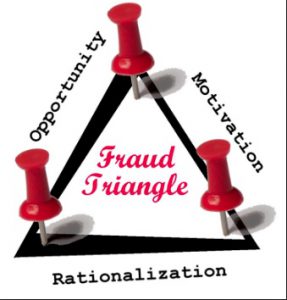
Fraud in the workplace cost Canadian businesses $3.2 billion, reported the CBC in 2011 (the last date I could find statistics). While lawyers have been aware of, and taken steps to prevent, fraud attempts by outsiders on their trust accounts for some time now, there is a largely unacknowledged vulnerability of fraud committed against law firms by employees. The sad truth about internal fraud is that people deny that there is a fraud problem in the first place or only react after a fraud is discovered.
Consider these internal fraud facts:
- “On the basis of the evidence it is likely that losses in any organisation and any area of expenditure will be at least 3%, probably near to 6% and possibly more than 10%” (PFK.com “The Financial Cost of Fraud, 2015).
- “25% of internal fraud cases result in losses of a million dollars on average” (Langlois Advocates – Lawyers, “Theft or Fraud by an Employee: Management Rights and Legal Action.”
- “Previous research suggests that fraud, like many crimes, is under-reported” (Statistics Canada, 2006; PricewaterhouseCoopers, 2005; Smith, 1999).
- “The more steps businesses take to control and uncover fraud, the greater their chances of detecting fraudulent activities and the better their ability to assess the effectiveness of their anti-fraud strat Thus, strategies for detecting and preventing fraud are key mechanisms in keeping the costs, direct and indirect, of fraud down” (PricewaterhouseCoopers, 2007).
- “The prospects of recovery of the proceeds of fraud are dim, with 65% of victim companies recovering 25% or less of the stolen funds. And many recover nothing.” (The True Cost of Fraud: Direct Costs, Tracy Coene in Insurance & Risk Management).
- ACFE in their 2018 Report to the Nations (A global study on occupational Fraud and Abuse being the largest global study on occupational fraud) looked at 2,690 real cases of occupational fraud from 125 countries over 23 major industry categories. They found:
- The mean, or average, loss due to the frauds in their study was $2.75 million, which is an enormous amount when considering how much damage such a loss represents to most organizations.
- The median loss for all cases in their study was $130,000. While 55% caused less than $200,000 in financial damage, more than one-fifth resulted in a loss of at least $1 million.
What are the steps you can take to reduce fraud?
Trust, but Verify: Trust your employees to do their jobs properly, but take steps to verify that this is in fact the case.
Establish Hiring Procedures: Check references of your final candidates. Let your candidates know that you will be doing this.
Set up Internal Controls: There are a number of well-established policies and procedures you can put into place now to reduce the opportunity for someone to commit a fraud.
Dual Signatures: While trust accounts require the signature of a practising lawyer, there is nothing that prevents you from adding a second signatory to both your general and trust accounts. Two sets of eye balls looking at a cheque is better than one.
Train Employees in Fraud Prevention: By having regular training on how to prevent and detect fraud, your law firm is sending the message on what behaviour is acceptable and what is not. Anti-fraud examiners state that employees are the “best possible fraud detectors.”
Conduct Regular Audits: “Internal auditing is an independent, objective assurance and consulting activity designed to add value and improve an organization’s operations. It helps an organization accomplish its objectives by bringing a systematic, disciplined approach to evaluate and improve the effectiveness of risk management, control, and governance processes.” (Wikipedia)
Monitor Vacation Absences (or lack thereof): “Two classic fraud prevention techniques are mandatory vacations and periodic job rotations. Mandatory vacations of one week or more (consecutively) are helpful, because the employee cannot continuously monitor a fraud scheme while away. Job rotations are also effective at disrupting these schemes especially when the employees are not given advance notice” (Essentials of Corporate Fraud).
Hire Experts: Periodically hire an expert in detecting fraud to examine your policies and procedures and assist in your antifraud steps.
Check your bank statement for unusual activity and signatures. If someone has forged your signature, you must detect this and report this to your bank quickly.
There are a number of steps that you can take to ensure that you do not become a victim of internal fraud. However, if the worst should happen, then at least you can take some solace in the fact that you have established systems and procedures that should detect the fraud and ensure that the perpetrator is eventually caught.
Internal Fraud Resources:
The Association of Canadian Anti-Fraud Examiners (ACFE) has a Fraud Prevention Check Up in PDF format in both English and French. It recommends that you perform this check up in conjunction with an Anti-Fraud Examiner but the list provides a good overview of the steps you can take now to reduce fraud.
The Law Society of BC published “The Trust Accounting Handbook” that encapsulates the procedures and rules for operating a trust account. It also publishes a list of the Fraud Alerts to the profession.
PracticePro has an excellent resource that addresses several types of fraud.
RubinBrown LLP has a list of 30 internal control considerations in an article entitled “Focus on Law Firms: Managing Law Firm Fraud Risks – An Internal Control Checklist” (June, 2016).
The Association of Certified Fraud Examiners, Inc.,in an article entitled “Designing an Effective Anti-Fraud Training Program,” sets out the topics to cover in designing employee training to counter fraud.
The Canadian BankingAssociation,in an article entitled “Protecting Yourself from Cheque Fraud,” advises “Review your monthly bank statement or regularly check your transactions through online or telephone banking. If you see transactions you didn’t do, notify your bank immediately and they will investigate.”
Dave Slovin,in an article entitled “Blowing the whistle: a well-designed, accessible whistleblower hotline can be a powerful tool in the fight against fraud,” quotes Warren E. Buffett chairman of the board of Berkshire Hathaway, a global investment firm with 180,000 employees, who said after their recently installed hotline, “Berkshire would be more valuable today if I had put in a whistleblower line decades ago.” The issues raise dare usually not of a type discoverable by audit, but relate instead to personnel and business practices.
((originally published in BarTalk, a publication of the BC Branch of the Canadian Bar Association. This article has been updated for the purposes of republishing).

♫ Nothing takes the past away
Like the future
Nothing makes the darkness go
Like the light…♫
Lyrics and Music by: M. Ciccone, M. L. Ciccone, P. Leonard, recorded by: Madonna
After a break of a couple of years due to health concerns, we are resuming the New Year’s Legal Predictions Blog Post! We have reached out to our friends & colleagues for their insights into the future of the legal world. This year we are grouping everyone’s thoughts under 16 categories from “Artificial Intelligence in the law firm environment” to “Something you will be working on or thinking about in 2019.”
I am happy to present their thoughts and trust that they will be interesting, humorous and thought-provoking. I hope our dear readers will share their thoughts in the comments area!
1. Artificial Intelligence in the law firm environment
Andrew Clark
• AI is already seeing hype and uptake this year and will continue into next year. As decision-makers realize the hype is gathering momentum, the focus will shift to the risks associated with AI – which will delay actual implementation.
Eugene Meehan QC:
• Will AI and their juridical spawn replicate or replace us? Need to watch Blade Runner again, but only Ridley Scott’s Director’s Cut version – the one with the not-so-ambiguous ending.
• Service, filings, production, billings, and even reception will become increasingly automated. For some law firms. Not all.
Stewart Levine:
• Perfectly suited…perhaps better than many attorneys.
Andre Coetzee:
• Artificial Intelligence is no longer a buzz word and firms will leverage AI services to assist with mundane tasks so as to enhance productivity, save time, increase accuracy and allow the lawyer to focus on strategic work. Trust, however will be key in adoption of AI services. A few examples of the application of AI:
o automate legal searches of case law;
o proof reading of contracts and legal documentation;
o document analysis.
Nikki Black:
• AI software development will continue to increase in 2019 and we’ll see some really creative tools come to light that will help reduce the mundane aspects of practicing law, allowing law firms to streamline their workflows so that lawyers can focus on more high level, complex analytical issues. So keep an eye on AI advancements in the legal tech space – there’s sure to be a lot of interesting developments in 2019!
David J. Bilinsky
• AI will be applied for success in cases where the data sets (contracts, discovery, case law) are better suited to automated processes either due to the prohibitive costs of traditional search, the need for speed of search results or where substantive increases in accuracy favour such processes. The challenge for small to medium law firms will be to lever this technology as the application of AI currently favour the resources of a larger law firm.
2. Alternate legal service providers
Bill Lipner:
• Startup – both “public” and “in-house incubations” – will begin to spring up like mushrooms in the rainy season, as AI enters the early-market stage of development. Point-applications will continue to chip away at repetitive data-intensive applications within law firms, nudging the efficiency-curve upward.
Stewart Levine:
• Growing and rightly so…with AI great for delivery and cost to consumer.
Bill Lipner:
• You’ll see a quantum leap as legal service consumers continues to seek faster-better-cheaper services…
David J. Bilinsky:
• There are many factors that can be resisted, but battling against economics is one where the battle is ultimately futile. The demands for more affordable access to justice will continue to get louder and the movements calling for change will ultimately be successful. This will translate into the loss of exclusivity for lawyers as consumers demand more affordable justice in such areas as family law, residential tenancies, low value claims and others. Non-lawyer alternative service providers will be licensed to provide legal services in these areas, resulting in the “Wall of Jericho” that protects lawyers to come a’tumbling down.
3. Alternate business structures
Eugene Meehan QC:
• Advanced digital legal assistant technologies will begin to displace the need for some office staff at some firms, in some areas of law, but again, not all. Some areas of practice are necessarily labour intensive, and benefit from higher than average staff ratios. At Supreme Advocacy our clients benefit significantly from having our lawyers as efficient, fast, and productive as possible – our staff to lawyer ratio is 2:1. i.e. 2 staff for 1 lawyer, not the other way around.
Stewart Levine:
• Growing and rightly so…with AI great for delivery and cost to consumer.
Bill Lipner:
• Not here in the good old USA.
David J. Bilinsky:
• ABS – Alternative Business Structures – will be approved shortly after governments approve new non-lawyer legal service providers (as noted above) to provide lower-cost A2J(Access to Justice) services in addition to lawyers.
4. Law school education
Eugene Meehan QC:
• Ever since Law Schools abolished obligatory courses (i.e. first year plus Civil Pro is all you need to take in Ontario) ‘law school education’ is a potential oxymoron. You can graduate while knowing nothing of Tax, Family, Evidence, Trusts, Real Estate, Employment Law, Creditors’ Remedies, Corporate, Insurance, Municipal Law, Statutory Interpretation. Would you go to a physician that skipped cardiology, pediatrics, or infectious diseases? Sure you can say I’m stuck in medieval times – but so are law students that don’t take what they should.
• Law schools should change their focus from simply providing a legal education to creating lawyers. Dentists are good dentists on graduation, good-to-go, because they have a structured not-much-choice dental school. If a dental student goes to dental school and says I don’t wanna learn how to pull teeth, how do you think that’s gonna go?
• Lakehead has it right. They so prepare their students for the practice of law they are (in Ontario) exempted from articling. That will be the future.
Stewart Levine:
• Don’t think a move to two years will happen anytime soon but more clinical education.
Bill Lipner:
• Will legal-tech finally become a serious course of study? Ethics issues are pushing us in this direction.
David J. Bilinsky:
• Law Firms will be a major, but not the exclusive, factor finally calling for law schools to produce graduates that are trained to practice law rather than research it.
5. Post call legal training
Ajit Roopnarine
• 2019 will see a wider array of CPD courses and programs with increasing emphasis on sensitivity and unconscious biases in the workplace. Ethics-based discourse will take shape around equality, diversity and inclusion. Ultimately, heightened awareness will culminate in law firms updating or introducing internal workplace policies on topics including harassment, diversity and cannabis.
David J. Bilinsky
• Eventually lawyers will lose the right to self-regulation as governments respond to the demand for greater access to justice. With the loss of self-regulation will come the demand by governments regulating lawyers and the public that lawyers periodically demonstrate competence in certain areas prior to being allowed to practice. This will necessitate the need for CLE courses to incorporate exams to indicate actual competence in the area of study.
6. Blockchain and smart contracts
Sharon Nelson and John Simek:
• Bitcoin became a household name over the last year as front-page news reports tracked its meteoric rise and analysts speculated whether the “Bitcoin bubble” was about to burst. The recent roller-coaster ride in bitcoin value, peaking at an all-time high of just under $20,000 per bitcoin, demonstrates that digital currencies have real-world value. Unsurprisingly, the financial and legal sectors are paying close attention because cryptocurrencies now are replacing some bank functions.
• The advent of Bitcoin and the blockchain technology that powers it heralds a new period of disruption — and opportunity — for the legal profession. Lawyers will need to become familiar with these technologies work in order to remain competitive as the practice of law continues to evolve. We have seen great strides in the use of smart contracts based on blockchain this year and that trend will certainly continue.
Andrew Clark
• Blockchain is already in progress in BC – with corporate registries. It will continue – not just with contracts – but with evidence management.
Stewart Levine:
• Happening.
Bill Lipner:
• Sure: they’ll become a real thing, but so will legal services surrounding the way smart contracts function. This is just one of several new legal-services categories (AI is another). Things always go wrong with tech…
David J. Bilinsky:
• Blockchain, virtual currencies, smart contracts and AI will be four major disruptive technologies forcing change on the legal profession. Education, understanding, adaptation and assimilation will be essential to be able to continue to practice in areas touched by these technologies.
7. Legal service regulation
David J. Bilinsky:
• As noted above, as a consequence of lawyers opposing the increased calls for alternative and affordable access to justice solutions, the legal profession will be facing the loss of self-regulation in the short-term. The long-term consequences of this will be governments approving new non-lawyer service providers and a consequential new legal services regulation model. Once self-regulation is lost in one jurisdiction, the dominos will start falling in other jurisdictions and this will result in a wave of change in how lawyers operate.
8. Practice management
Stewart Levine:
• PM movement continues.
Bill Lipner:
• AI will lend a BIG hand here… all the big folks will be announcing AI-Assisted PM solutions..
Ajit Roopnarine
• 2019 will see small and small-to-medium law firms spending big on cybersecurity measures. As the trend toward work from home continues in 2019, the risk of being compromised will increase. Management will respond by implementing more cybersecurity layers for employees accessing firm servers and databases at distance. The cost of enhanced defense systems will challenge the smaller firm’s bottom line, but will provide much needed peace of mind.
Thomas. L. Spraggs:
• Over the last decade, cloud computing has become increasingly important in day-to-day activities. The cost of this transaction has been to trade significant amounts of personal privacy. In 2019, mainly in part through the reporting of data breaches, personal information use and data security will continue to be a hot topic. In reality, the bargain will continue to be too seductive for most users. People continue to trade their privacy for the convenience of free and low cost and ubiquitous access to the Internet and services. Lawyers who have wisely used these products to increase efficiency will have new dedicated legal products to choose from. From highly automated services delivery platforms to personal client portals (good riddance email) and compelling A.I. tools, 2019 is looking like the year that technology is finally becoming intuitive and relevant for lawyers who want to practice their craft in a responsible technology-enabled way. I predict 2019 will mark the year where this finally begins.
David J. Bilinsky:
In Canada, there will be increased demand for a ‘one-stop’ solution that combines integrated full legal and general accounting with practice management that is affordable, scalable and in the Cloud.
9. Legal technology
Brian Mauch:
• My prediction is now that hosted email services like Microsoft’s Office 365 are available in Canada, and are reliable, secure and inexpensive, I don’t expect many law firms of any size to continue to maintain on-premise email servers. This will be a radical switch for firms who are more comfortable keeping their email servers in their office, but they will appreciate it the first time that power or internet issues take their office off-line, and they find that they’re still able to send and receive email on their smartphones. It will also be a radical switch for technology professionals who have made a living out of maintaining on-premise email servers, but everyone will need to adapt to the new reality of cloud computing, which is finally becoming mainstream.
Michele Lange:
• The next era of communication is upon us. Legal teams are used to fast-paced, always-on communications, no matter in the office, at home or on a client site. It’s the culture of the practice of law. Furthermore, legal professionals, for the most part, live in their email because of the need for access to information all the time. Finding the next generation of communication platforms that meet these demands, while protecting security and privacy, is a significant challenge.
• In 2019, legal collaboration tools will take root as a new communication channel in law firms and corporate legal departments. These platforms are built around team messaging and represent a convergence of forces to get legal teams interacting in a fluid manner with chat, supplemented with videoconferencing and document and screen sharing.
• Collaboration platforms specific to the legal industry make this technology no longer a nice-to-have, but rather an essential tool which enables law firms and corporate legal departments to get more done in less time, contributing to the bottom line while increasing employee and client satisfaction.
Nikki Black:
• In 2019, legal cloud computing software will continue to be adopted at a record pace, acquisitions in the legal tech space will occur at at a similar rate, and artificial intelligence software will show incredible promise as it comes of age.
• For starters, cloud computing software use by law firms will continue to increase. For most firms, the focus has already shifted from whether they should use it to when and how they should use it. This is occurring, in part, because some well known legacy software programs that are premise-based are being phased out and moved into the cloud. The end result is that cloud-based options abound for, among other things, billing and law practice management software, and thus the challenge for many law firms in 2019 will be how to choose the right software tools to fit their unique needs.
• Another trend to keep on eye on will be legal tech acquisitions and mergers. In 2018 there were a record-breaking number of acquisitions and mergers in the legal technology space and that trend will continue into the coming year. Because competition is fierce, new startup companies often struggle to stay afloat. Funding has been scarce compared to prior years, leading to acquisitions as a means to an end for some companies. Also of note – more established legal cloud software companies, such as those in the law practice management space, will continue to grow their market share since they’ve already established a foothold and as a result have gained significant momentum. But don’t forget about the well known larger technology companies such as LexisNexis, Thomson Reuters, and Bloomberg Law either. All three show great promise, in part due to the large amounts of data owned and the ways that they’re putting that data to use. Between some interesting and strategic acquisitions in recent years and lots of new product development, you’re going to see increased product roll-outs from these companies that have lots of potential, especially in their use of AI tools to harness and make sense of all that data.
Stewart Levine:
• Perfectly suited…perhaps better than many attorneys.
Bill Lipner:
• Legal-Tech will become a more and more important differentiator among firms. Both what they use – and what THEY CREATE.
Andre Coetzee:
• To remain competitive, flexibility and agility are becoming increasingly important for firms. Those firms who have not adopted cloud services will do so as to ensure they remain nimble and competitive.
• We are literally swimming in data and hence leveraging Business Intelligence tools to access and depict key information visually, will lead to better decision making within firms.
• The adoption of software that allows for collaboration between staff, clients, co-council etc. is going to increase and will enhance productivity and efficiency. Lawyers and staff are able to use the collaboration software to communicate with each other at the office, at a client site, working from home or in different geographic regions.
Thomas. L. Spraggs:
• Technology just keeps getting better. Remember the days where learning software was a big thing. Now, software must be intuitive or face immediate failure. The legal community has been responsibly slow to adopt new technologies. Responsibility to fundamental principles of procedural fairness, confidentiality, and truth-seeking underpin the tensions that the ever-increasing technology landscape may encroach. 2019 may mark the year where technology begins to finally align with legal principles and technology as they become further integrated.
David J. Bilinsky:
• The New Yorker Magazine, Nov. 12, 2018 edition, published an article entitled: The Upgrade – Why doctors hate their computers. Atul Gawande states:
“Something’s gone terribly wrong. Doctors are among the most technology-avid people in society; computerization had simplified tasks in many industries. Yet somehow we’ve reached a point where people in the medical profession actively, viscerally, volubly hate their computers.”
• The issue seems to be that in moving from paper files (where doctors could write as much or as little as they wished), to computer-driven systems that span all functions across a hospital has meant that doctors must complete many if not most of the fields in the systems used to store patient records. This is seen as a time drag on most doctors – but the benefits of so doing are shared by all those working within the health care provider – from nurses to physios to pharmacists.
• The same issue exists in law firms; lawyers resent the need to record all or most of the information called for in a robust firm-wide practice management system; they don’t fully realize or appreciate the benefits to the firm as a whole in so doing.
• The doctor’s solution: moving to scribes who sit with the doctor and fill in the computerized forms with instructions from the doctor while the doctor treats the patient. I believe that lawyers could benefit from the same solution: go back to secretaries whose function is to enter all information in the practice management system (including detailed notes of all meetings, phone calls, billable time, tasks remaining and such) in order that the firm overall can realize the full benefit of the practice management system.
10. Online justice/online dispute resolution/access to justice
Sharon Nelson and John Simek:
• In August 2018, the American Bar Association released a report titled, “Access to Justice Commissions: Increasing Effectiveness Through Adequate Staffing and Funding,” available at https://www.americanbar.org/content/dam/aba/administrative/legal_aid_indigent_defendants/ls_sclaid_atj_commission_report.authcheckdam.pdf. The report’s major findings and recommendations included:
• Expand the stakeholders in the A2J effort beyond the judicial and legal community to include participants from business, civic, social services, and community groups;
• Adequate and effective staffing is necessary to provide A2J Commissions with support, continuity, communications, and continued momentum;
• Leadership provided by the Conference of Chief Justices and individual Chief Justices in expanding access to justice cannot be overstated; and
• Private philanthropy through contributions from private foundations have played a key role in expanding A2J and accessing such financial support should be continued and encouraged.
• Our own state of Virginia is studying and adopting some of these recommendations and we expect many other states to do the same.
Andrew Clark:
• ODR will continue to grow – in volume and jurisdiction. The judiciary will get more engaged to understand how this impacts the courts and will also focus on ensuring ODR maintains a sufficient open court system.
Stewart Levine:
• GROWING.
Jordan Furlong:
• BC’s Civil Resolution Tribunal, the most successful online dispute resolution system in the world, will export its expertise to two other Canadian provinces intrigued by the prospect of re-routing a significant number of smaller and more straightforward disputes out of the courts while keeping them within the overall justice system.
Jeremy Hessing-Lewis:
• No Click Search: Google will continue the trend of no-click search results, where answers to queries are delivered directly rather than a list of websites. Some law firm websites will leverage this technology to improve traffic through banks of Q&A content. The accuracy of this information will become increasingly problematic as Google attempts to match the authority of search engines with localized legal authority. This will help address the access to justice gap even while misinformation is occasionally broadcast at scale. Rather than competing with free, lawyers will double down on the message that “legal information is free, legal advice costs money.”
Bill Lipner:
• It’s coming: but on-line “assisted” by real attorneys using tools like AI to reduce the issues and facts to a short-list a human will then sift through.. less leg-work – more cases per attorney at lower cost.
David J. Bilinsky:
• The kinks in BC’s Civil Resolution Tribunal are being worked out. As it matures, other jurisdictions will jump on the Online Dispute Resolution bandwagon. Already the UK is moving forward on Her Majesty’s Online Court as are other jurisdictions. No one expected the transition from bricks and mortar courts to virtual courts to be seamless; but the promise of lower costs, faster resolutions and greater access to justice offers too much promise to ignore. Progress will continue on this front.
11. Law, ethics and technology
Andrew Clark:
• The high cost of court houses will continue to prioritize and put pressure on the courts to make use of technology in an effort to defer or eliminate some of the needs for major courthouse upgrades and replacements.
Stewart Levine:
• Time to “get over it.”
Bill Lipner:
• Oh boy: this will continue to evolve as law schools finally admit that technology is part of legal practice, and the ethics of AI (the newest but not the only example) show us there are no bright lines…
David J. Bilinsky:
• Each new technology will continue to raise ethical issues for lawyers. Legal regulators, in order to do their job properly, must acquire the technical sophistication to understand the legal and ethical implications of emerging technologies. This will present a challenge for regulators, CLE providers and law schools in order to stay ahead of the curve and educate and regulate the lawyers of the future.
12. Cybersecurity
Joe Kashi:
• With the publication of ABA Formal Ethics Opinion 483, the ethical obligations of lawyers to prevent, disclose, and remedy data breaches have become clearly defined.
• These data security ethical mandates and the increasingly severe consequences of data breach will substantially change the trajectory of legal technology.
• In a very real sense, the highly-connected online world is now filled with unascertainable dangers. Paradoxically, being so easily and broadly connected may force us to re-adopt a less connected model of practicing law in self-defense, as leading cybersecurity experts warn that threats are evolving faster than reliably effective defenses.
• Increasingly, smaller law firms are prime targets for extensive “spearphishing” financial fraud and organized crime in the form of ransonware extortion, causing major business disruption and mounting losses for even the smallest law office. When your files become unusable due to extortionate encryption, it’s hard, if not impossible, to effectively represent your client and avoid blowing deadlines. Perhaps a quarter of our local law offices have been immobilized by ransomware within the past year or so, and those are only the ones of which I am aware.
• Consequently, lawyers who fail to prioritize data security, protection of client confidences, and continued operations increasingly do so at their own peril.
The current data security environment has several short-to-intermediate-term implications:
- In the short term, cloud computing will become less attractive, at least from an ethical standpoint, as multi-hundred-million account breaches become the norm, affecting even experienced online companies like Yahoo, Equifax, and Adobe.
The advent of sophisticated data security threats like spearphishing and ransomware add another layer to older security threats, such as the identity threat, “social engineering, and interception of unsecured Wi-Fi and cable networks. Those older threats remain very real in many law firms.
Due diligence will become more demanding than simply accepting marketing puffery about “assured online security” at face value. Data security, avoiding operational disruption, and protecting client confidences will trump desktop convenience and techno-cool when in apparent conflict.
- One unexpected short-term result of tightened security is that fax transmissions of highly confidential documents are becoming more common. That’s already occurring with medical records being faxed rather than Emailed. Easier, more wide-spread encryption of transmitted records will remedy this.
- Our highly connected world may become less connected in self-defense, as certain critical law office functions like accounting and billing are moved to internal systems that have no connection to the Internet.
- Standalone applications that are not reliant upon cloud computing/storage will again become attractive due to their ascertainable level of security and greater end-user control.
- Encryption will become the norm for confidential client data, particularly with the advent of Windows 10’s easy Bitlocker implementation.
- Stricter Internet usage policies and user training to avoid phishing and inadvertent introduction of malware into an office network will become critical parts of law office data security.
Current data suggest that over 90% of serious data breaches are due to human error and that smaller law offices have become prime targets for highly specific “spearphishing” financial fraud.
- Layered anti-malware defenses at each office will become the norm. Relying upon some free anti-virus software of uncertain provenance will not be ethically nor operationally sufficient.
- Cyber insurance and third party cybersecurity testing will become the norm.
Sharon Nelson and John Simek:
• Since 2016, many solo/small/mid-sized firms began adhering to the Center for Internet Security’s (CIS) Controls. In March 2018, CIS released CIS Controls Version 7, the newest (and free) iteration of its original 20 important cybersecurity recommendations. The CIS Controls are a prioritized set of actions any organization can take to improve their cybersecurity posture.
• The controls are now separated into three categories: basic, foundational, and organizational:
• Basic (CIS Controls 1–6): These are key controls which should be implemented in every organization for essential cyber defense readiness.
• Foundational (CIS Controls 7–16): The next step up from basic – these technical best practices provide clear security benefits and are a smart move for any organization to implement.
• Organizational (CIS Controls 17–20): These controls are different in character from 1–16; while they have many technical elements, CIS Controls 17–20 are more focused on people and processes involved in cybersecurity.
• The new CIS Controls, which may be found at https://www.cisecurity.org/controls/, align better with the NIST Cybersecurity Framework and map directly to it. Think of the NIST framework as the “what” and to the CIS Controls as the “how.” Together, these resources are concise and easily understood. Both are valuable free resources and we expect an increasing number of law firms to work with both of these standards to enhance their security posture in 2019…
Andrew Clark:
• All this technology growth will result in mounting focus and pressure on cyber security. Any major breach will trigger a significant pushback and delay in the courts adopting more technology.
Stewart Levine:
• Great idea, not a reality, question is how to spread the risk.
Jeremy Hessing-Lewis:
• Data Breaches at Canadian Law Firms: With mandatory breach reporting now in effect, we will start to see Canadian law firms confess to data breaches. While they may not match the scale of the Panama Papers, all law firms have a tendency to aggregate data. It is hard to imagine a legal data breach that wouldn’t meet the “real risk of significant harm” standard. Privacy Commissioners will be notified, and we will slowly start to see law firms using information security competency as a competitive advantage. Cybersecurity is a precondition to confidentiality. This should accelerate the trend away from on-premises computing infrastructure and will lead insurers to take a closer look at legal practice management systems.
Bill Lipner:
• Clients will push law firms on this, in a big way. Smaller firms will be challenged to meet the bar (no pun)…
Andree Coetzee:
• Ransomware and other malicious software will continue to evolve and become even harder to detect. Business class anti-virus software, firewalls, spam filtering and a well planned and executed backup, disaster recovery and business continuity plan is essential to ensure your firm is protected from these cyber-attacks.
Thomas. L. Spraggs:
• The marketplace has put recording devices that stream live events into nearly every aspect of life (mobile phones, citywide high-speed wifi, 5G mobile) The world has never been this connected and it will continue to strain expectations about what is being done and what should be done for clients. Sometimes there is a good reason to slow down.
13. Risks and speed bumps for lawyers
Stewart Levine:
• Low value services will be provided by AI.
Bill Lipner:
• Adoption is the biggest risk for lawyers. Always has been – always will be. But as technology innovation accelerates and the rest of the work drives the efficiency curve up – and the cost curve down – with technology, those slow-to-adopt lawyers face an ever-growing risk of extinction.
David J. Bilinsky:
• The challenge for lawyers, legal regulators, law schools, CLE providers and others in the legal and judicial sector is to stay current on new technologies. AI, the Blockchain, cybersecurity, electronic fraud and privacy are just a few of the powerful forces working on the legal profession. Failing to stay current on the implications of technology today is dangerous; in the future it may be dire or even negligent.
14. Strategic goals and planning for law firms
Stewart Levine:
• Essential for business functions.
Jeremy Hessing-Lewis
• Distributed Offices: Law firms will be increasingly unable to retain staff in the urban core of the Vancouver and Toronto markets. This will be compounded by the reality of commercial real estate costs and the ubiquity of cloud computing. Firms will respond by decentralizing their practices into multiple regional offices. This will better serve their clients, reduce staff commutes, and force firms to rethink the “downtown” firm business model. It will also push firms away from on-premises computing and allow for the wholesale reconsideration of practice management systems.
Bill Lipner:
• Tech assisted. Informed by big-data. Creativity and ingenuity become an essential part of strategic planning in 2019.
David J. Bilinsky:
• Technology is moving from what began as a support role to a central role in how to practice law today. The implications of this are that technologies must be central in planning how a law firm will approach practice today.
15. The future of the legal profession
Stewart Levine:
• Critical to understand high value service and what good service is.
Bill Lipner:
• Unknown.
Andrea Cannavina:
• Due to increased attention/awareness/aggressive protection of privacy, lawyers will be under increased scrutiny regarding their duty not to inadvertently disclose.
David J. Bilinsky:
• The need for lawyers is assured as lawyers are central to the operation of the Rule of Law in our democracies. What is not assured is the Main Street lawyer, or the Big Firm lawyer as we envision them today. New Technologies, new non-lawyer legal service providers, increased competition, increased A2J needs and many other threats will be working to transform the legal profession. One cannot afford to remain complacent.
16. Something you will be working on or thinking about in 2019
Stephen Gallagher:
• Here is a project I am working on with the New York State Bar Association’s Senior Lawyer Section.
• Meeting of the Minds is a series of regional Gatherings for lawyers created by the Senior Lawyer Section of the New York State Bar Association, in partnership with county bar associations throughout the state. The goal for these meetings is to connect senior lawyers looking to transition away from full-time law practice with younger attorneys and law students seeking personal growth in the profession. These Gatherings will bring lawyers together with a diverse group of speakers, coaches, medical professionals, and experienced attorneys to share their successes in handling life transitions.
• The Gatherings are designed to bring together lawyers who are looking for a safe place to participate in community to gain greater knowledge and support for transition planning. Access to a private intranet along with monthly webinars will be added as the community grows. Rather than looking for one, grand design for the perfect transition into a law practice or retirement away from a law practice, these Gatherings will use 10-minute, video sessions to provide just-in-time learning for each participant. These “quick hits” of information have been designed so they can be accessed through mobile devices such as smartphones and tablets.
• We believe this collaborative process can help better utilize the skills of lawyers age 55 and over by expanding the dialogue about how individuals can build their way forward from wherever you currently are, regardless of the life design problem you are currently facing.
• You may have heard this all from me before, but now, the young lawyers I worked with during my time at NYSBA are the senior lawyers I am once again enjoying working with. Growing old “in community” can be powerful.
Doug Munroe:
• One topic that is not on your list, and I have been thinking of for some time, relates to AI outside the law firm environment and how it might impact our substantive legal rights and procedural rights and, possibly, redefine the role of lawyers in society in ways more transformative than AI inside a law firm ever can. I don’t have time to hash out the thesis, but consider the extreme connectivity of all aspects of life, constantly collecting information about all people and establishing data on things as varied as who was at certain location at a certain time, where people travelled in a day and by what means of transportation, what they bought, searched for, said, perhaps thought, etc. and the warehousing of that data, largely in trust of corporations, but also of state agencies, and the sharing of that information, or the harvesting of it through technology, and lastly, of the potential tyranny of algorithmic AI to profile each and every one of us and “risk rate” us according to a host of classifications (e.g. likely to buy X, likely to commit crime Y, likely to support a politician with Z views, likely to contract a certain illness, likelihood to be a greater or lesser insurance risk, a model employee, citizen, etc.). In such a world are our rights merely symbolic? Can how we are codified by AI create barriers to getting jobs, accessing essential services, being discriminated against, etc.? What role do lawyers have if those trend-lines start to form? Think here of how little, collectively, the profession has done regarding mass surveillance. I don’t think this will all come to a head in 2019, but the capacities are being created for some (perhaps many) of these issues to impact the world we live in and therefore the clients we will one day serve.
• Stay well and active.
Andrew Clark:
• For me personally – 2019 looks like I will be spending a significant amount of time on the videoconferencing strategy for the courts – which encompasses many of the points above.
• Have fun with this!
Eugene Meehan QC:
• How soon to put the snow tires on my bike in Ottawa. How long to leave them on.
• More Scottish-Canadian lawyers will run the Boston Marathon. In kilts.
Stewart Levine:
• WELLBEING / SELF CARE for Lawyers…
Bill Lipner:
• Technology and its impact on the business of law.
David J. Bilinsky:
• I will continue to be fascinated in watching the wheels of change working not just on the legal and judicial sector but in society generally. I believe that this is a most exciting time; we are witnessing the birth of a new era akin to the Industrial Revolution with all the consequential implications. Technology is the force of change; the rate of change is phenomenal and will only continue to accelerate, provided that the economy doesn’t collapse. I truly believe we haven’t seen anything yet and we are highlighting some of the changes here. Nothing makes the darkness go like the light.
Bios:
David J. Bilinsky:

David J. Bilinsky is a Practice Management Consultant and lawyer for the Law Society of British Columbia (presently on health leave).
He is a Fellow of the National Center for Technology and Dispute Resolution (NCTDR) at the University of Massachusetts. He is also a Fellow of the College of Law Practice Management and past Editor-in-Chief of ABA’s Law Practice Magazine.
For many years, David has been an adjunct professor at Simon Fraser University teaching a totally online, graduate level course in the Masters of Arts in Applied Legal Studies program. This MA program received the 2011 Award of Excellence from the Canadian Association for University Continuing Education. He has designed and has taught the first legal technology course in Canada for the University of Toronto Law School.
Dave’s mission in life is to empower lawyers to anticipate the changes, realize the opportunities, face the challenges and embrace the expanding possibilities of the application of practice management concepts to the practice of law in innovative ways that provide service excellence.
Dave is the founder and Chair of the Pacific Legal Technology Conference and a past Co-Chair of the American Bar Association’s TECHSHOW.
Dave writes regularly for many publications in the USA and Canada including being a contributor to the award-winning blog www.slaw.ca, its sister blog, tips.slaw.ca as well as his own blog: www.thoughtfullaw.com. His blog has been named a Finalist or Award Winner eight times in the Canadian Legal Blog Awards (CLAWBIEs) and was part of the first group of legal blogs inducted into the CLAWBIE Hall of Fame (2017).
Nicole (Nikky) Black:

Nicole Black is a Rochester, New York attorney, author, journalist, and the Legal Technology Evangelist at MyCase, legal practice management software for small law firms. She is the nationally-recognized author of “Cloud Computing for Lawyers” (2012) and co-authors “Social Media for Lawyers: The Next Frontier” (2010), both published by the American Bar Association. She also co-authors “Criminal Law in New York,” a Thomson Reuters treatise. She writes regular columns for Above the Law, ABA Journal, and The Daily Record, has authored hundreds of articles for other publications, and regularly speaks at conferences regarding the intersection of law and emerging technologies. She is an ABA Legal Rebel, and is listed on the Fastcase 50 and ABA LTRC Women in Legal Tech. She can be contacted at niki.black@mycase.com.
Andrew Clark:

Andrew Clark is an independent consultant specializing in management consulting and project management in the Justice Sector. Andrew has spent the last fourteen years providing management consulting for a number of clients worldwide. Andrew started his career over 20 years ago in software engineering as a specialist in user interface design. Andrew worked as an IT Director for the BC Ministry of Attorney General where he was the project director for the JUSTIN project, BC’s criminal case management system. After managing a software company for 8 years, Andrew started his own consulting company. Throughout his career, Andrew has focused on Project Management and Team Building within an organization. He is a UVIC graduate with a B.Sc. and an MBA. Andrew is also a Project Management Professional certified by the Project Management Institute and was an associate faculty at Royal Roads University where he taught project management education within the MBA program for 6 years.
For the past fourteen years, most of Andrew’s work has been in the Courts, highlighted by his work in the British Columbia as well as work in the Yukon, Vietnam, Rwanda and Guatemala. Andrew was the Project Manager for the British Columbia eCourt program, a portfolio of projects co-sponsored by the Judiciary and Court Services Branch. He also worked on the JUDGE Project – a CIDA funded project working with the courts in Vietnam – where he was responsible in overseeing the design, procurement and implementation of Digital Audio Recording in 3 courtrooms.
Andrew is a volunteer technology board member for BC Justice Education Society and has been a member of several national committees and working groups. He has spoken at several conferences including the Court Technology Conference (CTC), the Canadian Forum on Court Technology and the Center for Legal and Court Technology Affiliates Conference.
Andre Coetzee:

André Coetzee, MBA, PMP, BA, H.Dip.Ed.
(Master’s in Business Administration, Project Management Professional, Bachelor of Arts, Higher Diploma in Education)
Andre Coetzee is a Director and a founding partner of i-worx, a Premium Hosting Service Provider for law firms. Andre is constantly researching and exploring new and better Hosted IT services with the goal of continuously providing legal firms a premier IT experience. As a result i-worx has developed a reputation for delivering innovative Hosted IT services to law firms, including Hosted Desktops, Hosted Email and secure file sharing with exceptional personalized service. For more information or to learn more about how hosted services could benefit your Firm, call 604.639.6300 or email andre@i-worx.ca.
Andrea Cannavina:

Andrea Cannavina is the creator of the D-A-F-T™ organizational process, CEO of LegalTypist, Inc. and director of the Virtual Bar Association. She has more than 15 years of legal secretarial and administrative experience coupled with 17 years as a Virtual Assistant. These years of experience helped her to carefully consider, thoughtfully develop, and thoroughly test the application of specific technology in law firms — helping firms improve efficiency and reduce costs.
Steve Gallagher:

I am a frequent speaker at bar association meetings on topics related to transition/succession planning, leadership skills training, and professional development.
Jordan Furlong:

Jordan Furlong is a consultant, author, and legal market analyst who forecasts the impact of changing market conditions on lawyers and law firms. Jordan is the author of Law Is A Buyer’s Market: Building a Client-First Law Firm and writes regularly about the changing legal market at his website, law21.ca.
Jeremy Hessing-Lewis:

- a business lawyer with Vancouver-based Small Law;
- a legal practice management consultant through Appropriate Legal Technology; and
- the Senior Digital Advisor at the legal marketing agency, Skunkworks Creative Group.
jeremy@skunkworks.caSkunkworks Creative Group Inc.
604.739.8976
600 – 55 Water StreetVancouver, BC V6B 1A1
http://skunkworks.ca
Joe Kashi:

Joe Kashi is a trial lawyer in Soldotna, Alaska. He received his BS and MS degrees from MIT in 1973 and his JD from Georgetown University in 1976. Since 1990, he has written and presented extensively on legal technology issues. When not verbally castigating recalcitrant computers, he expends otherwise billable hours piloting his twin-engine Cessna Skymaster aircraft in Alaska, as a karate black belt and frequently exhibited fine art photographer, and working up to be the 2020-2021 Rotary District Governor for District 5010, comprising the State of Alaska and Canada’s Yukon Territory.
Michelle Lange:

Michele C.S. Lange (mlange@workstorm.com) is the VP, Legal Technology for Workstorm. She has more than 15 years of experience in e-discovery, computer forensics, cybersecurity, privacy and technology’s role in law. Workstorm (www.workstorm.com) is an enterprise-grade workplace collaboration platform built for legal professionals.
MICHELE C.S. LANGE, ESQ.
Vice President, Legal Marketing
Workstorm
T: (612) 400-5290
E: mlange@workstorm.com
W: workstorm.com
Thanks for the opportunity to look toward the future of the practice of law!
Michele
Stewart Levine:

Stewart Levine is an attorney, mediator, management consultant, and coach. He creates resolution and agreement in the most challenging circumstances.
He has written and spoken extensively before legal professionals for over thirty-five years. He is the author of the best-seller Getting to Resolution: Turning Conflict into Collaboration.
Bill Lipner:

Bill Lipner is a consultant to law firms who wish to execute paperless or paper-lite strategies for more efficient, less costly, mobile-aware operations . Mr. Lipner also advises law firms on Quality-of-Service and Business Development strategies that dramatically improve client retention and profitability.
Mr. Lipner also is editor of the Legal Administrator Daily, a daily newsletter delivering all the news about the business of law.
Brian Mauch:

Brian Mauch is CEO of BMC Networks, a Vancouver-based outsourced IT provider that specializes in law firms. Brian obtained both law and commerce degrees from the University of British Columbia, and then combined his education with his passion for computers to form BMC Networks in 1997.
Happy holidays, and all the best for 2019!
Eugene Meehan QC:

After graduating from the University of Edinburgh (LL.B.), I was awarded a Commonwealth Scholarship to pursue an LL.M. at McGill University. In the Québec milieu, I (mis)treated Montréalers to French spoken with a Celtic accent. People thought I was from northern Québec … way north (some actually figured I came from Abitibi Temiscamingue). I did a second LL.B. at the University of Ottawa, and then a Doctorate in Civil Law back at McGill.
A teaching opportunity drew me to Edmonton where I was a Law Professor at the University of Alberta. During eight years in western Canada, I also articled and practised law in Edmonton (Parlee McLaws LLP, as it now is). After that, Law Professor and Director of Graduate Studies at the University of Ottawa, when Chief Justice Lamer asked me to be his (first) Executive Legal Officer.
My spouse Giovanna was appointed to the Superior Court of Justice, sitting in Ottawa, on April 11, 2003.
Doug Munroe:

Sharon D. Nelson, Esq.:

Sharon D. Nelson, Esq., is the President of Sensei Enterprises, Inc., a digital forensics, cybersecurity and information technology firm in Fairfax, Virginia.
Ms. Nelson is the author of the noted electronic evidence blog, Ride the Lightning and is a co-host of the Legal Talk Network podcast series called “The Digital Edge: Lawyers and Technology” as well as “Digital Detectives.”
She is a frequent author (sixteen books published by the ABA and hundreds of articles) and speaker on legal technology, cybersecurity and electronic evidence topics. She was the President of the Virginia State Bar June 2013 – June 2014 and a past President of the Fairfax Law Foundation.
She may be reached at snelson@senseient.com
John W. Simek:

Mr. Simek is the Vice President of Sensei Enterprises, Inc., an information technology, digital forensics and cybersecurity firm located in Fairfax, VA. Mr. Simek has a national reputation as a digital forensics technologist and has testified as an expert witness throughout the United States. He holds a degree in engineering from the United States Merchant Marine Academy and an MBA in finance from Saint Joseph’s University.
Mr. Simek holds the prestigious CISSP (Certified Information Systems Security Professional) certification in addition to multiple other technical certifications. He is the co-chair of ABA TECHSHOW 2019 and a co-host of the Legal Talk Network podcast Digital Detectives. He is a frequent author (sixteen books published by the ABA and hundreds of articles) and speaker on legal technology, cybersecurity and electronic evidence topics.
He may be reached at jsimek@senseient.com.
Ajit Roopnarine:

Ajit Roopnarine is a family law lawyer at Russell Alexander Collaborative Family Lawyers. He works in all areas of family law and often advocates in the Superior Court of Justice on family law matters, though he prefers collaborative practice.
Ajit can be reached at:
T: 1-905-655-6335
E: ajit@russellalexander.com
Thomas L. Spraggs:

Tom Spraggs is the owner and operator of Spraggs & Co. Law Corporation, an injury litigation boutique. He holds a Bachelor of Laws, Master of Laws, and Masters of Business Administration. Tom is also a Qualified Arbitrator. His law firm has experienced significant growth over the last several years, and his lifelong passions for technology and learning have helped him develop unique approaches to collaborative work processes and practice management. The firm was acknowledged by the Canadian Bar Association with the 2016 Innovative Workplace Award.
Tom Spraggs joined the British Columbia Law Institute board of directors in 2012 by appointment of the Attorney General. He has served on the Strategic Planning Committee, the Audit, Finance and Risk Committee (as Chair), and is currently serving as Chair of the BCLI.
Tom is active in the community, previously serving a six-year term as a director of Douglas College. Currently, Tom is a proud member of the Canadian Bar Association and co-chairs the Civil Litigation Tri-Cities/New Westminster section. As a member of the Law Societies of British Columbia, Yukon and Alberta, Tom’s work has been primarily in civil litigation, and he also has a strong interest in administrative law, legal technology and governance. He has been a frequent participant in the CLEBC Solo and Small Firm Conference as well as co-charing the 2018 Professional Wellness for Lawyers and Law Firms. Tom is a regular contributor to the TLABC publication “The Verdict” writing on legal technology. Tom is Co-founder of Qase.ca, a legal technology start-up based out of Vancouver.
♫ But there never seems to be enough time
To do the things you want to do
Once you find them… ♫
– Music, Lyrics and recorded by: Jim Croce

Photo by Jordan Benton from Pexels.
As lawyers we are accustomed to working long, hard hours. Indeed, some writers such as Jordan Furlong have stated there is no such thing as work-life balance as our lawyer work culture has changed over the last while from moderate to frenetic. As our clients’ demands and needs sped up, our pace increased to meet them. However, while our clients’ figured out how to increase efficiencies with technology and new ways of doing things, we as lawyers fell behind. Jordan’s suggestion is that we now need to learn to reshape the way we work to align better with what our clients want and what we need. In the process we can consider and address the toll that our current pace places on our lives and those close to us.
To start, we need to perform better client service in ways that reduce the time we spend on a matter. This leads to learning how to increase efficiencies and improve workflows to accomplish more in less time. There is a role for the increased use of technology here. Besides figuring out how to be more efficient in the office, we also need to turn our minds off when we are out of the office to get the rest and relaxation we need to continue to be on the top of our game and avoid burnout. We all know what we love to do outside of work to relax; the trick is finding or creating the time to do it.
So how do we do this? In January 2016, Inc.magazine published an article entitled “A Simple, Science-Backed Trick to Better Work-Life Balance.” All of us leave our desks each night with uncompleted goals and tasks. Brandon Smit of Ball State University found these uncompleted tasks are intrusive and interrupt our evening’s peace. He cited the Zeigarnik effect, wherein uncompleted tasks are more likely to be remembered and intrude on your non-work time, interrupting your ability to recharge.
But Smit found a way to neutralize these intrusive thoughts. Before leaving the office, not only make a list of your outstanding to-dos, but take the next step and clearly plan when, where and how you will tackle each one. He found that by specifying how you will deal with these as-yet uncompleted tasks, you can put these matters out of your mind and lessen their intrusion into your private time. You need not worry about unfinished business waiting for you back at the office. There were added benefits from adopting this approach. Smit found that by using this system, participants found it easier to let go of work. Your mind can relax as it “knows” that you have thought about how to accomplish the tasks that you need to get done.
By not only planning what you need to do but also when, where and how you will do it, you tell your mind in its restful time it can stop worrying. This way you can use your relaxation time to do the things you want to do, now that you have found them.
So how do you achieve a better work-life balance?
If getting more efficient and effective is part of the answer to achieving better work-life balance, then here are tips, apps and sites that can further you along in this journey.
Inbox Zero
This is a technique where you decide what to do with every email in your inbox immediately as you read it. File it, add it to a To-Do list, trash it – just don’t leave it in your inbox! Strive to empty your inbox daily. Also use SimplyFile which speeds up dealing with email by “guessing” which folder in Outlook an incoming and outgoing email belongs in. It is fast, accurate and amazing! I would recommend it for any PC (unfortunately only for Windows….not Mac).
Brainstorm
This is sitting down and writing down as many ideas as you can generate to address a problem. Fortunately, mind-mapping software can help you organize and grow/group the ideas as they come to you. You can try: Mindjet, XMind, Coggle, Freemind or MindNode (the 5 best mind-mapping applications per Lifehacker.com).
Capture Your Ideas
Ideas come to you at all times in the day. Use Evernote, Microsoft’s OneNote or carry a paper notebook in your briefcase to capture those ideas before they slip away. Evernote and OneNote are also great ways of organizing digital information of all types, including web pages, video and audio. You can even dictate your notes into Evernote.
Build Lists
Many of us live by our To-Do lists. Time management experts tell us to have separate lists for work and for personal use. Apps such as Wunderlist allow you to keep these lists on your smartphone, PC, Mac, Android, iPhone, Watch and more and keep them all in sync.
Block off Time and Reduce Interruptions
Take your To-Do list and block off time in Outlook, or whatever calendar application you are using, to allocate time to tasks. Have a sign for your door that politely asks people to not interrupt your work time unless it is an emergency. RescueTime and similar applications will not only block Internet access for a set period (allowing you to concentrate on tasks at hand) but will provide you with a breakdown of how you spent your time during the day. Studies have shown that it takes time to spool up to really attack a task; if you are being constantly interrupted then you are not making the best use of your time and reducing your effectiveness.
Log Time
Even if you don’t bill by the hour, it is a great idea to track your time to determine your effectiveness. This can also help you determine your effective hourly rate if you divide your collected fees on a matter by the actual (not just billable) time put into a matter. There are many time tracking and time and billing applications such as: PCLaw, Clio (goclio.com), Amicus Attorney (amicusattorney.com) and many others.
Learn to Say No
People will always request that you take on new commitments. While none of us wish to be curmudgeons who never help out others, you have to balance this time with the time spent on tasks that are important to you, and allow yourself the time to complete them. Accordingly, one important skill is to say no gracefully but firmly.
(originally published in BarTalk, a publication of the BC Branch of the Canadian Bar Association).
♫ Open up your eyes now, tell me what you see..♫
Lyrics and music by John Lennon and Paul McCartney, recorded by The Beatles.

After too long a layover, I am bringing back the Legal New Year Predictions!
This year we are going to look at 16 different categories that seek to cover the bigger issues in law, education, access to justice, technology and what the future may hold. This is your chance to add your voice to what lies ahead for the legal profession in 2019. I will also be asking past and new contributors to chime in. I am hopeful that we can generate some interesting insights into where you see change happening in the legal profession and have some fun in the process.
Here are the categories:
2019 Prediction Categories
- AI in the law firm environment
- Alternate legal service providers
- Alternate business structures
- Law school education
- Post call legal training
- Blockchain and smart contracts
- Legal service regulation
- Practice management
- Legal technology
- Online justice/online dispute resolution/access to justice
- Law, ethics and technology
- Cybersecurity
- Risks and speed bumps ahead for lawyers
- Strategic goals and planning for law firms
- The future of the legal profession
- Something you will be working on or thinking about in 2019
Send me your thoughts at daveb@thoughtfullaw.com. I will be publishing these starting mid-December, 2018.
So gentle reader – tell me what you see!
♫ Oh but workin’ too hard can give you a heart attack
You oughta know by now… ♫
Music, Lyrics and recorded by: Billy Joel.

In December 2014, Edward Greenspan, one of Canada’s most famous criminal defence lawyers, died at age 70 from heart failure, ironically while on holiday. He is not alone. Many lawyers will be diagnosed this year with heart disease, heart attacks, high blood pressure, atrial fibrillation, pulmonary embolisms and strokes and some will die. Globally, cardiovascular disease is the leading cause of death and claims more lives than all forms of cancer, combined.
Lawyers are particularly susceptible to stress-related illnesses, including heart disease, “because of the unique interplay of the legal profession and lawyer personality” (per the ABA Journal). It is no secret that the legal profession has to deal with stress, depression and a degree of hostility. This, unfortunately, is a particularly lethal combination.
Lawyers have the highest rate of depression among 100 professions (Sells, The Sole of Law: Understanding Lawyers and the Law (1994) at 94.)
Edward C. Suarez, Ph.D., of Duke University, says a recent study, “. . . suggests the possibility that men who are . . . hostile and exhibit depressive symptoms, even in the mild to moderate range, are at heightened risk for cardiac events.”
Dan Lukasik, a personal injury lawyers asks, given the “clear connection between lawyer hostility, depression and the heightened risk for a cardiac event, what can lawyers do about it?”
One of the first things we can do as a profession is to curtail uncivil behavior and over-aggressiveness. While we live in an adversarial system, neither our clients, the legal system, or the public are well-served by this approach and it causes undue stress and toil for all concerned.
Another thing that we can do is curtail long work hours. The cure for overwork is not time management, or less holidays or not taking vacations or even weekends off; it is improving our work conditions such that our minds and our bodies have an adequate time to rest and rebound from the stresses of the day.
Take time to exercise, maintain good nutrition, good weight control and not smoking are four things that all of us can do, right now. An added incidental benefit will be a lower exposure to substance abuse triggers.
In Stress Management for Lawyers – How to Increase Personal and Professional Satisfaction in the Law“, 3rd ed, by Amriam Elwork, Ph. D, the author puts forth many concrete suggestions to reduce stress. One suggestion is by shifting our point of view of a stressful situation we can control our emotional response and look to generate solutions rather than generating anxiety and depression.
A very interesting aspect of Dr. Elwork’s book is his suggestion to be true to your values. He lists seven areas of people’s lives where values are important: finance, work, character, growth, relationships, society and religious faith. He then asks if you are living true to your values in these seven areas.
Do we recognize the signs of overwork and stress in ourselves that can lead to a heart attack? We ought to know by now…
—
What are the signs and symptoms of types of heart conditions?
Atrial Fibrillation (known as AFib) (according to WebMD.com) is where the smaller vessels of your heart are being activated in a chaotic electric pattern in excess of 400 beats per minute, as compared to 60-100 coordinated beats in a normal heart.
Signs and Symptoms of Atrial Fibrillation
- Heart palpitations (feeling that your heart is racing or fluttering)
- Awareness that the heart is beating.
- Chest pain, pressure, or discomfort.
- Abdominal pain.
- Shortness of breath.
- Fatigue or lack of energy.
- Exercise intolerance.
AFib raises your risk for stroke, since the chaotic rhythm may case blood clots to form inside the heart and then travel to your brain.
Congestive Heart Failure symptoms (according to Mayoclinic.org)
Heart failure signs and symptoms may include:
- Shortness of breath (dyspnea) when you exert yourself or when you lie down
- Fatigue and weakness
- Swelling (edema) in your legs, ankles and feet
- Rapid or irregular heartbeat
- Reduced ability to exercise
- Persistent cough or wheezing with white or pink blood-tinged phlegm
- Increased need to urinate at night
- Swelling of your abdomen (ascites)
- Sudden weight gain from fluid retention
- Lack of appetite and nausea
- Difficulty concentrating or decreased alertness
- Sudden, severe shortness of breath and coughing up pink, foamy mucus
- Chest pain if your heart failure is caused by a heart attack
Pulmonary Edema’s signs and symptoms (per medicalnewstoday.com)
Signs and symptoms may include:
- Difficulty breathing
- Coughing up blood
- Excessive sweating
- Anxiety
- Pale skin
- Pink frothy sputum (which may be coughed up)
- Nocturia (getting up at night frequently to urinate)
- Swollen ankles (ankle edema), there may also be general swelling in the legs
- Orthopnea – the patient becomes breathless when lying down flat
- Paroxysmal nocturnal dyspnea – episodes of severe sudden breathlessness at night.
If left untreated this can lead to coma and then death – usually due to hypoxia (oxygen deprivation).
High Blood Pressure (HBP): According to the American Heart Association, “The truth is that HPB is largely a symptomless condition. If you ignore your blood pressure because you think symptoms will alert you to the problem, you are taking a dangerous chance with your life”
Heart Attack: The signs and symptoms of a heart attack (per: Medicinenet.com) are:
- Chest discomfort, manifest as pain, fullness, and/or squeezing sensation of the chest
- Jaw pain, toothache, headache
- Shortness of breath
- Nausea
- Vomiting
- Upper middle abdomen discomfort
- Sweating
- Heartburn and/or indigestion
- Arm pain (commonly in the left)
- Upper back pain
- General malaise
- No symptoms.
One cannot overemphasize the importance of seeking prompt medical attention in the presence of symptoms that suggest a heart attack.
(originally published in BarTalk, a publication of the BC Branch of the Canadian Bar Association).